
YKK / YXKK
YKK and YXKK Series High-Voltage Three-Phase Induction Motors
Cage-rotor high-voltage machines in frames 355 to 630, at 6 kV or 10 kV, covering the mill, blower, compressor and hoist duty that dominates heavy industry.
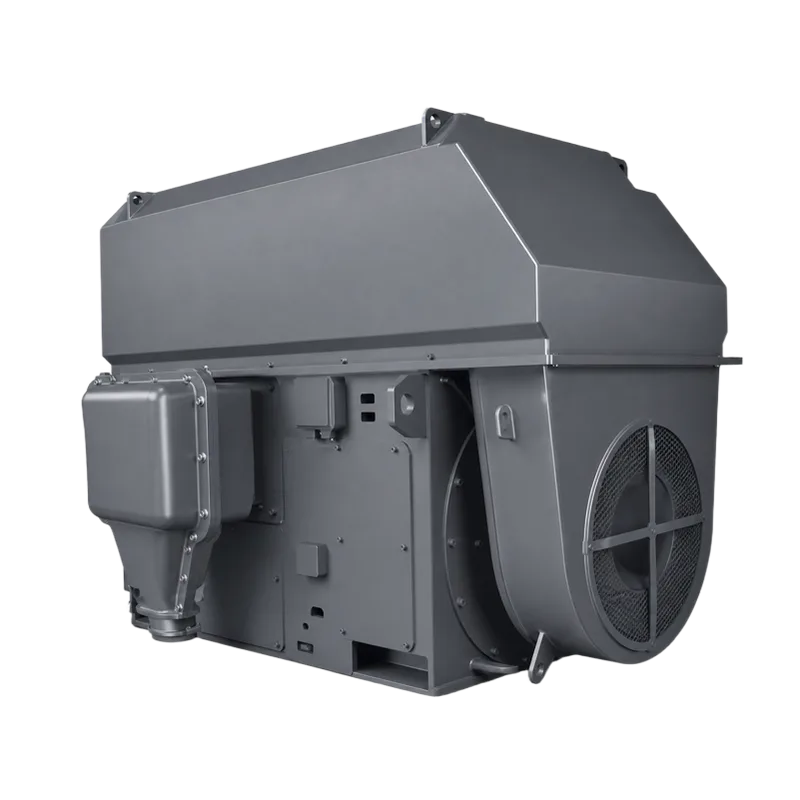
YKK and YXKK are high-voltage squirrel-cage three-phase induction motors. The two designations mark the efficiency step: YKK meets grade 3 of GB 30254—2013 and YXKK grade 2, as assigned by the product standards these machines are built to. The 6 kV range is built to JB/T 12730-2016 and the 10 kV range to JB/T 12729-2016.
Construction and mounting is IMB3, rating is continuous duty S1, and cooling is air-to-air or air-to-water heat exchange (IC611 / IC616) rather than the open frame ventilation used on older high-voltage designs.
Power, metallurgy, building materials and petrochemicals together account for the bulk of the domestic high-voltage motor market, followed by oil and gas, steel, coal, cement and paper — which is a fair description of where these machines end up.
Note on efficiency classes: the IE scale of IEC 60034-30-1 applies below 1000 V, so it has never covered these machines. Since February 2024 there is a separate high-voltage scale — IEC 60034-30-3 defines IE1 to IE4 for fixed-speed high-voltage cage induction motors between 200 kW and 2000 kW. Part of this range sits inside that window and part of it does not. We have not yet classified the series against it, so the figure we quote is the GB grade assigned by the product standards, not an IE number. If your specification calls for an IE class at high voltage, raise it early and we will tell you where the specific rating stands.
Core specifications
| Parameter | Value |
|---|---|
| Frame size | 6 kV: H355 – H630 mm · 10 kV: H400 – H630 mm |
| Power range | 6 kV: 185 – 3150 kW · 10 kV: 220 – 2500 kW |
| Voltage & frequency | 6000 V or 10000 V, 50 Hz |
| Efficiency | GB 30254—2013 — YKK grade 3, YXKK grade 2 (the edition referenced by the product standards; see note below) |
| Protection degree | IP54 / IP55 |
| Cooling | IC611 / IC616 |
| Insulation class | Class F |
| Mounting | IMB3 |
| Duty type | S1 (continuous) |
| Ambient / altitude | 40 °C · up to 1000 m |
Standards and certification
- JB/T 12730-2016 (6 kV series)
- JB/T 12729-2016 (10 kV series)
- GB 30254—2013 (high-voltage motor efficiency) — the edition normatively referenced by JB/T 12730—2016 and JB/T 12729—2016, which is where the grade 3 / grade 2 assignment comes from. GB 30254—2024 superseded the 2013 edition on 1 September 2025; re-assessment of these ratings against the new edition is in progress and we will state the result rather than assume it carries across.
Typical applications
- Power generation — cooling fans, pumps and auxiliary plant
- Metallurgy — blast furnace blowers, rolling mills, coilers
- Petrochemicals — compressors, pumps, agitators
- Mining — hoists, conveyors, crushers
- Building materials — cement mills, crushers, conveyors
- Water treatment and environmental plant — pumps and fans
Selection guide
FAQ
Downloads
Certificates and test reports are issued against the specific model and rating rather than the series, so we send the ones that apply to your order. Tell us the rating and the market and we will send them.
Related products
Technical articles on this series
6 kV and 10 kV Motors: When High Voltage Makes Sense
ReadFixed and Floating Bearings in Electric Motors
ReadGas Compressor Motors: Reciprocating versus Centrifugal
ReadSelecting a High-Voltage Motor for a Cement Kiln-Head Drive
ReadHigh-Voltage Motor Differential Protection
ReadDo High-Voltage Motors Have IE Classes? Only Inside a Narrow Window
ReadStarting Methods for High-Voltage Motors
ReadCoupling Selection for Industrial Motor Drives
ReadSelecting Motors for Mining Crushers and Ball Mills
ReadMotor Failure Modes in Mining, Ranked by How Often They Come Up
ReadMotor Foundation and Grouting Inspection Checklist
ReadMotor RTDs and Bearing Temperature Sensors
ReadMotor Shaft Alignment: What to Record Before Startup
ReadMotor Shaft Key and Keyway Fit: Avoiding Fretting
ReadMotor Space Heaters and Condensation Control
ReadMotor Starting Voltage Drop: A Review That Includes the Load
ReadMotor Winding Resistance: When a Phase Difference Matters
ReadPipeline Booster Pump Motors: What the Station Decides
ReadResonance, Unbalance or Misalignment? Follow the Evidence
ReadSelecting Motors for a Steel Rolling Mill Line
ReadSleeve vs Rolling Bearings in Large Motors
ReadAxial Thrust in Vertical Motor Applications
ReadRequest a quote — YKK / YXKK
Tell us the rating, quantity and application and an engineer will come back with a specification, the documents for that model, and a price.
Contact Sales