
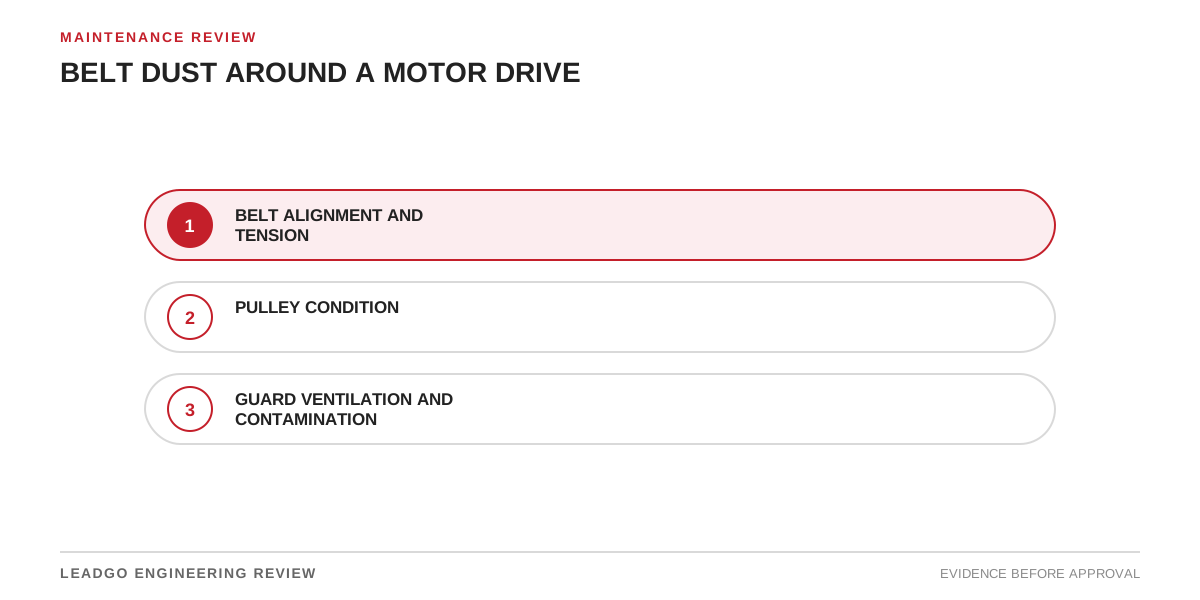
Do not clean a belt drive before documenting the dust pattern. Concentration at one pulley edge, uniform glazing, deposits inside the guard and airborne process dust point to different checks.
| Observation | Inspect next | Avoid assuming |
|---|---|---|
| Dust concentrated on one side | Pulley alignment, shaft position and guard contact | That additional tension will correct it |
| Glazed belt surface or heat marks | Slip, load, pulley groove and tension | That the belt alone is defective |
| Fragments or localised wear | Guard clearance, damaged groove and foreign material | That normal run-in created the debris |
| Process dust coating the full drive | Guard ventilation and contamination source | That all residue is belt material |
Close the mechanical checks together
With the equipment isolated, inspect belt condition, pulley grooves, fasteners, shaft runout where relevant, motor feet and adjustment rails. Verify tension using the belt manufacturer’s method for the installed span and belt set. Confirm that the resulting belt pull remains within the motor and driven-equipment limits.
After correction, establish a follow-up inspection under normal load. A clean guard immediately after maintenance is not evidence that the cause has been removed; recurrence rate and location provide the useful comparison.
Related reading: belt tension after installation and repeat motor bearing failure.