
AC Induction

YE5 (IE5)

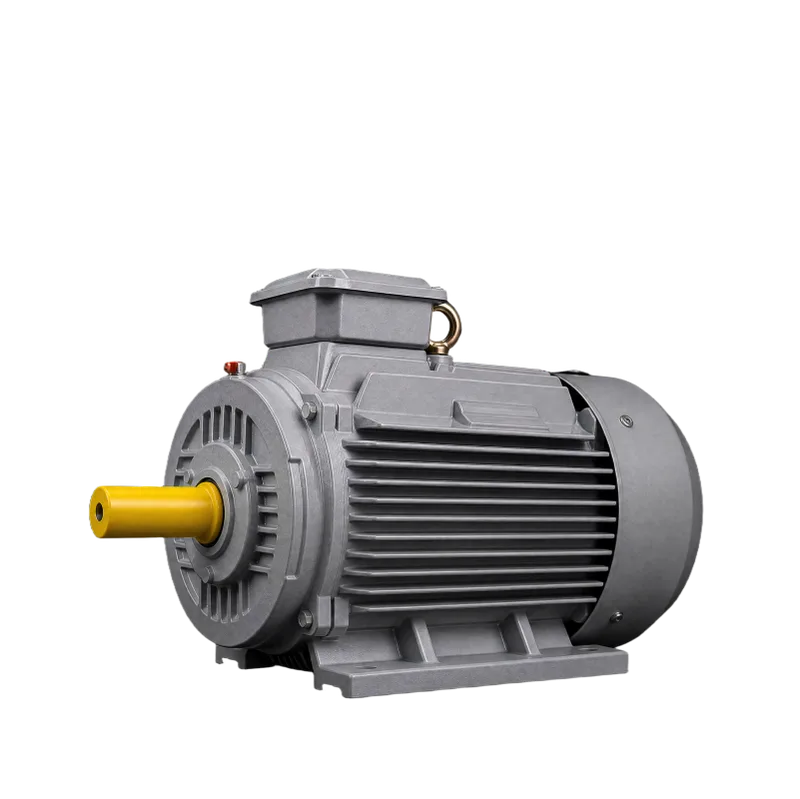
YE5 (IE5) Series Three-Phase Induction Motor

The top induction efficiency class LEADGO builds — grade 1 under GB 18613—2020, IE5 under IEC 60034-30-1:2025, in standard IEC frames.
IE50.55–315 kWIP55
YE series three-phase induction motor

YE5 is a single-speed, totally enclosed, fan-cooled, continuous-duty low-voltage squirrel-cage induction motor reaching grade 1 of GB 18613—2020, corresponding to IE5 in IEC 60034-30-1:2025.

It matters most where the machine runs close to rated load for most of the year. On that duty an IE5 induction motor is frequently the lower-total-cost answer against a permanent magnet machine, because it needs no drive to reach its rated efficiency.

Core specifications

ParameterValue
Frame sizeH80 – H355 mm
Power range0.55 – 315 kW
Poles2 / 4 / 6 / 8
Voltage & frequency380 V, 50 Hz (custom on request)
Efficiency classIE5 · GB 18613—2020 grade 1
Protection degreeIP55
Thermal class155 (F), assessed to class B rise
CoolingIC411
MountingB3 / B5 / B35

Standards and certification

  • GB 18613—2020 grade 1
  • IEC 60034-30-1:2025 IE5 (IE5 was introduced in the 2025 second edition)

Typical applications

  • Crushers and storage conveyors running at constant speed near rated load
  • Continuous process fans and pumps with high annual operating hours
  • Sites where the efficiency class is written into the specification

Selection guide

Constant-speed, high-utilisation duty. Few failure points, high efficiency and strong momentary overload capability, with no drive required.
For constant-speed duty running near rated load, evaluate YE5 first — the capital cost is lower and no drive is needed. Where the duty is variable-speed or involves frequent starting, a permanent magnet machine holds its advantage across the whole load range.

FAQ

Datasheets, dimension drawings and certification copies are issued on request — tell us the rating and we will send the documents for that specific model.

Downloads

DatasheetPDF · 2.2 MBDownload
Installation & maintenance manualInstallation, commissioning and servicingRequest
CertificationCertificates and test reportsRequest

Certificates and test reports are issued against the specific model and rating rather than the series, so we send the ones that apply to your order. Tell us the rating and the market and we will send them.

Related products

Technical articles on this series

B3 vs B5 vs B35 vs V1 Motor Mountings: Dimensions and Selection

Compare IEC motor mounting codes B3, B5, B35 and V1. See how feet, flanges, shaft orientation and bearing loads affect replacement and installation.

Read

Centrifugal Pump Motor Margin Without Blanket Oversizing

Choose pump motor margin from the absorbed-power curve, system envelope, fluid condition and control method instead of a fixed percentage.

Read

Conveyor Motor Selection: Breakaway Torque and Restart

How to size conveyor motors for breakaway, loaded restart, acceleration, backstops and multi-drive load sharing instead of running kW alone.

Read

Crusher Jam Restart: Motor and Drive Questions

A practical review of trapped load, clearing method, reverse jog, torque limits and protection before restarting a jammed crusher.

Read

GB 18613 and IE Classes: Reading a Chinese Efficiency Grade

The two systems number in opposite directions, and neither is a label — both are tables of values at a rating. Compare the cells, not the words.

Read

GB 18613, IEC IE and NEMA MG 1: How to Compare

A procurement method for reconciling Chinese efficiency grades, IEC IE classes and NEMA motor-efficiency requirements without false equivalence.

Read

How to Read a Motor Performance Curve: Current, Efficiency and Torque

Read motor current, efficiency, power factor, speed and torque on one performance curve, then compare the actual load point before selecting a motor.

Read

IE3 vs IE4 vs IE5: A Project-Lifecycle Selection Framework

A lifecycle framework for selecting IE3, IE4 or IE5 motors using operating hours, load, regulation, replacement constraints and measured losses.

Read

Motor Duty Profile: What to Define Before Selection

Build a motor duty profile from load, speed, starts, braking, dwell time and cooling conditions before comparing catalogue ratings.

Read

Motor Efficiency at Partial Load: Beyond the Nameplate Value

Understand how industrial motor efficiency and power factor change at partial load, and when an oversized motor is worth replacing.

Read

Motor Losses Explained: Copper, Core, Mechanical and Stray Load

Understand where motor input power becomes heat, how losses change with load and why system operating points matter in efficiency decisions.

Read

Why Motor Power Factor Falls at Light Load

Understand low-load motor power factor with measured kW and kVA, then decide whether loading, motor sizing or system correction needs review.

Read

How to Document Motor Torque Margin

Document motor torque margin against the driven-load curve, acceleration case, supply condition and agreed process upsets instead of one percentage.

Read

Motor Total Cost of Ownership: A Worksheet Buyers Can Audit

A practical motor TCO worksheet covering purchase, energy, installation, downtime, maintenance and end-of-life costs without relying on generic savings claims.

Read

Pipeline Booster Pump Motors: What the Station Decides

It looks like the easiest duty in the field — constant load, steady flow. Then you learn that capacity is changed by switching whole pumps in and out.

Read

What Is an Induction Motor? How It Works, Slip and Selection

Learn how a three-phase induction motor works, calculate synchronous speed and slip, compare rotor types, and identify the data needed to select one.

Read

Request a quote — YE5 (IE5)

Tell us the rating, quantity and application and an engineer will come back with a specification, the documents for that model, and a price.

Contact Sales