
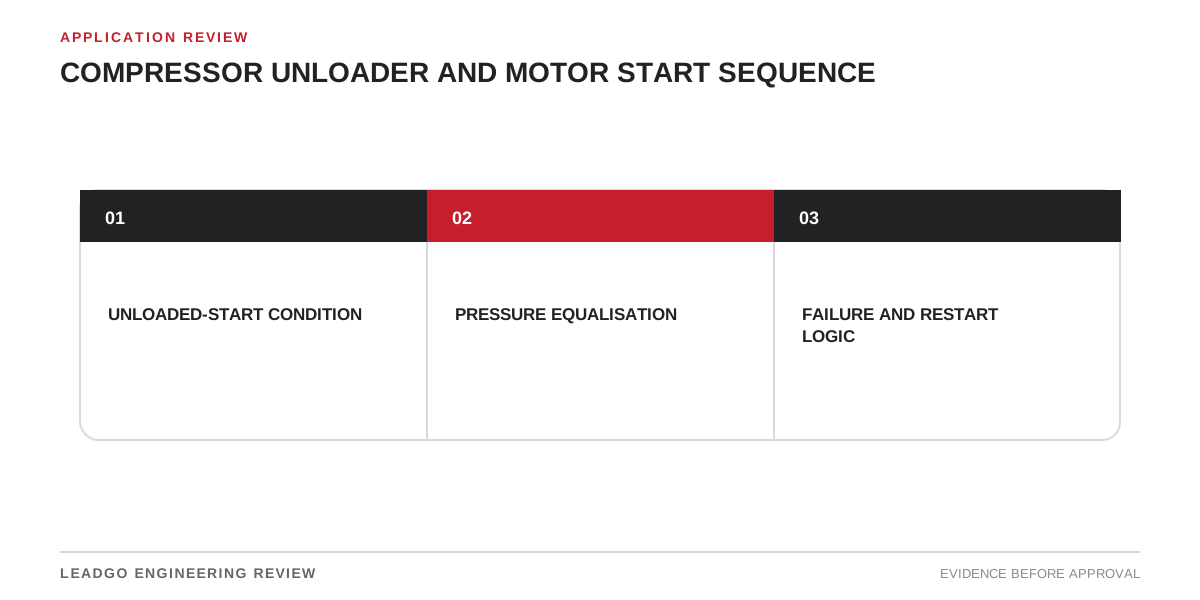
Motor selection and compressor control are coupled. A quotation based on unloaded starting can be unsafe if a valve sticks, receiver pressure remains high or a power dip triggers a premature restart.
Start-sequence decision
- Confirm the compressor is in the defined unloaded or capacity-reduced state.
- Verify suction/discharge or interstage pressure conditions required by the compressor supplier.
- Start the motor and supervise current, speed and acceleration time.
- Load only after minimum speed, lubrication and process permissives are established.
- On failed start, trip without repeated automatic attempts until the cause and pressure state are known.
| Scenario | Control response | Evidence |
|---|---|---|
| Normal start | Unload, accelerate, then load | Cause-and-effect test |
| Unloader disagreement | Inhibit start or trip per design | Feedback simulation |
| Power interruption | Controlled unload/equalise | Restart timing test |
| High residual pressure | Hold start permissive | Pressure trend |
Supply the motor vendor with compressor torque-speed data, inertia, start method, starts per hour and loaded-start contingency. Commission with time-aligned current, speed, pressure and valve-state trends.
Related reading: compressor motor selection and high-inertia starting.