
AC Induction

YVP Series

YVP Series Variable-Frequency Three-Phase Induction Motor

An induction motor designed for the drive rather than adapted to it — constant torque from 5 to 50 Hz, constant power from 50 to 100 Hz, with its own separately driven cooling fan.
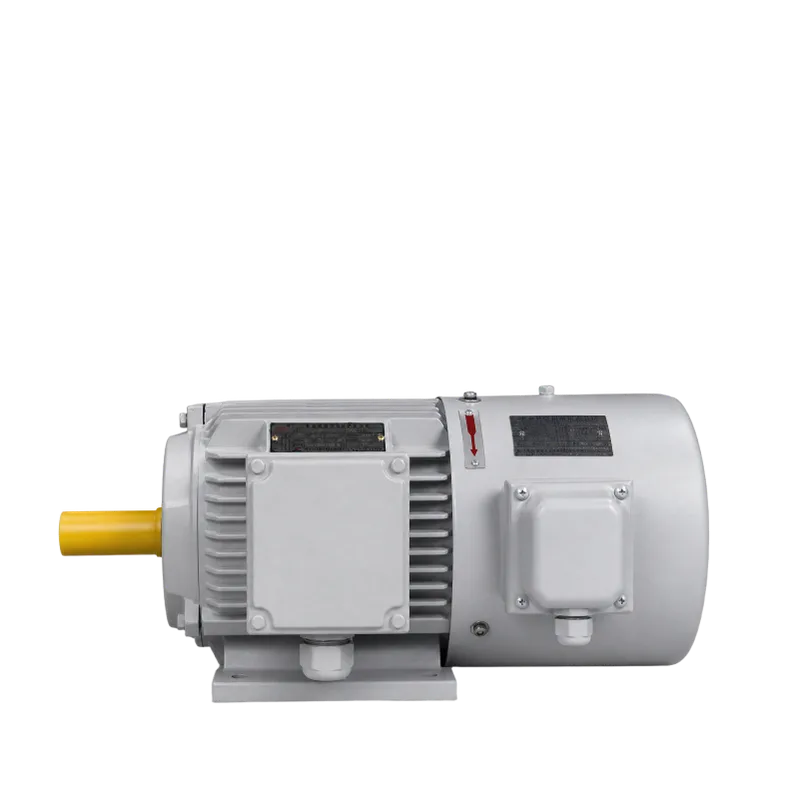
0.55–560 kWIC416 forced coolingEncoder option
YVP variable-frequency induction motor with a separately driven cooling fan

YVP is designed to work with an induction-motor drive for stepless speed control. It runs constant torque across 5–50 Hz and constant power across 50–100 Hz, with smooth running and low torque ripple. Encoder and non-encoder versions are built; the encoder version starts more smoothly and holds speed more precisely.

The detail that matters most is the cooling. A standard shaft-mounted fan slows down with the motor, so a general-purpose machine run slowly on a drive cools itself progressively worse exactly when it may still be delivering full torque. YVP carries a separately driven fan (IC416), so cooling is the same at 5 Hz as at 50 Hz.

It replaces YCT electromagnetic-slip machines on stepless speed duty, with higher efficiency and better control accuracy.

Core specifications

ParameterValue
Frame sizeH80 – H400 mm
Power range0.55 – 560 kW
Constant-torque range5 – 50 Hz
Constant-power range50 – 100 Hz
Voltage & frequency380 V, 50 Hz (custom on request)
Protection degreeIP54 / IP55
Thermal class155 (F)
CoolingIC416 (separately driven fan)
FeedbackWith or without encoder

Typical applications

  • Fans, pumps and hydraulic power packs
  • Plastics machinery, paper machinery, rubber machinery
  • Any stepless speed application replacing a YCT electromagnetic-slip drive

Selection guide

Below about half speed a shaft-mounted fan stops moving useful air while the motor may still be at full torque. That is the failure mode behind a lot of "the drive cooked the motor" stories. YVP has separate forced cooling, which is what makes the low end of the range usable.
Sensorless is enough for fan and pump duty. Specify an encoder where the process needs tight speed holding at low frequency or defined torque during starting.
YVP keeps an induction rotor, which means lower capital cost and no demagnetisation failure mode. TYP is more efficient across the range, particularly at part load. Long-running variable-speed duty tends to favour TYP; intermittent or cost-sensitive duty tends to favour YVP.

FAQ

Datasheets, dimension drawings and certification copies are issued on request — tell us the rating and we will send the documents for that specific model.

Downloads

DatasheetPDF · 2.0 MBDownload
Installation & maintenance manualInstallation, commissioning and servicingRequest
CertificationCertificates and test reportsRequest

Certificates and test reports are issued against the specific model and rating rather than the series, so we send the ones that apply to your order. Tell us the rating and the market and we will send them.

Related products

Technical articles on this series

Why a Centrifugal Fan Can Overload Its Motor

Practical engineering guidance on why a centrifugal fan can overload its motor, including the checks, evidence and common mistakes that matter before purchas

Read

Common-Mode Chokes in Motor Drive Systems

A system-level guide to common-mode chokes, including current paths, grounding, bearing risk and the evidence needed before selection.

Read

Compressor Unloader and Motor Starting Sequence

Coordinate pressure equalisation, unloader proof, motor acceleration, loading delay and restart logic for compressor drives.

Read

Drilling Rig Motors: Drawworks, Mud Pump and Top Drive

Three loads on one rig floor, and three different motor problems. One of them spends part of its cycle generating rather than consuming.

Read

Drive System Efficiency: IE for the Motor, IES for the System

Three efficiency classes can appear on one variable speed drive, and they are not the same scale. The motor class tells you least about the bill.

Read

How Dust, Oil and Moisture Damage Motor Windings

A failure-path guide to winding contamination, with inspection clues and safe cleaning decisions for dust, oil and moisture.

Read

dV/dt Filter vs Sine-Wave Filter for VFD Motors

Practical engineering guidance on dv/dt filter vs sine-wave filter for vfd motors, including the checks, evidence and common mistakes that matter before purc

Read

Extruder Motor Selection: Low-Speed Torque, Cooling and Overload

Select an extruder motor and VFD from recipe-based torque, low-speed cooling, material starts and gearbox limits.

Read

Fan Motor Acceleration: Inertia Matters More Than Running kW

Why fan starting studies need combined inertia, damper position, torque-speed data and terminal voltage rather than running power alone.

Read

Gas Compressor Motors: Reciprocating versus Centrifugal

Two compressor families, two different motor answers. The centrifugal one fails on a specification most enquiries never mention: how long the start takes.

Read

IGBT vs Thyristor Motor Drives: What Changed and Why It Matters

A practical explanation of how fully controlled power switches, PWM and faster protection changed modern variable-frequency motor drives.

Read

Coupling Selection for Industrial Motor Drives

A practical coupling review for industrial motor drives covering torque, speed, misalignment, shaft fit and driven-equipment constraints.

Read

Insulation Resistance and Polarization Index

How to measure, record and interpret motor insulation resistance and polarization index without losing the test conditions.

Read

What an Inverter-Duty Efficiency Figure Actually Measures

Converter-fed efficiency is tested against a standardised reference converter — good for comparing designs, not a prediction for your drive.

Read

How to Use Locked-Rotor Current Data

Turn locked-rotor current from a catalogue value into usable evidence for voltage-drop, starting-method, cable and protection reviews.

Read

Matching a VFD to a Motor: The Checks Buyers Should Not Skip

A practical VFD-to-motor matching guide covering current, overload, speed range, cooling, insulation, cable length, braking and load behaviour.

Read

Selecting Motors for Mining Crushers and Ball Mills

A motor-selection guide for mining crushers and ball mills, covering breakaway torque, inertia, starting, supply limits, dust and maintenance.

Read

Mixer Motor Sizing for Changing Viscosity and Batch Starts

Select agitator motors and VFDs when viscosity, fill level, impeller torque and starting condition change during the batch.

Read

Motor Auxiliary Power Supply Checklist

Commission heaters, blowers, brakes, pumps and sensors by checking each auxiliary supply, protection, interlock and failure response.

Read

Motor Bearing Internal Clearance: When C3 Is Not a Default

A clear method for reviewing motor bearing internal clearance using fit, temperature, speed, load and the actual bearing arrangement.

Read

Motor Braking Methods: Coast, Ramp, DC and Resistor

How to choose a motor stopping method by reviewing process time, regenerated energy, heating, safety and mechanical stress.

Read

Motor Commissioning Baseline Data Worth Keeping

Create a repeatable electrical, thermal, vibration and process baseline at handover so future condition changes can be judged against evidence.

Read

Motor Cooling Air Recirculation at Site

Find and correct layouts where a motor draws its own heated discharge air because of walls, guards, ducts or nearby equipment.

Read

Motor Cooling Method IC Codes: What Buyers Need to Confirm

How to move beyond an IC cooling code by confirming airflow source, heat exchanger, auxiliaries and site interfaces for the motor.

Read

Motor Direction Reversal: Electrical and Mechanical Checks

A commissioning sequence for reversing an industrial motor without losing feedback polarity, lubrication, cooling or process protection.

Read

Motor Encoder Wiring, Shielding and Grounding

A commissioning guide to encoder cable routing, shield termination, supply reference and signal verification on motor drive systems.

Read

Motor Fan Rotation and Cooling Airflow Checks

Verify shaft fan or independent blower direction, airflow path, guards, filters, interlocks and recirculation during motor commissioning.

Read

Motor Grounding and Earthing: Installation Checklist

Separate protective bonding from cable-screen and high-frequency current paths, then verify the installed motor before energisation.

Read

Running a Motor at Low Speed Without Cooling Failure

Practical engineering guidance on running a motor at low speed without cooling failure, including the checks, evidence and common mistakes that matter before

Read

Motor Overload: Process, Mechanical or Electrical?

Use time-aligned process and electrical evidence to separate real load growth from supply, mechanical, cooling, motor and protection problems.

Read

Motor Overspeed on a VFD: Limits to Check

Practical engineering guidance on motor overspeed on a vfd: limits to check, including the checks, evidence and common mistakes that matter before purchase o

Read

Motor Phase Current Imbalance

Practical engineering guidance on motor phase current imbalance, including the checks, evidence and common mistakes that matter before purchase or commission

Read

Motor Restart After a Power Dip: Residual Speed and Process Risk

Review contactor dropout, residual speed, bus recovery, VFD restart and process permissives before enabling automatic motor restart.

Read

Motor Rotation Bump Test: Scope, Readiness and Safety

Plan a controlled direction check only after mechanical, process, electrical and communication risks have been cleared.

Read

Motor Shaft Grounding Rings: Benefits and Limitations

How shaft grounding rings fit into a bearing-current mitigation plan and why cleanliness, path impedance and opposite-end bearings still matter.

Read

DOL, Star-Delta, Soft Starter or VFD: Which Start Method?

Compare DOL, star-delta, soft-starter and VFD motor starting by current, torque, control, mechanical stress and application fit.

Read

Motor Feeder Fault Level: Check the Complete Equipment Interface

Coordinate available short-circuit current, equipment ratings, cable withstand and protection clearing time on one power-system case.

Read

Motor Trips After Two Hours: A Diagnostic Sequence

Practical engineering guidance on motor trips after two hours: a diagnostic sequence, including the checks, evidence and common mistakes that matter before p

Read

Motor Voltage and Frequency Tolerance: Project Review

Compare the real supply envelope with motor load, flux, starting and protection conditions instead of approving voltage and frequency separately.

Read

Oilfield Electric Drive vs Gas Engine: A Decision Framework

A practical framework for comparing electric motors and field-gas engines on pumpjacks and other oilfield surface equipment.

Read

PTC Thermistors vs RTDs for Motor Temperature Protection

A practical comparison of PTC thermistors and RTDs in motor protection, including measurement purpose, wiring and trip logic.

Read

Pump Affinity Laws and Motor Power

Practical engineering guidance on pump affinity laws and motor power, including the checks, evidence and common mistakes that matter before purchase or commi

Read

Pump Cavitation vs Motor Failure

Practical engineering guidance on pump cavitation vs motor failure, including the checks, evidence and common mistakes that matter before purchase or commiss

Read

Pump Minimum Flow and Motor Load

Check motor power across the permitted pump curve, minimum-flow operation, control modes and off-design cases instead of sizing from one duty point.

Read

Why Motor Bearings Keep Failing After Replacement

Practical engineering guidance on why motor bearings keep failing after replacement, including the checks, evidence and common mistakes that matter before pu

Read

Resonance, Unbalance or Misalignment? Follow the Evidence

A practical vibration investigation that uses direction, phase, location and speed response instead of diagnosing a motor from one spectrum peak.

Read

VFD Retrofit: Keep the Induction Motor or Move to PM?

An existing variable-speed drive is five parts, not one. Which of them a motor swap puts back in play is what decides this — not the motor comparison.

Read

Selecting Motors for a Steel Rolling Mill Line

How to specify rolling-mill motors by stand duty, torque-speed envelope, overload, reversing, regeneration, cooling and mechanical shock.

Read

Screw Compressor Motors: High-Speed PM or Conventional Drive?

A practical comparison of high-speed permanent-magnet and conventional motor arrangements for industrial screw-compressor packages.

Read

Speed Loop vs Current Loop: Why Motor Drives Use Nested Control

A clear explanation of cascaded motor-drive control, including the roles of the current loop, speed loop, limits and commissioning order.

Read

Synchronous Speed Formula, Slip and Rated Speed

Synchronous speed = 120 × frequency ÷ poles. How slip turns it into rated speed, and why nameplate speed is an operating point, not a fixed ratio.

Read

Variable-Torque vs Constant-Torque Loads

Practical engineering guidance on variable-torque vs constant-torque loads, including the checks, evidence and common mistakes that matter before purchase or

Read

VFD Reactors and Filters: Work Out Which Side the Problem Is On

Line reactors, dv/dt filters and insulated bearings are not stronger versions of one device. They fix three different problems in three different places.

Read

VFD Base Speed and Motor Operating Range

Define base speed, constant-torque duty, field weakening and cooling limits before approving a motor's VFD speed range.

Read

VFD Bearing Currents: Causes, Warning Signs and Controls

Understand how variable-frequency drives create bearing currents, how electrical fluting develops, and which grounding and insulation measures help.

Read

VFD Cable Length and Motor Insulation Stress

Practical engineering guidance on vfd cable length and motor insulation stress, including the checks, evidence and common mistakes that matter before purchas

Read

VFD Carrier Frequency: Effects on Motor and Drive

Practical engineering guidance on vfd carrier frequency: effects on motor and drive, including the checks, evidence and common mistakes that matter before pu

Read

Why a VFD Needs EMC Design: Common Mode and Differential Mode

A drive shifts the winding neutral away from ground and couples it to the rotor. What common mode is, and why EMC is a property of the installation.

Read

VFD Flying Start for High-Inertia Loads

What to check before enabling flying start or catch-on-the-fly control for fans, centrifuges and other rotating loads.

Read

VFD Min and Max Frequency Settings for Motors

How to set VFD minimum and maximum frequency from motor cooling, mechanical speed limit, load torque and process requirements.

Read

Output Reactors for VFD-Fed Motors

When an output reactor may help a VFD motor circuit and what must be checked for cable, switching, voltage drop and drive compatibility.

Read

VFD Skip Frequencies and Mechanical Resonance

How to identify and document restricted speed bands without hiding a structural or mechanical problem in a VFD-driven system.

Read

What Is an Induction Motor? How It Works, Slip and Selection

Learn how a three-phase induction motor works, calculate synchronous speed and slip, compare rotor types, and identify the data needed to select one.

Read

Request a quote — YVP Series

Tell us the rating, quantity and application and an engineer will come back with a specification, the documents for that model, and a price.

Contact Sales