
The cheapest starter is not always the lowest-cost start. A motor has to accelerate the load before its thermal limit or the protection trip is reached. Every starting method changes current, torque and mechanical shock in a different way, so selection begins with the load curve and the electrical network.
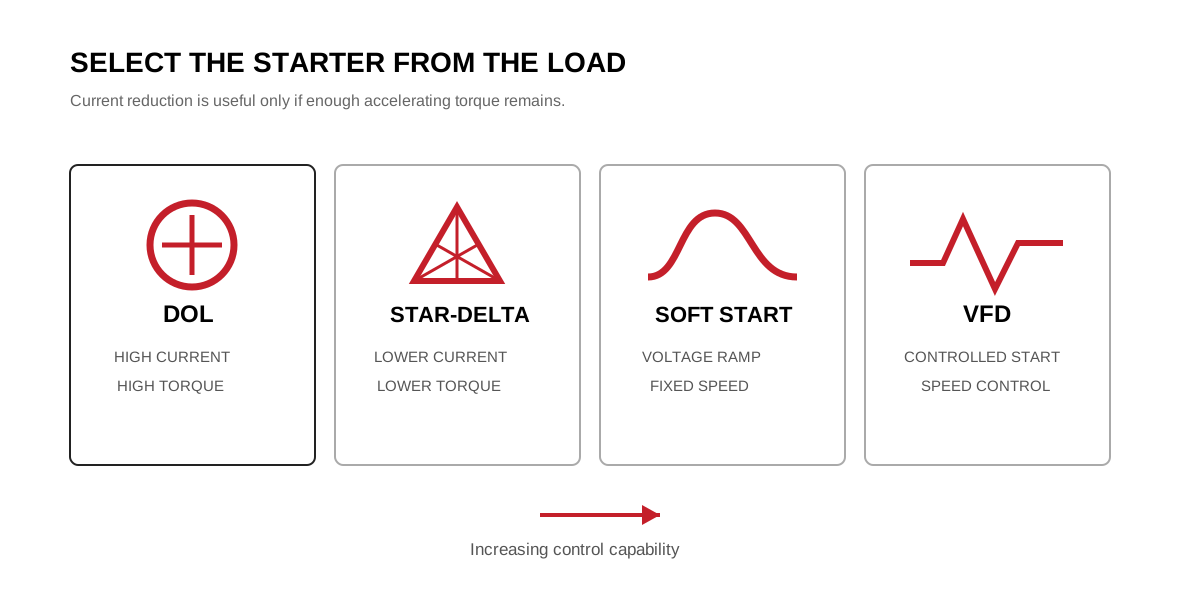
ABB’s motor guidance describes four common routes: direct-on-line, star-delta, soft starting and variable-speed drive. The useful distinction is not “old versus modern.” It is what each method can control.
Four methods at a glance
| Method | Starting current | Starting torque | Speed control after start | Main limitation |
|---|---|---|---|---|
| DOL | Highest | High, motor-defined | No | Network dip and mechanical shock |
| Star-delta | Reduced | Strongly reduced | No | May not accelerate the load; transition transient |
| Soft starter | Adjustable voltage ramp | Adjustable within motor/load limits | No | Cannot provide continuous variable speed |
| VFD | Controlled | Controlled over a wide range | Yes | More cost, setup and EMC considerations |
Direct-on-line: simple when the system can accept it
DOL connects the motor directly to the supply through correctly rated switching and protection. It is compact, familiar and efficient in steady operation because no electronic converter remains in the power path.
The tradeoff is an uncontrolled start. Current can be several times rated current, while the torque step can load couplings, belts and driven equipment. DOL is reasonable when the transformer and feeder are stiff enough, voltage dip is acceptable, and the machine can withstand the acceleration.
Star-delta: current and torque fall together
Star-delta starting temporarily connects a delta-rated winding in star, reducing phase voltage. ABB gives a practical comparison for a suitable motor: starting current is about 30% of the DOL value and starting torque about 25% of DOL.
That torque reduction is the central limitation. A lightly loaded pump or fan may accelerate; a loaded conveyor, crusher or positive-displacement machine may not. If the motor stalls in star, the lower current is not a success—it extends heating without completing the start.
The motor must also expose the correct six terminals and be designed to run in delta at the line voltage. The changeover itself can create a transient, especially if timing and phase relationship are poor.
Soft starter: controlled acceleration at fixed line frequency
A soft starter controls applied voltage during acceleration. It can reduce mechanical shock, manage current and provide a controlled stop that is useful for some pumping systems. Once the start is complete, a bypass contactor commonly carries the running current.
Because induction-motor torque falls sharply with reduced voltage, the current limit cannot be selected in isolation. It must still produce more accelerating torque than the load requires throughout the run-up. Start time, starts per hour and bypass arrangement belong in the specification.
VFD: choose it when the process needs speed control
A VFD controls frequency and voltage, enabling a motor to develop useful torque while starting at low speed. It also controls normal operating speed, which can deliver large process savings on variable-torque pumps and fans.
The drive introduces other engineering work: motor insulation stress, cable length, EMC, cooling at low speed, bearing-current risk and correct parameter setup. See matching a VFD to a motor before treating it as a universal starter.
If speed control has no operating value, a soft starter may be the cleaner solution. If speed control changes flow, pressure or production, compare the complete drive system rather than starter purchase price alone.
Use torque and time to decide
Collect these values before selecting hardware:
- motor locked-rotor current and torque;
- load torque from zero to full speed;
- combined motor and load inertia;
- permitted voltage dip at the point of connection;
- maximum acceleration time and starts per hour;
- required stopping behaviour;
- need for continuous speed control;
- hazardous-area and environmental constraints.
For high-inertia equipment, acceleration time is a thermal question. For cyclic equipment, starting frequency can decide the duty even when each individual start appears acceptable. The meanings of S1 through S10 are covered in motor duty types.
The selection rule
Use DOL when simplicity is valuable and the system accepts the electrical and mechanical step. Use star-delta only when its reduced torque still clears the load curve. Use a soft starter when controlled acceleration or stopping is needed without continuous speed control. Use a VFD when variable speed or strong low-speed control creates process value.
The correct method is the one that accelerates the real load safely—not the one with the lowest current printed in a comparison table.