
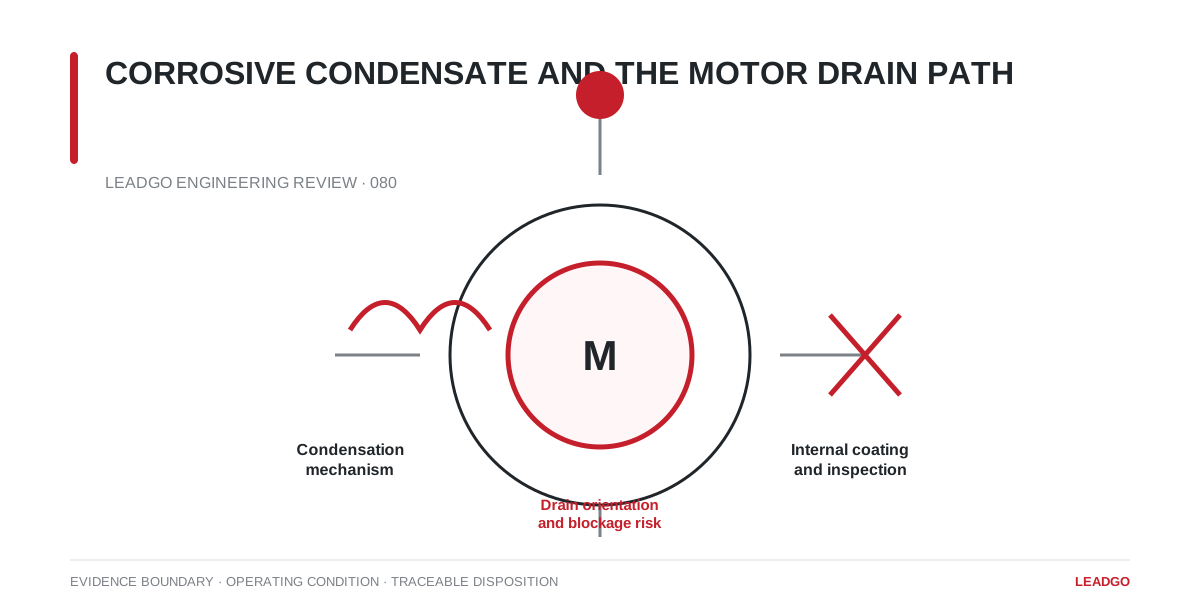
Clear water after a temperature cycle and acidic or salt-laden condensate do not create the same maintenance problem. Once the drained liquid shows corrosion products or process contamination, the investigation must follow the complete path from atmosphere to internal surface and out of the housing.
Trace source, path and consequence
| Question | Evidence | Possible action |
|---|---|---|
| Where did moisture enter or form? | Spray pattern, humidity, shutdown history | Correct shielding, sealing or heater control |
| Where does liquid collect? | Mounting drawing and internal low points | Confirm approved drain arrangement |
| What is in the liquid? | Site process knowledge and suitable analysis | Review material and coating compatibility |
| What has been attacked? | Internal photographs and component inspection | Repair under an approved scope |
| Can the path block? | Drain condition and contamination history | Add a defined inspection/cleaning task |
Do not drill an additional opening or replace a certified drain device as an improvised field repair. Such changes can affect enclosure integrity and hazardous-area compliance.
Inspect beyond the visible drain
Look for coating lift, rust staining, contaminated windings, terminal corrosion and moisture trapped around fasteners or cable entries. Check insulation condition using the site’s controlled procedure and compare like-for-like readings.
The maintenance record should state motor identity, orientation, process state, weather or washdown condition and time since shutdown. This makes recurrence patterns visible.
Release only after the source is addressed
Cleaning the drain restores a path; it does not prove that internal damage is acceptable. Define who reviews insulation, coating, bearings and terminals, and document the repair or monitoring decision.
Related guidance: motor drains and condensation management and TEFC enclosure boundaries.