
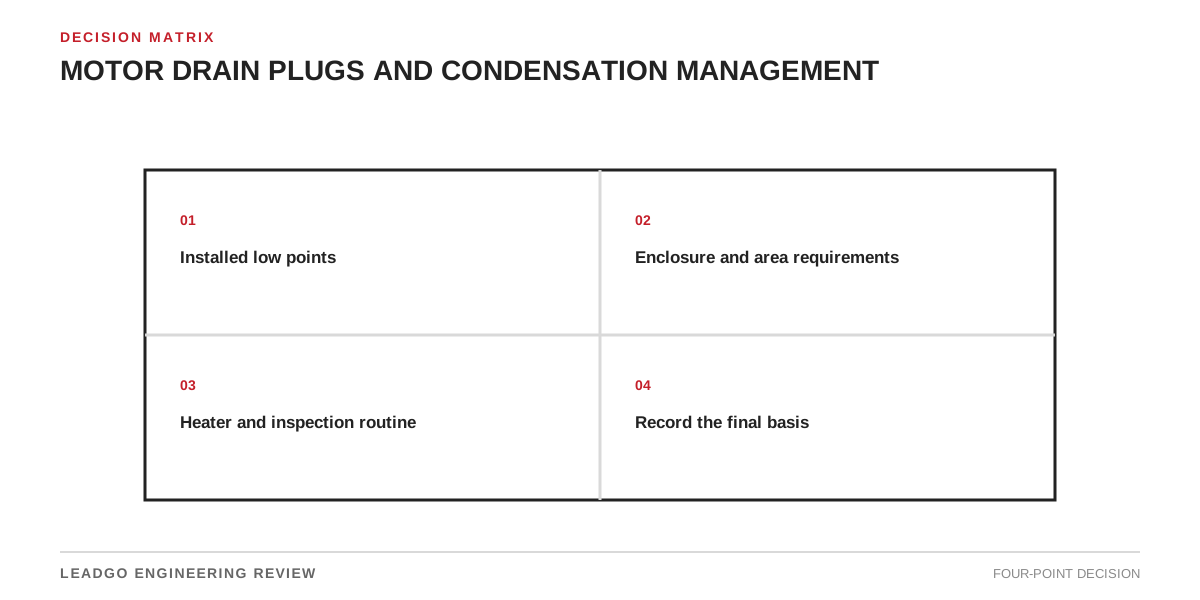
A drain plug is a small part with a location-dependent function. It can only remove water that reaches it, and its permitted position depends on the motor’s enclosure design and installation requirements.
Map the installed low points
| Check | Record | Stop condition |
|---|---|---|
| Mounting | IM mounting and shaft orientation | Drawing and installed orientation disagree |
| Drain location | Openings that are lowest after installation | Water pocket remains below the drain |
| Drain device | Plug, breather or automatic drain identification | Device is substituted without approval |
| Enclosure | Required IP and site exposure | Proposed drain position conflicts with protection |
| Hazardous area | Certificate and manufacturer instructions | Field change is outside the certified arrangement |
| Maintenance | Access, inspection and cleaning method | Drain cannot be checked safely |
Photograph the final orientation before coupling guards and surrounding pipework make the area difficult to see.
Coordinate drainage with standby heating
Specify when the space heater energises, how its circuit is protected and how technicians verify operation. The normal arrangement should prevent simultaneous heater and motor energisation where required by the design. Long storage or outages may need additional insulation checks and preservation measures.
Do not assume that opening a plug is harmless. It can allow dust, water jets or hazardous material to enter. Maintenance instructions should state the permitted operating position and the conditions for inspection.
Record what leaves the motor
Water at a drain is evidence, not merely waste. Note quantity, colour, odour, contamination and recurrence. Repeated corrosive liquid calls for investigation of the entry path, internal coating and surrounding process.
See space heaters and condensation and what an IP rating means for the related controls.