
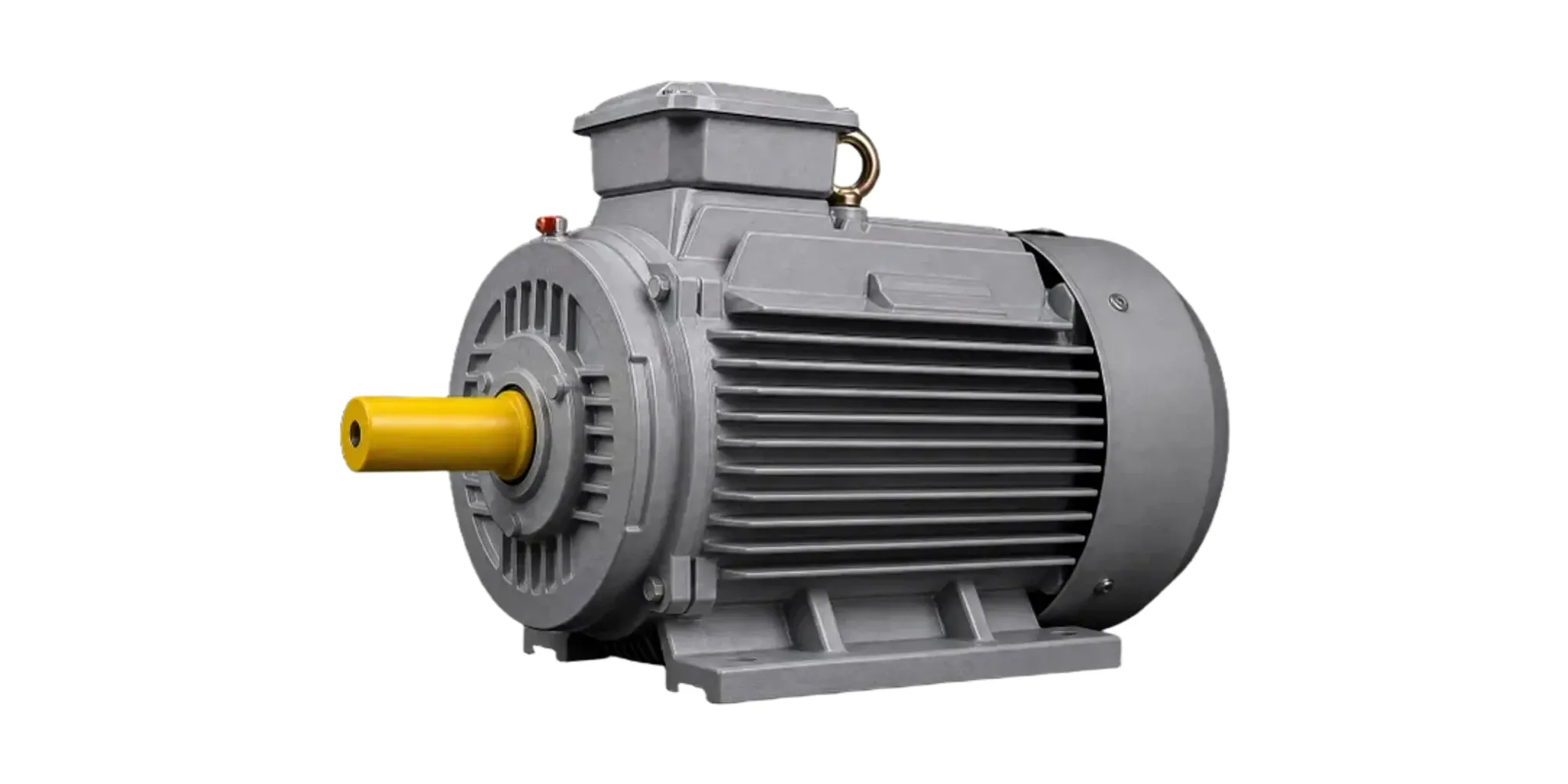
Ask three suppliers for a motor for a dusty plant and you will get three datasheets that all say TEFC, with IP ratings that differ. That is not an inconsistency. TEFC and the IP rating answer different questions, and treating one as a proxy for the other is how a motor ends up in a duty its enclosure was never specified for.
Direct answer
TEFC — totally enclosed, fan-cooled — specifies two things:
- Totally enclosed. There is no free exchange of air between the inside of the motor and the surrounding air. Heat generated in the windings has to reach the outside through the frame, not by air passing through the machine. Totally enclosed does not mean airtight or sealed.
- Fan-cooled. An external fan, normally mounted on the motor’s own shaft behind a cowl, blows air over the outside of the frame to carry that heat away.
TEFC does not specify how much dust or water the enclosure keeps out. That is the ingress protection rating, written as IP followed by two digits. The two specifications travel together on a nameplate, but neither implies the other.
The three axes, and what each one answers
| Specification | Answers | Example |
|---|---|---|
| Enclosure type | Does air pass through the machine? | TEFC, ODP |
| IP rating | How much solid matter and water gets in? | IP55, IP66 |
| IC code | How is the cooling air moved? | IC411, IC416 |
A specification is incomplete until all three are pinned down. “TEFC motor” on its own does not describe an enclosure well enough to order against.
Reading the IP rating
Under GB/T 4942.1—2006 and EN IEC 60034-5:2020 the two digits are independent:
- First digit — solid bodies. Rises from protection against large objects through to dust. IP5x is protected against dust in a quantity that would interfere with operation; IP6x is dust-tight.
- Second digit — water. Rises from dripping water through spraying and jetting to immersion. IPx4 is splashing from any direction; IPx5 is jetting; IPx6 is powerful jetting.
So IP55 and IP65 differ only in dust, and IP55 and IP56 differ only in water. A plant that washes down its equipment needs the second digit; a cement or mining plant usually needs the first.
There is a second reason the first digit matters in dusty plant, and it is not about the motor’s own survival: a layer of dust on the outside of the enclosure insulates it and raises its surface temperature. Where combustible dust is present, that surface temperature is part of the explosion protection, which is why dust-protected motors carry a marked maximum surface temperature and a requirement to keep the enclosure clean.
IC411 and IC416: the same enclosure, different cooling
The cooling arrangement is specified separately again, by an IC code. Two arrangements cover most industrial TEFC machines:
- IC411 — the fan is driven by the motor’s own shaft. Simple, needs no extra wiring, and the cooling airflow rises and falls with motor speed.
- IC416 — the fan has its own motor and its own mains-frequency supply. Cooling stays constant no matter how slowly the main motor runs.
The difference is decisive for any motor that will run at reduced speed on a drive. A shaft-driven fan delivers least cooling at exactly the speed where a constant-torque load still demands full current. That is why variable-frequency duty motors are commonly specified IC416, and why the separate fan must never be fed from the drive output — it would slow down with the motor and defeat its own purpose.
The Chinese efficiency standards that cover these machines carry the cooling arrangement in their scope for exactly this reason: GB 30253—2024 for permanent magnet synchronous motors and GB 30254—2024 for high-voltage cage induction motors both state which IC arrangements their efficiency grades apply to, rather than leaving cooling as an unstated assumption.
What to put on a request for quotation
Instead of “TEFC motor, 55 kW”, specify all three axes plus the duty:
- Enclosure and cooling arrangement — TEFC, IC411 or IC416
- Ingress protection — the IP rating your environment needs, both digits considered separately
- Ambient and altitude — both derate the machine
- Speed range, if a drive is involved — this is what decides IC411 versus IC416
LEADGO’s IE3, IE4 and IE5 induction series are totally enclosed, fan-cooled machines across the H80–H355 frame range; the hazardous-area series are built on the same enclosure principle with the protection concept added on top. For the IP rating and cooling arrangement of a specific series, ask us for the rating you need — these vary by series and by frame, and are worth confirming against the application rather than assumed from the family.