
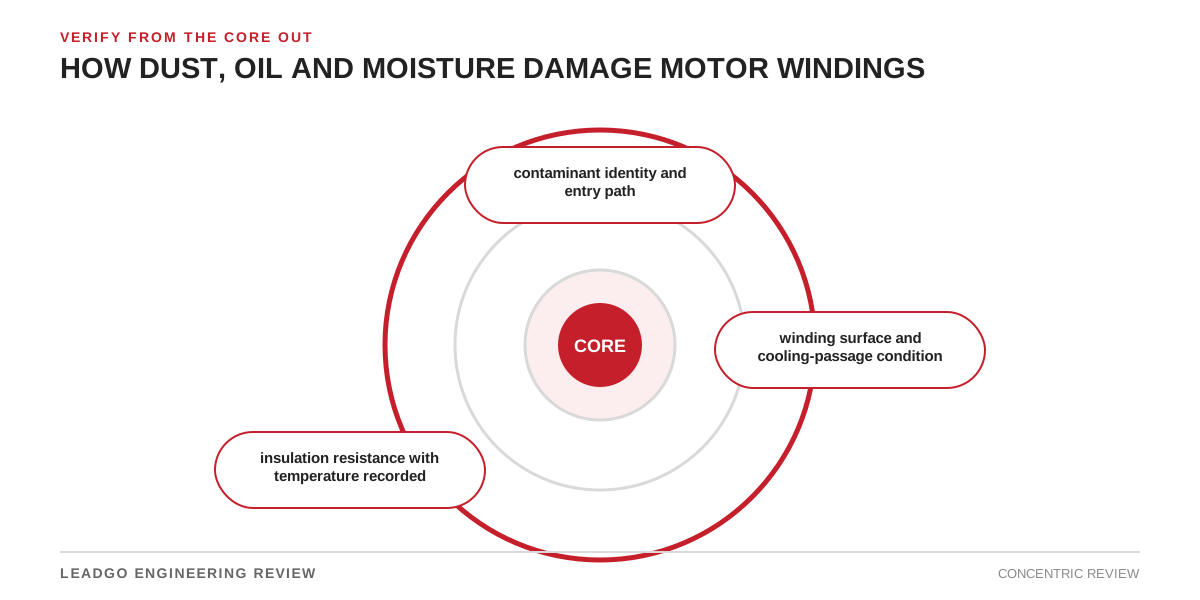
Contamination rarely damages a winding by one mechanism. A dust layer can restrict cooling, absorb moisture and create a surface leakage path at the same time. Oil can hold abrasive particles against insulation and may attack materials that tolerate dry dust. Water can lower surface resistance, but salts left after evaporation can remain conductive.
Cleaning should therefore begin with diagnosis, not with a solvent.
Read the deposit pattern
Before disturbing the motor, isolate it safely and photograph the winding, air passages, terminal box, drains and the inside of the end shields. The location of the deposit often points to the entry path.
- A fan-side gradient suggests contaminated cooling air or a failed filter.
- Local oil near a bearing or seal suggests migration from the lubrication system.
- Water marks below a terminal-box entry point a different way than uniform condensation.
- Tracking marks, charred branching patterns or a sharp local discharge mark require an insulation assessment, not routine cleaning.
Keep a sample when the contaminant is unknown. Compatibility decisions depend on whether the material is conductive carbon, mineral dust, cement, salt, process chemical, grease or another substance.
Three contaminants, different failure paths
| Contaminant | Immediate effect | Longer-term concern |
|---|---|---|
| Dry dust | Blocks cooling surfaces and passages; may abrade moving clearances | Heat retention, moisture absorption and conductive bridges if the dust contains carbon or metal |
| Oil or grease | Creates a film that traps particles and migrates along surfaces | Material compatibility, softened coatings and persistent low-resistance leakage paths |
| Water or high humidity | Lowers surface insulation resistance and promotes condensation | Corrosion, dissolved contaminants, tracking and repeated wet/dry cycling |
ABB’s large-machine maintenance manual notes that dirt and humidity generally reduce insulation resistance and polarization index. The same manual treats visual inspection, cleaning, drying and electrical measurements as complementary evidence.
Choose the cleaning method from compatibility evidence
The approved method should identify the insulation system, contaminant, cleaning material, application technique and drying endpoint. Obtain manufacturer approval when the winding materials or previous repairs are uncertain.
Avoid four shortcuts:
- Uncontrolled high-pressure air. It can force particles beneath bracing, damage leads and spread hazardous dust.
- A familiar workshop solvent. A solvent safe for metal may soften varnish, insulation, adhesives, seals or paint.
- Water washing without a drying plan. Residual moisture can remain in porous deposits and tight interfaces.
- Heating without source correction. A dry winding will become wet again if drains, heaters, seals or ventilation remain defective.
For combustible or toxic dust, cleaning also needs a site safety review. The collection method must not create an ignition or exposure hazard.
Verify the result rather than the appearance
After cleaning and drying, inspect hidden collection points where practical and confirm that air passages are open. Repeat insulation measurements using a controlled method, with winding temperature and connection recorded. Compare phase resistance if the maintenance scope calls for it, and check sensors, space heaters and terminal insulation.
A bright winding surface is not an acceptance test. Conversely, cosmetic staining alone does not prove active damage. The decision should combine visual evidence, electrical results and the history of how the contamination entered.
Stop the recurrence
Close the job by assigning the entry-path correction. Depending on the finding, this may involve a bearing seal, terminal-box gland, drain orientation, space-heater control, cooling-air filtration, process leak, housekeeping interval or enclosure/cooling selection.
When the environment itself is outside the ordered motor’s design basis, repeated cleaning is not a durable control. Review the enclosure, cooling method and maintenance access for the actual site.
Release rule
Return the motor to service when the contaminant has been identified sufficiently to choose a compatible method, the winding has passed the applicable inspection and electrical checks, and the entry path has been corrected or placed under a documented control.
Related reading: