
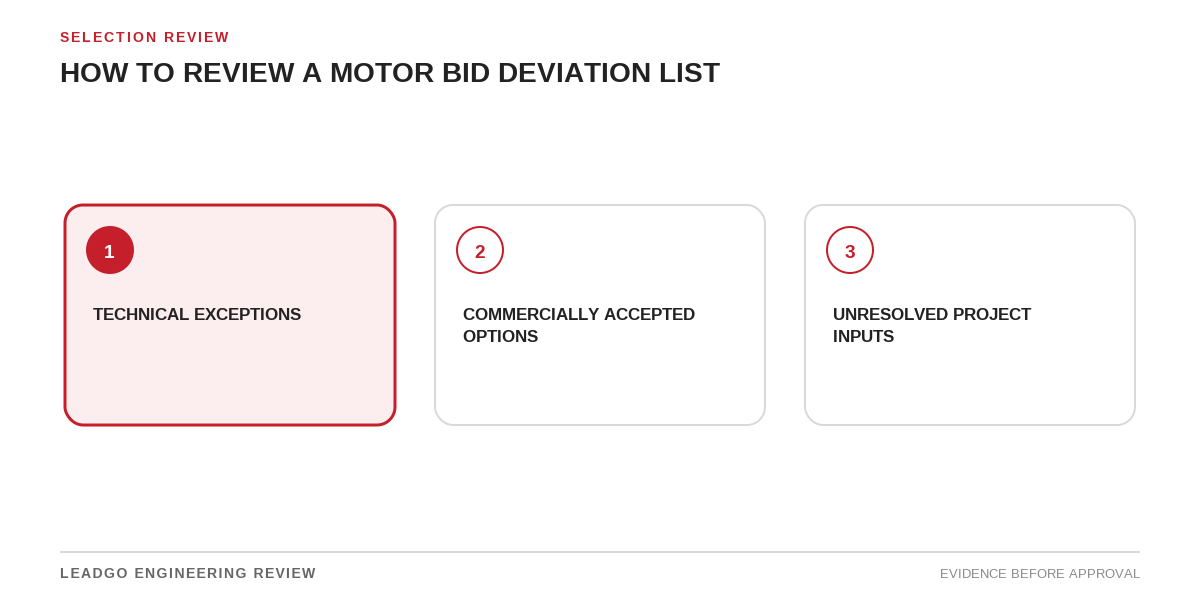
Review a motor bid deviation list by linking every exception to the requirement it changes, the offered alternative and the evidence needed for a decision. Record who can accept the consequence and where that decision will appear in the order. A short deviation list is useful only when it accounts for qualifications elsewhere in the quotation, drawings and commercial notes.
For a technical enquiry, send the motor specification and the supplier’s numbered exceptions. Include the quotation revision, required delivery stage and any purchaser inputs still outstanding. This gives the supplier a defined question to answer instead of a general request to confirm compliance.
Scope and purchasing boundary
This worksheet supports a buyer reviewing motor offers before order placement. It focuses on individual exceptions, rather than ranking complete bids or negotiating the final price. It also helps a package contractor explain a motor supplier’s qualification to the equipment owner without losing the original requirement.
The applicable tender procedure controls what clarification, alternative offer or correction is permitted. Do not assume that an unacceptable offer can always be repaired through negotiation. In a formal competition, refer questions about responsiveness and permitted clarification to the procurement authority before inviting revised terms.
The World Bank’s goods bidding document distinguishes deviations, reservations and omissions when assessing bids. That is useful background for reading an exception list, but its particular rules apply only where adopted by the procurement. The table below is a proposed motor purchasing aid, not an official tender form.
Find qualifications outside the deviation sheet
Collect the specification, amendments, quotation, offered data sheet, drawings and attachment index at their identified revisions. Search the offer for phrases such as “standard arrangement,” “by others,” “if required,” “subject to confirmation” and “excluded.” Each may change what the price covers, even when the supplier’s deviation sheet says none.
Read each phrase in context. A standard arrangement may meet the requirement, while an optional accessory may already be included elsewhere in the price schedule. Log the apparent inconsistency and ask for a document-specific answer. Avoid turning an ambiguous sentence into an assumed technical failure.
Check which purchaser inputs remain undefined. If the requested shaft interface has not been supplied, the offer may contain an assumption rather than a deliberate exception. Give that assumption an owner and a decision deadline. The industrial motor data-sheet review helps locate requirements that need a consistent basis across the offer.
Exception register to use during clarification
Create one record per issue. Separate unrelated exceptions even when they occur in the same paragraph, because their owners and consequences can differ. Use the following fields as columns or as a repeatable issue sheet.
| Field | What the reviewer enters | What prevents closure |
|---|---|---|
| Exception identifier | Stable issue number used in correspondence | Comments refer only to changing page numbers |
| Requirement reference | Specification clause, amendment and revision | No traceable statement of what was requested |
| Offered condition | Supplier wording and document location | Alternative described only as standard practice |
| Classification | Departure, qualification, missing item or unresolved input | Administrative omission confused with technical acceptance |
| Equipment coverage | Motor tags, quantity and affected accessories | Response applies to a different model or package |
| Consequence | Interface, duty, inspection or maintenance decision affected | Supplier claims equivalence without addressing the actual use |
| Supporting evidence | Drawing, data, calculation or scope statement required | Catalogue statement does not describe the offered configuration |
| Commercial treatment | Included scope, separate price and schedule assumptions | Technical acceptance used to infer price inclusion |
| Decision authority | Responsible technical and purchasing roles | Person responding lacks the relevant authority |
| Final incorporation | Disposition and revised order-document references | Email agreement never reaches the purchase baseline |
For each issue, retain the question, supplier response and disposition together. When an answer changes the proposed supply, request a revised offer or controlled clarification document. Copying the response into a tracking spreadsheet is helpful, but the agreed documents must still describe the equipment to be purchased.
Assign an open status when evidence is incomplete. If the proposal is acceptable only under stated conditions, write those conditions in full and identify how compliance will be verified. An unexplained “accepted with comments” label leaves too much for the next engineer to interpret.
Six decision steps before recommending an order
- Confirm the requested condition and whether the current tender rules allow an alternative or clarification.
- Identify the exact difference between the requirement and the offer, including affected motor tags and accessories.
- Ask the responsible discipline to assess consequences using the offered configuration and actual application inputs.
- Request the missing evidence and record any resulting cost, delivery or inspection implications separately.
- Obtain the authorized disposition and identify which purchase documents must change if the proposal is accepted.
- Check that the final quotation, data sheet and order attachments reflect the disposition before closing the issue.
If evidence supports equivalence, record the demonstrated basis instead of a general equivalence claim. If a requirement remains unmet, retain that finding and follow the purchasing procedure. If the requirement itself changes, control that change through the purchaser’s process rather than quietly editing the deviation row.
The WTO’s government procurement agreement discusses equivalent solutions in technical specifications for procurements within its scope. It does not establish that a particular motor alternative is equivalent. The buyer still needs evidence relevant to the stated requirement and application.
Worked example: sensors excluded from a quoted package
Suppose an illustrative motor specification requests winding temperature sensors, while a quotation footnote excludes sensors from its base scope. The main data sheet merely says “available.” No sensor count, type or price is assumed in this example, and it does not describe an actual customer order.
Open an exception linked to the specification and footnote. Ask the supplier whether sensors are included in the offered configuration, what devices and connections are proposed, and which document will identify them. Ask the purchaser’s controls owner what interface information is required to evaluate that proposal.
The response may confirm that the base offer omitted a required item. Procurement then follows the tender rules for the omission; it should not simply add an informal allowance and mark the bid compliant. If a revised scope is permitted, the supplier must identify the revised price and relevant data-sheet changes.
Alternatively, the supplier may show that the item is already included in a priced accessory schedule and that the footnote is erroneous. Obtain a corrected quotation and consistent data sheet. Closure then refers to those documents, with the controls review recorded where required.
Both outcomes require a precise documentary resolution. The register makes the difference visible without pretending that an acknowledgement email, an estimated price or the word “available” defines the purchased equipment.
Common mistakes in exception disposition
Accepting a familiar model name as evidence can leave an accessory or interface unexamined. Request data for the offered configuration. A product family may contain options that are irrelevant to this particular quotation.
Treating all exceptions as equivalent also weakens review. A missing attachment, an excluded test and a different mounting interface need different responses. Describe the affected decision before choosing the reviewer, rather than sending every issue to one general mailbox.
Allowing sales correspondence to overwrite an engineering requirement creates conflicting instructions. Keep the original requirement, the proposed change and the authorized decision visible. Where commercial and technical documents disagree, resolve document precedence through the order process.
Finally, avoid closing purchaser assumptions without contacting the input owner. An estimate of site conditions may be enough to prepare a budget offer, but it should remain identifiable when a firm purchase decision requires confirmed inputs. State the agreed treatment explicitly.
Supplier evidence request and order handover
Request a consolidated response using the same exception identifiers. Ask the supplier to identify any new qualifications introduced by its answers and to provide the revised attachment index. Specify which clarifications need updated drawings or data sheets rather than prose alone.
Before handover, reconcile the exception register with the supplier document delivery matrix. An accepted alternative may create a new drawing or test-record requirement. Where it changes inspection evidence, connect the decision to the ITP hold and witness points agreed for the order.
Send the final register to the people administering manufacture, inspection and receipt. Highlight accepted exceptions that they must verify and unresolved inputs that still restrict progress. The useful result is a purchase package in which the motor scope, supporting evidence and remaining actions can be understood without reconstructing the bid negotiations.