
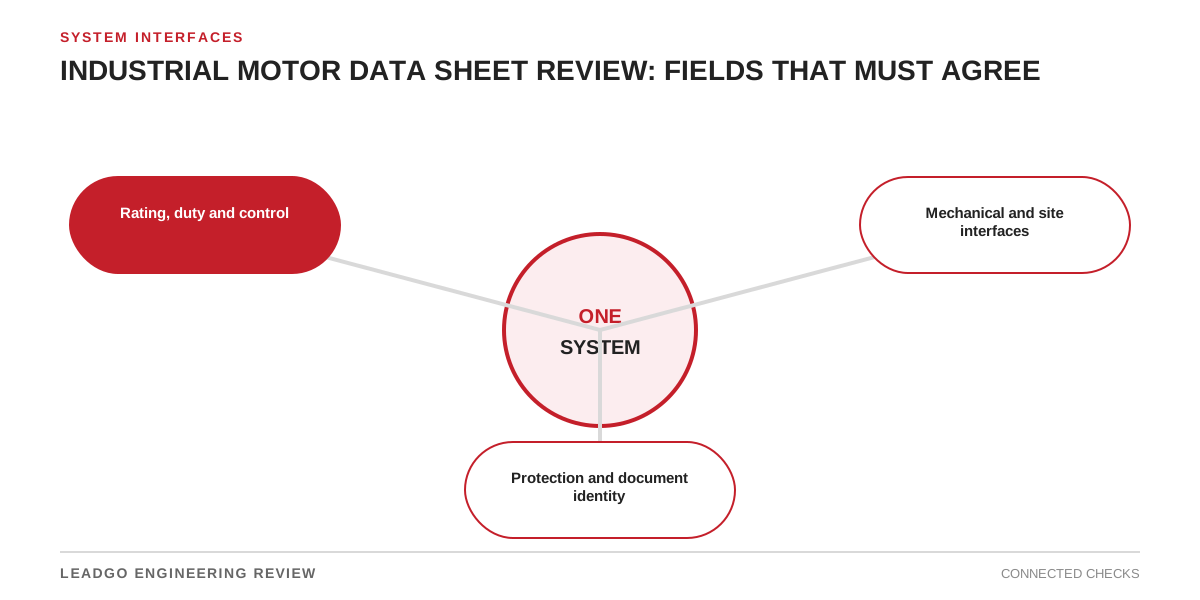
A long motor data sheet can appear complete and still describe several different machines. One section may carry the requested voltage, another the manufacturer’s standard winding, and the drawing a third terminal-box arrangement. Checking boxes does not expose that conflict; tracing relationships does.
Start with one defined operating case
Identify the rated output at the shaft, supply voltage and frequency, rated speed, duty type, starting method and load torque. Then identify the site ambient, altitude and cooling medium. These values create the thermal and electrical boundary for the offered motor.
If the load varies, add the duty profile rather than replacing it with an average kilowatt figure. State starts per hour, hot restart requirement, overload duration and VFD speed range where applicable.
Use a conflict matrix
| Data-sheet field | Must agree with | Typical contradiction to find |
|---|---|---|
| Output, speed and torque | Load list and performance curve | Rated kW copied correctly but speed changed |
| Voltage and frequency | Single-line diagram and site supply | 50 Hz rating offered to a 60 Hz duty |
| Duty and starts | Load cycle and starting study | S1 selected for a cyclic or frequent-start load |
| IP and cooling code | Site environment and GA drawing | Enclosure stated without the required cooler arrangement |
| Mounting and shaft | Driven-equipment drawing | Correct frame with incompatible shaft extension |
| Terminal-box position | Cable routing drawing | Position named from a different viewing end |
| Accessories | Control schematic and auxiliary supply | Heater or fan voltage absent or inconsistent |
| Ex marking | Area classification and certificate | Series certificate does not cover the ordered variant |
The table makes each answer traceable to the interface it affects. It does not force every project to use the same construction.
Separate rating data from construction options
Output, voltage and speed define the operating point. Mounting, enclosure, cooling, bearings, coating and accessories define how the motor survives and connects at site. A substitution in the second group can invalidate assumptions made in the first.
For example, a separately powered fan changes the accessory supply and control logic. An insulated bearing changes the bearing arrangement and spare-parts list. A space heater needs its own voltage, power and interlock definition.
Check evidence at the right level
A catalogue proves that a series exists. A motor-specific data sheet states what is offered. A certified drawing fixes physical interfaces. A test report records measured results for an identified machine. A certificate establishes the assessed scope for a regulated protection concept.
Do not accept evidence from a “similar model” where the disputed item is exactly what differs. Record document number and revision beside any value that controls acceptance.
Close commercial ambiguity before approval
Technical and commercial scope should meet on the data sheet. Confirm whether coupling halves, space heaters, RTDs, vibration probes, cable glands, terminal-box adapters, test witnessing and final documentation are included. Otherwise two compliant-looking quotations may cover different supply boundaries.
The final review should show three states: accepted, accepted with an identified deviation, or open. A blank cell is not an approval state.
Data needed for a comparable RFQ
Send the load point, starting case, site conditions, mounting and shaft interface, cable-entry direction, accessories, required tests and applicable certification. LEADGO can return a completed motor data sheet with explicit deviations, giving the buyer a like-for-like basis for technical comparison.