
Use the motor-specific grease type, quantity and interval, then adjust from monitored condition and environment rather than habit. That conclusion is useful only after it is connected to the actual machine, load and site. Mechanical interfaces carry real load. A dimension that looks minor on a drawing can change bearing force, alignment, drainage or service access after installation.
Begin with the operating boundary
A sound review starts by fixing what is inside the decision. State the rated and abnormal operating points, the supply and control arrangement, the mechanical interface, the environment and the evidence required at delivery. If any of those items remain open, suppliers may make different assumptions while offering equipment that appears identical in a price table.
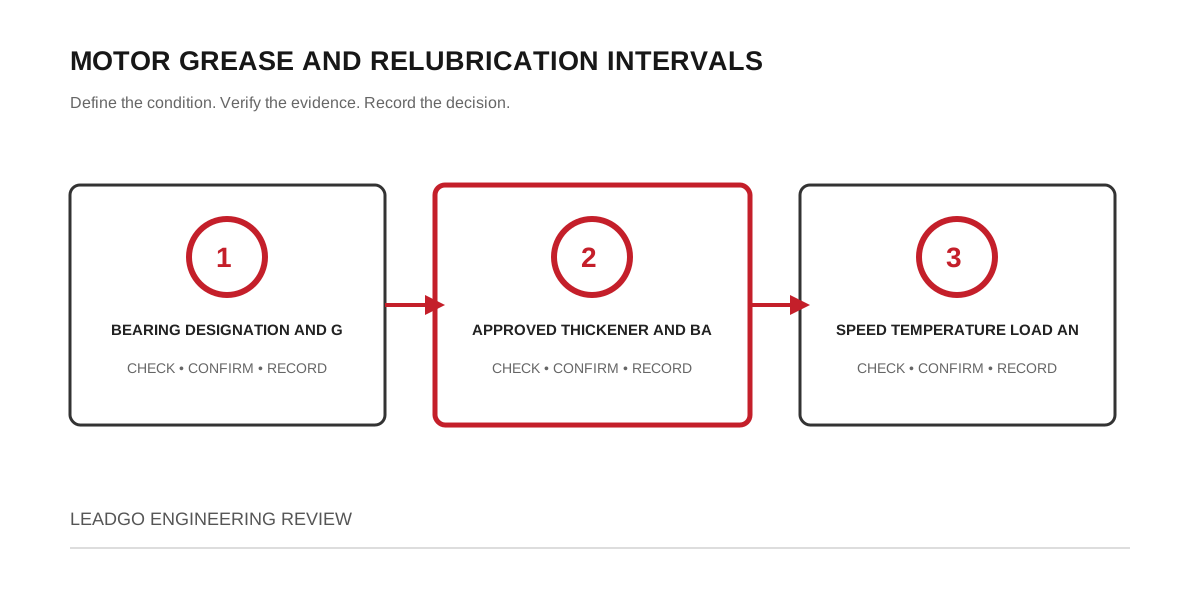
For this topic, collect bearing designation and grease cavity design, approved thickener and base-oil compatibility and speed, temperature, load and shaft orientation. Add contamination and washdown exposure and purge path and safe regreasing procedure before final approval. These are not administrative details: each one changes the load, temperature, interface or acceptance basis.
| Step | Evidence to collect | How it is used |
|---|---|---|
| 1 | bearing designation and grease cavity design | Confirm against the ordered motor and actual site |
| 2 | approved thickener and base-oil compatibility | Confirm against the ordered motor and actual site |
| 3 | speed, temperature, load and shaft orientation | Confirm against the ordered motor and actual site |
Why the system view matters
Mechanical interfaces carry real load. A dimension that looks minor on a drawing can change bearing force, alignment, drainage or service access after installation. The manufacturer can confirm the capability of the quoted motor, but the owner or responsible designer still defines the site condition and the driven-equipment requirement. Keeping those responsibilities separate prevents a catalogue statement from being mistaken for an installation approval.
The relevant value should be taken from the document that governs it: a certified drawing for dimensions, a motor-specific data sheet for ratings, a test report for measured performance, and a certificate for a regulated protection concept. Similar model numbers are not evidence that two units share every limit.
A practical review sequence
- Bearing designation and grease cavity design. Record the source, revision and operating condition instead of copying an unqualified catalogue value.
- Approved thickener and base-oil compatibility. Record the source, revision and operating condition instead of copying an unqualified catalogue value.
- Speed, temperature, load and shaft orientation. Record the source, revision and operating condition instead of copying an unqualified catalogue value.
- Contamination and washdown exposure. Record the source, revision and operating condition instead of copying an unqualified catalogue value.
- Purge path and safe regreasing procedure. Record the source, revision and operating condition instead of copying an unqualified catalogue value.
After the paper review, compare the findings with the physical installation. Photographs, measured dimensions, protection settings and operating trends often expose assumptions that were invisible in the original enquiry. Resolve deviations before shipment or energisation, when changes are still controlled and traceable.
Common mistakes
- Mixing greases because both are labelled high temperature. This removes the condition that makes the comparison valid and can shift risk into installation or commissioning.
- Adding grease until it appears at a seal. This removes the condition that makes the comparison valid and can shift risk into installation or commissioning.
Another common error is to optimise one number while weakening the rest of the system. Lower current may reduce torque; tighter mechanical fit may remove thermal movement; a more sensitive protection setting may nuisance-trip during a legitimate transient. Record the reason for each limit and check the consequence at the neighbouring interfaces.
What to put in the enquiry or report
A useful record should identify the motor model and serial number where available, drawing revision, supply, load, duty, ambient condition, test method and acceptance owner. Attach source documents instead of transcribing selected values into an email. If the decision depends on a manufacturer limit, request written confirmation for the exact offered design.
For a replacement or fault investigation, preserve as-found evidence before dismantling. For new procurement, distinguish “must comply” items from information requested for review. This makes deviations visible and prevents late arguments over whether a feature was included in the quoted scope.
Decision rule
Use the motor-specific grease type, quantity and interval, then adjust from monitored condition and environment rather than habit. Apply that rule to the complete operating envelope, then document the remaining assumptions. Where site data are missing, hold the item as an open engineering question rather than filling the gap with a typical value.