
“The motor is noisy” is useful only as a starting point. The same hum can come from magnetic forces, a resonant guard or a heavily loaded driven machine. A click can originate in a fan, coupling, belt, brake or bearing.
The first task is to preserve the pattern without creating a new hazard.
Direct answer
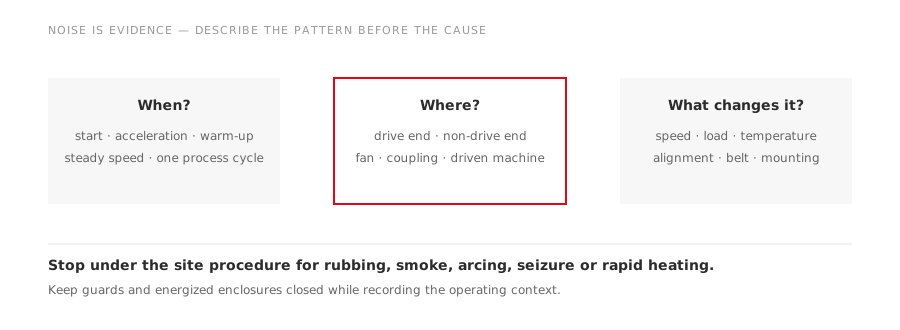
Describe the sound by when, where and what changes it:
- Does it begin at energisation, during acceleration or only after warming up?
- Does its repetition rate follow shaft speed?
- Does it change with load, frequency or crank position?
- Is it strongest at the drive-end bearing, non-drive-end bearing, terminal box, fan cover, coupling or driven machine?
- Did it appear after alignment, bearing, belt, foundation or drive work?
A sound label such as “buzz” or “grind” is subjective. Operating context makes it useful.
What common patterns may indicate
| Sound or behaviour | Possible sources | Checks to add |
|---|---|---|
| Steady electrical hum | Normal magnetic force, voltage unbalance, overload, air-gap eccentricity or structural resonance | Phase voltage and current, load, mounting and vibration spectrum |
| Rubbing or scraping | Fan contact, seal contact, rotor-stator rub, brake drag or foreign material | Isolate, inspect clearances and turn only by an approved safe method |
| Rhythmic click | Fan damage, key or coupling feature, belt defect, looseness or local bearing damage | Compare repetition with shaft and belt speed; inspect the train |
| Growl or roughness | Bearing damage, poor lubrication, gear or process noise | Bearing-point vibration, temperature and lubricant history |
| High-pitched tone | Drive switching, aerodynamic source, resonance or bearing-related high-frequency energy | Compare with drive carrier settings, speed and fan condition |
| Intermittent bang | Severe looseness, contact, brake or driven-machine event | Stop under site procedure and inspect before restart |
None of these rows proves a failure mode. Sound travels through steel, and the motor frame may act as a loudspeaker for a source elsewhere.
Safe first inspection
Keep guards and energized enclosures closed. From a safe position, record:
- motor speed or drive frequency;
- load or process condition;
- current by phase and any active alarm;
- bearing and frame temperatures with the measurement location;
- where the sound is strongest;
- whether it changes through acceleration, load or one process cycle;
- a short recording from a fixed position, if site rules allow.
Then compare the motor, base, coupling or belt guard and driven machine using vibration measurements from repeatable points. A recording alone is not a calibrated noise test, but it can show whether the event is continuous, periodic or transient.
When not to keep testing online
Stop and isolate according to the site’s procedure when the sound is accompanied by:
- smoke, electrical arcing or a burning smell;
- rubbing or impact that could damage rotating parts;
- sudden severe vibration;
- a seized or slowing shaft;
- rapid temperature rise;
- loss of lubrication or visible mechanical displacement;
- unsafe operation of the driven equipment.
These are conservative escalation triggers, not a substitute for the equipment manual or the site’s risk assessment. The precise shutdown criteria and alarm values must be approved by the responsible technical team before this draft is published.
What to send for remote support
Send the motor nameplate, the sound recording, speed, load, phase current and voltage, temperatures, vibration data and a photograph showing the complete drive train. State exactly where the phone or sensor was placed. Include recent work and whether the sound existed at commissioning.
Avoid repeated starts simply to reproduce the noise. Each start adds electrical and thermal stress, and resetting protection can erase the best clue to the original event.