
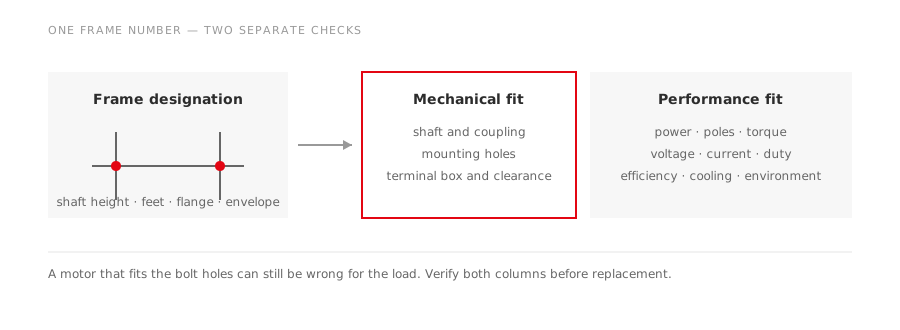
Two motors can both be marked 160M and still have different kilowatt ratings. Two motors can carry the same kilowatt rating and require different frames. Neither case is unusual.
The misunderstanding comes from treating a frame number as though it were a power code. It is mainly a dimensional code.
Direct answer
For common horizontal foot-mounted IEC motors, the frame number is associated with shaft centre height. A 160 frame therefore belongs to the 160 mm centre-height family. S, M and L distinguish frame lengths within that family.
That information helps answer whether the shaft and mounting geometry can fit the machine. It does not uniquely determine output, poles, torque or efficiency.
NEMA frames serve a similar dimensional purpose through a different numbering system. A NEMA frame should not be converted into an IEC frame by matching horsepower alone.
Why one frame carries several outputs
The heat and torque that can be handled inside a frame depend on more than its outside dimensions:
- pole count and rated speed;
- active-material design and temperature rise;
- efficiency class;
- cooling method and enclosure;
- duty cycle and ambient conditions;
- series-specific standard and design margin.
A four-pole and an eight-pole motor in the same centre-height family do not deliver the same output simply because their feet line up. Likewise, a newer high-efficiency design may obtain a different rating from a familiar envelope, while a hazardous-area or brake-motor design may use part of the envelope for features unrelated to output.
This is why product standards publish tables that map frame, pole count and rated output together. The mapping belongs to that series and standard; it is not a universal law for every motor with the same number on the casting.
Mechanical fit and performance fit are separate
| Check | Questions to answer |
|---|---|
| Shaft | Diameter, extension length, key and allowable load |
| Feet or flange | Hole pattern, register, orientation and mounting code |
| Shaft centre | Height relative to the driven machine |
| Envelope | Overall length, fan cover, terminal box and lifting clearance |
| Rating | Output, voltage, frequency, current, speed and duty |
| Torque | Starting, pull-up, breakdown and acceleration requirements |
| Environment | IP rating, cooling, ambient, altitude and hazardous-location approval |
| System | Starter or drive, protection settings, coupling and foundation |
A motor that fits the bolt holes can still fail to start the load. A motor with the right kilowatts can still require base modification or create a coupling-height problem.
Three common replacement mistakes
Reading only the centre-height number
The suffix and mounting form matter. A 160M foot-mounted machine is not mechanically identical to every 160-frame flange or vertical machine.
Assuming equal power means equal torque behaviour
Rated power describes one operating point. Starting torque, current and acceleration time depend on the motor design and the load. This matters for conveyors, compressors, crushers and high-inertia fans.
Converting IEC and NEMA by horsepower
The two systems use different frame dimensions and performance conventions. A transition may be straightforward, but it should be based on drawings and a complete datasheet, not a one-line cross-reference table.
What to send with a replacement enquiry
Send the nameplate, dimensional drawing and photographs of the complete installation. Add:
- shaft and coupling dimensions;
- mounting form and terminal-box position;
- driven equipment and load curve;
- starting method or drive model;
- required acceleration time and starts per hour;
- ambient, altitude, enclosure and cooling requirements;
- any certification or efficiency requirement.
Where the existing motor has been rewound, modified or relabelled, verify its operating speed and measured load rather than assuming the plate still describes the installation.