
Prove the complete motor-load system can start after the specified cold soak. Project teams should be able to reproduce the decision without relying on memory or an email fragment; the oilfield cold-start record must identify this boundary explicitly.
Define what the review must prove — oilfield cold-start
The driven machine defines torque, inertia, speed range, transients and environmental exposure; the oilfield cold-start record must identify this boundary explicitly. Motor selection is more reliable when the process owner supplies the real operating envelope rather than a single shaft-power point; the oilfield cold-start record must identify this boundary explicitly.
Fix the review point in time: proposal, approved design, factory test, installation or operating condition; the oilfield cold-start record must identify this boundary explicitly. A value can be correct in one state and misleading in another; the oilfield cold-start record must identify this boundary explicitly.
The evidence chain — oilfield cold-start
| Step | Review point | What to confirm |
|---|---|---|
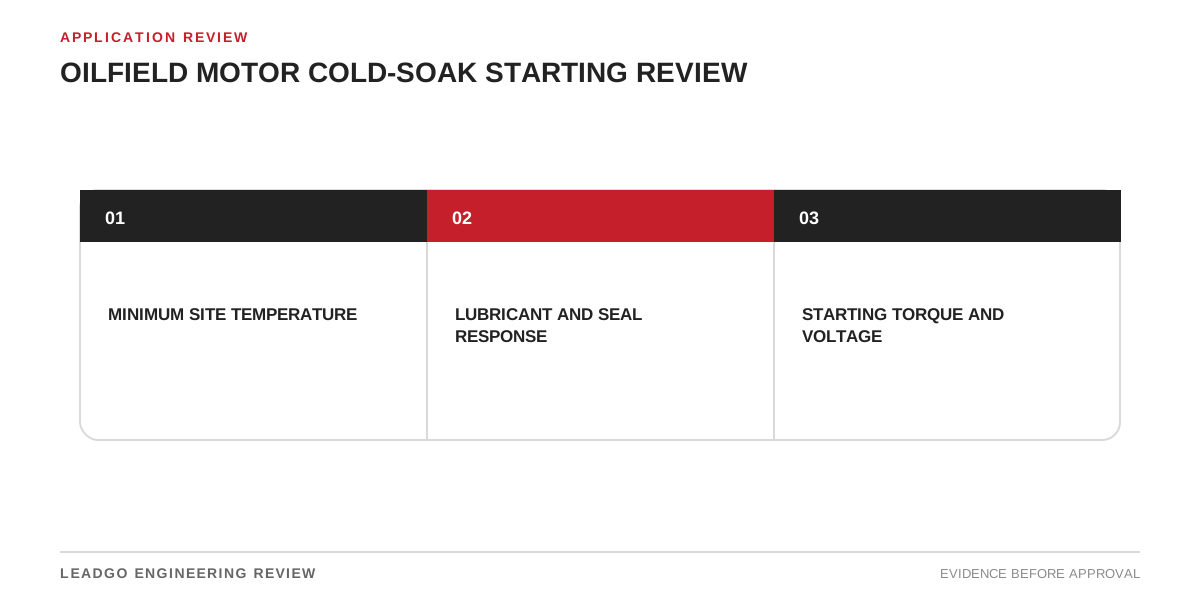
| 1 | Minimum site temperature | Confirm minimum site temperature under the stated operating condition rather than a nominal assumption. |
| 2 | Lubricant and seal response | Record lubricant and seal response with its source, revision and responsible reviewer. |
| 3 | Starting torque and voltage | Define starting torque and voltage and identify the controlled document or measurement that supports it. |
Compare the inputs on one common basis. Mixing a rated value, a temporary site reading and a worst-case calculation can produce a neat answer that does not describe a real condition; the oilfield cold-start record must identify this boundary explicitly.
What a checklist can miss — oilfield cold-start
- Borrowing an unverified input. Using minimum site temperature from a similar motor or site. Small differences in supply, mounting, load or environment can change the result; the oilfield cold-start record must identify this boundary explicitly.
- Treating an interface as a late detail. Closing the review before starting torque and voltage is documented. Approval should show the open action instead of burying it in a general note; the oilfield cold-start record must identify this boundary explicitly.
Where the evidence is incomplete, define what must be supplied and who owns it; the oilfield cold-start record must identify this boundary explicitly. The review can remain provisional without pretending the boundary is settled.
What belongs in the closeout record — oilfield cold-start
Keep these items with the approval or maintenance record:
- source and operating condition for minimum site temperature
- dated evidence for lubricant and seal response
- approved limit or disposition for starting torque and voltage
Keep the evidence with the equipment identity and operating case. A standalone screenshot or number is difficult to audit once the project team and site condition change; the oilfield cold-start record must identify this boundary explicitly.
Decision rule — oilfield cold-start
Prove the complete motor-load system can start after the specified cold soak. The decision is complete when the stated inputs refer to the same equipment, revision and operating case; the oilfield cold-start record must identify this boundary explicitly. Otherwise record the gap and its owner.
Going deeper — oilfield cold-start
Cold-start torque-margin worksheet — oilfield cold-start
Build one worksheet for each credible restart. Coldest air is not automatically coldest lubricant; soak duration and prior operation matter.
| Input | Required source | Why it controls the decision |
|---|---|---|
| Minimum ambient and soak duration | Site design basis | Establishes component temperature before start |
| Motor torque-current curve | Offered motor data | Defines available torque as voltage changes |
| Terminal voltage during start | Power-system study | Low voltage reduces acceleration capability |
| Load torque versus speed and temperature | Equipment supplier | Captures lubricant, seals and process load |
| Combined referred inertia | Mechanical calculation | Determines acceleration from torque margin |
| Starts and thermal state | Operating narrative and motor limits | Determines restart capability |
At each speed segment, compare motor torque at predicted terminal voltage with cold load torque. The difference is accelerating torque. Positive margin at one point is insufficient; review breakaway, pull-up and the full range. Calculate acceleration and verify motor thermal and protection limits.
Separate four cold effects — oilfield cold-start
First, motor resistance and performance change with temperature, while bus voltage may be weakest during remote winter operation. Use offered-motor and actual-supply data.
Second, gearbox and bearing lubricant viscosity rises at low temperature. Obtain viscosity grade, minimum start temperature, heater/circulation requirements and expected torque. Do not substitute ambient for oil temperature without a thermal basis.
Third, seals, belts, stuffing boxes and process fluid add breakaway load. For a pumpjack, include gearbox, counterbalance and polished-rod load across the cycle. For pumps, define viscosity, static head and valve state.
Fourth, ice, condensation or frozen product can create abnormal restriction. These are not normal torque allowances. Procedures should detect and clear them rather than relying on oversizing.
Decision steps — oilfield cold-start
- Define minimum ambient, soak time and energised heaters.
- Obtain temperature-dependent load and lubricant requirements.
- Confirm terminal voltage during the worst permitted start.
- Compare torque-speed curves and calculate acceleration.
- Check protection, feeder drop, permissible starts and failed-start lockout.
- Define preheat, unloading, valve position or required sequence.
- Validate at a safe representative cold condition and retain traces.
Applicability and limits — oilfield cold-start
This suits outdoor oilfield motors driving pumpjacks, pumps, compressors and auxiliaries after extended low-temperature shutdown. It does not give a universal minimum temperature or lubricant. Suppliers must confirm materials, lubrication, seals, heaters, enclosure and instruments for the project range.
Mild-temperature testing cannot prove the cold-soak case. A conservative calculation may be accepted where physical testing is impractical if inputs and margins are controlled. Hazardous-area heaters and controls must remain within certification and site rules.
Common errors — oilfield cold-start
- Using rated torque instead of the complete curve.
- Applying room-temperature load torque to winter restart.
- Ignoring bus dip and long-feeder voltage drop.
- Assuming a larger motor solves the issue without system-current and mechanical checks.
- Leaving gearbox or space heaters out of the sequence.
- Repeatedly attempting a stalled start without thermal limits.
Data to request — oilfield cold-start
Ask the motor supplier for low-temperature suitability, starting curves, permissible starts, thermal protection, grease/bearings, heaters and VFD constraints. Ask the equipment supplier for cold breakaway/running torque, inertia, lubricant/heater requirements, unloading sequence and prohibited conditions. Ask the electrical designer for minimum bus voltage, feeder drop, protection curves and restart philosophy.
Acceptance workflow — oilfield cold-start
Before winter, verify heaters, sensors, lubricant, rotation freedom, settings and sequence. During a representative start, trend terminal voltage, current, speed or cycle response, start time and temperatures. Agree stop criteria beforehand.
The record must identify soak and load state; “started successfully” is inadequate. If measured behaviour differs from the study, reconcile torque, voltage and temperature inputs before changing protection or adding boost. The goal is a repeatable cold restart with documented margin, not one fortunate start.
RFQ cold-condition schedule — oilfield cold-start
Issue a separate schedule instead of hiding cold requirements in a general ambient line. State minimum ambient, required soak duration, wind or enclosure assumptions where relevant, available auxiliary power, heater control, lubricant state, process load, feeder voltage case and permitted pre-start actions. Ask each supplier to return exceptions beside the affected row.
Require the motor and driven-equipment suppliers to identify the lowest permitted start temperature with and without preheat. Ask how long preheat must operate, how readiness is confirmed, and what alarm prevents starting outside the approved condition. The control-system supplier should translate those conditions into permissives that operators can understand.
If production requires restart after loss of auxiliary heater power, analyse that case explicitly. It may govern motor torque, generator size, recovery time or the need for an unloaded start. Do not let an undefined emergency case become the first real cold test.