
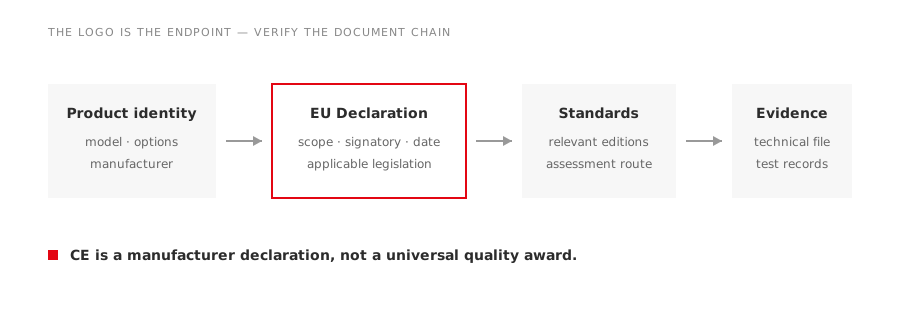
A CE logo on a nameplate is easy to photograph. The harder question is whether the legal documentation, model scope and supplied configuration all point to the same product.
Direct answer
CE marking means the manufacturer declares that the product complies with the EU requirements applicable to it. It is not a general award for quality, not a single certificate issued by Brussels, and not proof that one laboratory tested every unit.
For an electric motor, the buyer should verify:
- exact manufacturer and product identity;
- EU Declaration of Conformity;
- legislation listed on that declaration;
- standards used to support conformity;
- model and option scope;
- installation instructions and intended conditions.
Misconception 1: “CE approved” means government approved
There is no central EU office that pre-approves every CE-marked product. The manufacturer identifies the applicable legislation, performs the required conformity-assessment procedure, prepares technical documentation, issues the declaration and applies the marking.
Some product regimes require involvement of a notified body; others permit manufacturer assessment. The route depends on the applicable legislation and product. A buyer should therefore ask what legal requirements apply rather than accept “CE approved” as a complete answer.
Misconception 2: a generic CE certificate is enough
The document buyers normally need is the EU Declaration of Conformity. It should identify the manufacturer, product or series, applicable legislation, relevant standards or specifications, authorised signatory and issue details.
| Check | Warning sign |
|---|---|
| Manufacturer identity matches quotation/nameplate | Trading name appears with no legal relationship explained |
| Product scope includes supplied model | Declaration names only a broad category |
| Applicable legislation is listed | Document lists standards but no legislation |
| Standards are relevant and editions are plausible | Decorative list copied across unrelated products |
| Signatory and date are present | Unsigned template or editable marketing sheet |
A test report, voluntary certificate or laboratory letter can be useful supporting evidence. It does not automatically replace the manufacturer’s declaration.
Misconception 3: motor CE covers the finished machine
A motor is often incorporated into a pump, fan, compressor, conveyor or production line. The motor manufacturer assesses the motor within its declared scope and intended use. The machine builder remains responsible for the conformity of the completed machinery or assembly under the legislation that applies to that product.
Mounting a CE-marked motor does not settle guarding, control-system safety, emergency stop, mechanical hazards, noise, installation EMC or the interaction of the drive and machine.
Likewise, modifying a motor, adding an unassessed brake or encoder, changing cooling, or operating far outside the declared supply and duty can move the product beyond the original assessment.
Which requirements may be relevant?
The answer depends on the product configuration and how it is placed on the market. Electrical safety, electromagnetic compatibility, hazardous-area equipment, ecodesign and restrictions on substances can enter the assessment in different cases.
Do not build a purchase specification from a fixed internet checklist. Ask the manufacturer to identify the legislation applicable to the supplied configuration and explain exclusions. A motor intended as hazardous-area equipment, for example, follows additional requirements beyond an ordinary industrial motor.
Harmonised standards support the assessment
Standards provide recognised technical methods for meeting requirements, but the legal responsibility remains with the manufacturer. The declaration should use standards that fit the actual product and assessment.
For buyers, edition dates matter. A declaration issued years ago may still relate to a product, but the manufacturer should be able to explain its continued validity, product changes and the current legislative basis.
Model scope deserves the same attention as an Ex certificate
One declaration can cover a defined family, but “all motors” is not a meaningful scope without supporting identification. Options such as brakes, encoders, separate fans, heaters, VFD duty or special voltages can affect the assessment and documentation.
Compare:
- series and model code;
- rated voltage and frequency;
- frame and output range;
- options and accessories;
- manufacturer and production site where relevant;
- intended environment and installation limitations.
The logic resembles checking whether an Ex certificate covers a model: the mark is only the visible endpoint of a defined scope.
A buyer verification sequence
- Take the exact model and configuration from the quotation.
- Obtain the Declaration of Conformity before shipment.
- Match manufacturer, series and options.
- Review the listed legislation and standards.
- Check signing authority, date and document control.
- Request supporting evidence for high-risk or project-specific claims.
- Confirm installation instructions and integration responsibilities.
- Retain the accepted document set with the purchase record.
If the supplier sends only a logo image or a one-page “CE certificate” that does not identify the supplied product, verification is not complete.