
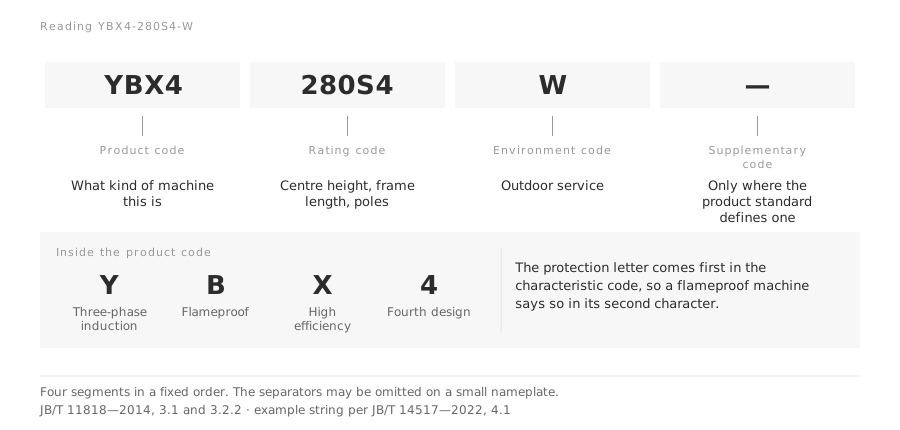
A buyer holding a Chinese motor nameplate is usually trying to answer one of two questions: is this the machine I ordered, and is it allowed where I intend to put it. The model string answers part of both — if you know which segment carries what.
Direct answer
A model number is built from four parts, in this order:
| Segment | What it carries | Example |
|---|---|---|
| Product code | What kind of machine this is | YBX4 |
| Rating code | How big, and how fast | 280S4 |
| Special-environment code | What conditions it is built for | W |
| Supplementary code | Anything the product standard adds | — |
The order is fixed. So the first thing to do with an unfamiliar string is find the boundary between letters-that-classify and digits-that-size — everything before the first size digit is the product code.
The product code, and the one position worth memorising
The product code is itself four sub-parts: a machine-type letter, a characteristic code, a design sequence number, and — on synchronous machines — an excitation code.
The characteristic code is where the useful information lives, and it carries one rule that is worth knowing before you go looking for the Ex plate:
For explosion-protected machines, the letter representing the type of protection is placed at the front of the characteristic code, immediately after the machine-type letter.
The letters are A for increased safety, B for flameproof, ZY for pressurized, and W for non-sparking. A model beginning YB is therefore declaring a flameproof machine in its second character.
That is a fast read, and it is a claim rather than a proof. What the model asserts and what the certificate covers are different documents — see checking an Ex certificate for why certification is per model and per rating rather than per family.
Working through a real one, YBX4:
- Y — three-phase induction motor
- B — flameproof
- X — high efficiency
- 4 — fourth design revision
The design sequence number has a convention attached that is easy to misread as marketing: a first design carries no sequence number at all, and derived products are numbered against the base series. So the step from YBX3 to YBX4 is a design generation recorded in the model, not a trim level.
The rating code changes shape with machine size
This is the segment most often mis-parsed, because it is not one format.
| Machine | Rating code runs |
|---|---|
| Small induction motor | centre height · frame length · core length · poles |
| Medium and large induction motor | centre height · core length · poles |
Frame length uses the international letters — S short, M medium, L long. Core length is numbered 1, 2, 3 from shortest. Where a flange is coded, the flange designation carries the bolt-circle diameter with it, and a distinct letter pair marks whether the flange has clearance holes or tapped holes.
So in 280S4: centre height 280 mm, short frame, 4 poles. Note what is not in there — no power rating. Power follows from the frame and pole count through the product standard’s own table, which is why two suppliers quoting the same frame can be quoting different kilowatts, and why a nameplate power figure deserves checking on its own terms.
The environment segment is the one you cannot decode from a general table
The coding standard lists environment codes for altitude, marine, outdoor, chemical-corrosion, tropical, damp-heat and dry-heat service, and sets one rule for combining them: where more than one applies, they are written in the order the standard’s table gives them, not in the order you think of them.
But the letters themselves are not universal, and this is the trap. The coding standard’s own worked example uses W for outdoor and F for chemical-corrosion service. A current flameproof product standard, covering the YBX4 series, defines the same segment as: omitted when nothing is required, W outdoor, F1 moderate corrosion protection, F2 severe — a graded pair where the general table has a single letter. Both are correct within their own document.
The practical consequence:
Decode the environment segment against the product standard for that series, not against a general table.
If you cannot obtain the product standard, ask the supplier which document defines the suffix. A supplier who can name it is telling you something useful, and one who cannot is telling you something too.
Two things about the string itself
The separators are optional. The standard permits the hyphens between segments to be dropped where the nameplate is small and the model long, provided the characters cannot be confused. YBX4-280S-4 and YBX4280S4 can be the same machine. When a model “does not exist” in a supplier’s catalogue or fails to match a certificate, try it both ways before escalating.
The model is supposed to be registered. The coding standard requires that a model designation be applied for before it is used. That is a procedural requirement rather than a quality one, but it gives a purchase specification something concrete to ask for: not “is this a real model” but “which document defines this designation, and when was it registered”.
What to ask for
- The product standard for the series, by number and year — it defines the rating table and the environment suffixes for that family.
- The full model string as it appears on the nameplate, including any supplementary code, written with separators.
- The Ex certificate, where the second letter claims protection — and check the model and rating on it, not the family.
- The rated output for the quoted frame and pole count, in writing, since the model does not carry it.
- Which environment suffixes are available for that series, and what each one changes physically.
LEADGO’s explosion-protected and high-efficiency series carry model designations built to this coding standard — the company is listed among its participating drafting organisations — so the segments above parse directly against our hazardous-area range. The useful request is the product standard and the certificate together: the model tells you what a machine claims to be, and those two documents are what stand behind the claim.
Going deeper
- Checking an Ex certificate — what the second letter of the model needs backing it, and the suffix that changes what you may do with the machine
- Type test versus routine test — the two reports that sit behind a series and behind a unit
- How to check a nameplate power rating — because the model number deliberately does not carry one
- Why buyers don’t trust Chinese motor manufacturers — the wider verification problem this sits inside