
Ask a supplier why one motor costs more than another and you tend to get an answer about quality or an answer about market conditions. You cannot check either one. The better question is what goes into the machine, because the blocks are few, they are known, and they behave differently from one another.
Direct Answer
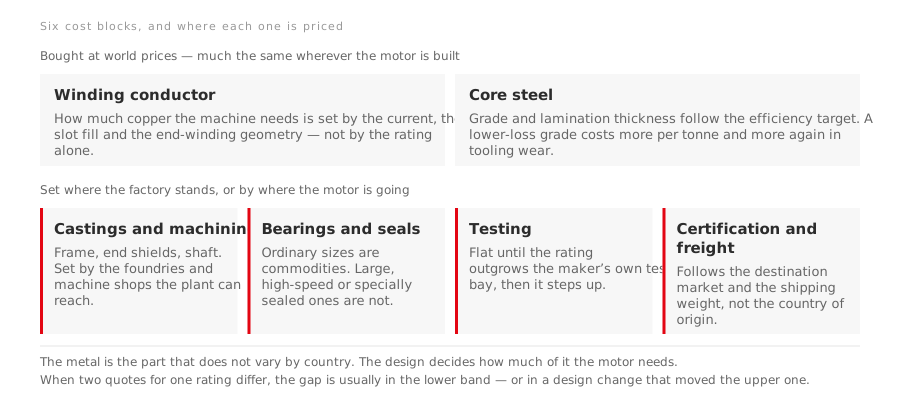
An industrial motor breaks into six cost blocks: the winding conductor, the core steel, the castings and the machining done to them, the bearings and seals, the testing, and certification together with freight. You buy the first two at world prices, so they cost much the same whoever builds the motor; what changes is how much of them the design needs. The other four are set locally: by the foundries and machine shops the plant can reach, by the size of test bay it owns, and by which market’s certificates the motor has to carry. Local does not mean cheap where wages are low, and the section below sets out why. If two quotes for the same rating differ, look in the last four blocks first, then at whatever design decision moved the first two.
What is in the price
Start with the machine rather than the invoice. A motor is copper wound into slots cut in a stack of thin steel sheets, held in a cast housing, carried on bearings, closed up, tested, certified and shipped. Every number on the quotation traces back to one of those, and nothing else is in there.
The blocks do not scale together, which is what makes the picture confusing. Doubling the output doubles none of them. Core steel and conductor grow with the active volume of the machine. Testing hardly moves until the rating outgrows the test bay, and then it steps. Certification ignores the rating altogether and grows with the number of markets the motor enters.
Key factors
| Block | What sets its size | Priced where |
|---|---|---|
| Winding conductor | Current, slot fill, and the end-winding geometry | World market |
| Core steel | Efficiency target, pole count, lamination thickness and grade | World market |
| Castings and machining | Frame size, mounting type, tolerance class | Locally |
| Bearings and seals | Speed, load, whether the shaft is sealed against dust or wash-down | Mixed |
| Testing | What the routine test covers, and whether the rating fits the test bay | Locally |
| Certification and freight | Destination market, protection type, shipping weight | By destination |
Technical explanation
How much copper, and where it sits
You buy copper on the metal exchanges, so the raw material costs roughly the same in any plant. The design decides how much of it ends up in the machine, and that is not a simple function of power. Pyrhönen and colleagues put it plainly: the way the coil connections are arranged “has a significant influence on the space requirements for the end windings, the amount of copper and the production costs of the winding”. End windings are the loops that carry current from one slot to the next, outside the magnetic circuit, and they do no useful work. A design that handles them badly buys copper twice, once as metal and once as the labour to place it.
Aluminium is the obvious substitution, so do the arithmetic instead of assuming it. At 20 °C copper conducts at 57 MS/m and aluminium at 37 MS/m, which means carrying the same current at the same resistance takes about one and a half times the cross-section. That section has to go somewhere: a deeper slot, a larger bore, or a longer stack. You get a cheaper metal inside a bigger machine, and which way the total moves depends on the frame rather than on the price of the metal.
An efficiency class is bought in the core steel
Electrical steel is not one product. Gieras and Shen note that the most universally accepted grading is by core losses, under the AISI system. The efficiency classes a buyer specifies are, at the factory end, largely a decision about which grade goes into the press. A lower-loss grade costs more per tonne, and it costs more again in the press shop: silicon is what suppresses eddy currents, and silicon “increases hardness of laminations and, as a consequence, shortens the life of stamping tooling”.
Thickness works the same way. Thinner sheets cut eddy-current losses and cost more to handle, and for 50 Hz machines the settled compromise, weighing losses and magnetising current against ease of stamping, is 0.5 to 0.6 mm.
Two plants can buy the identical grade and get different core losses out of it. Stamping work-hardens the material, and the loss calculation has to account for that hardening as well as for the steel. The condition of the tooling is part of the magnetic result, not only part of the factory’s overhead.
Why testing steps instead of scaling
A test is not free, and the cost that matters is the bay it runs in. ANSI/NEMA MG 1 says the tests it specifies “are type tests” and “shall be carried out on standard products or models of them”. The maker proves a design once, then gives each individual machine a shorter routine test. The split between type tests and routine tests is why the cost does not track the number of units. It tracks whether the maker owns equipment that can load the upper end of its own range.
Ask about this block. It explains more odd quotes than any of the others: a rating near the upper end of what a plant can load carries a test bay that sees little other use, and a rating in the middle of the range does not.
Where the supplier’s location matters
Most buyers assume the metal is where geography shows up. It works the other way round. Copper and electrical steel come off world markets and arrive at similar prices everywhere, and what a local market sets is the fabrication premium on top of them rather than the metal itself.
Geography shows up in the four blocks you cannot ship in ahead of time:
- Castings and machining. A plant inside a foundry and machine-shop cluster buys housings and end shields on different terms from one that trucks them across a country. That is a cluster effect rather than a labour-rate effect, and it does not follow national borders.
- Bearings. Ordinary sizes are commodity items. Large, high-speed or specially sealed ones are not, and their lead time can matter more than their price.
- Testing. Whether the rating sits inside the maker’s own bay, as above.
- Certification and freight. Both follow the destination. One machine sold into three regimes needs three sets of documents, and that cost sits with the market rather than the origin. If the site is a classified area, what the certificate has to say is fixed by the destination too. Freight follows weight, which the core steel and casting blocks already decided.
The low-wage location is often not the cheap one
Wages are the number buyers reach for first, and on their own they predict very little. Factories have moved motor production out of mainland China to places where the wage rate is a fraction of what they were paying, and have landed at a higher cost per machine than they started with. The wage line fell and the total went up.
Four things sit between a wage rate and the cost of a finished motor, and all four price the local blocks above rather than appearing anywhere on a quotation.
Labour is a rate, and what you buy is output. A line that takes longer per unit, or that scraps and reworks more of what it makes, turns a low rate into a high cost per motor. Winding, impregnation and final assembly are where this shows most, because they are the operations that still depend on the hands doing them.
How the plant is run. Throughput, work in progress, how long material sits between operations, how fast the plant turns its assets. Two plants with the same machines and the same wage rate produce at different costs when one holds three weeks of work in progress and the other holds three days. Nothing here is visible to a buyer, and it sets a large part of what the quotation can be.
What is outside the gate. Roads, port capacity and turnaround, customs handling, power reliability, and the systems that carry an order from enquiry through to shipping documents. A plant that cannot book a container when it planned to has to hold more stock to keep its promises, and that stock is a cost. This is where the cluster effect from the castings block reappears: a supplier base within a day’s drive is an infrastructure question as much as a sourcing one.
How deep the workforce is. Not a question of national character, but of how many people within reach have done this particular job before and for how long. A mature cluster has winders, balancers and test technicians with years on the same operation, and supervisors who trained on that line. A new plant in a new location buys the same machines and inherits a much shallower bench, and the gap surfaces as yield, as rework, and as how long a problem runs before someone notices it.
That last one is also the honest answer to why a relocation can raise costs while cutting wages. The machines move in a few months. The bench takes years, and until it is there the plant pays for its absence in scrap, in rework and in the stock it has to hold to cover its own variability.
Common mistakes
Reading price per kilogram as value. A heavier motor of the same rating usually has more active material, which often means lower losses. It can equally mean a conservative design reaching the same class on a cheaper steel grade. Weight alone does not tell you which; the loss figures do.
Assuming the cheapest conductor makes the cheapest motor. The saving migrates into the slot, the frame and the freight, as above.
Reading a wage rate as a cost. It is a rate. What it buys is hours, and what you are paying for is finished motors that pass their tests. The conversion between the two is the plant’s, and it varies more between plants than wages vary between countries.
Treating certification as a supplier attribute. It is a market attribute. A supplier holding a certificate you do not need has added nothing to your order, and one lacking a certificate you do need cannot be discounted into compliance.
Comparing quotes that are not the same machine. Same rating, same mounting and same protection class still leaves the efficiency class, the insulation system, the bearing arrangement and the test scope free to differ. Fixing those before you compare is the whole job, and it is the same discipline as checking a nameplate rating against the frame it sits in.
Selection considerations
Four questions get you further than a price negotiation:
- Which efficiency class, tested to which standard? This sets the core steel and much of the conductor.
- Is this rating in the middle of the maker’s range or at the upper end of it? The answer sits in the test block.
- Which certificates does the destination site require, and which does the quote include? Those are two different lists.
- What is the shipping weight? It tells you more about the design than the datasheet usually admits, and it is the freight block.
- What is the first-pass yield on this line, and how long has it been running? This is the plant question, and it is the one a wage rate cannot answer.
LEADGO Recommendation
Ask for the loss figures rather than the efficiency percentage, and ask what the routine test covers. A maker either has both on file or does not, and the answer says more about how a motor was built than any discussion of price. The energy savings calculator works the operating side of the same question, and the selection tool narrows the series before any of this turns into a quotation.