
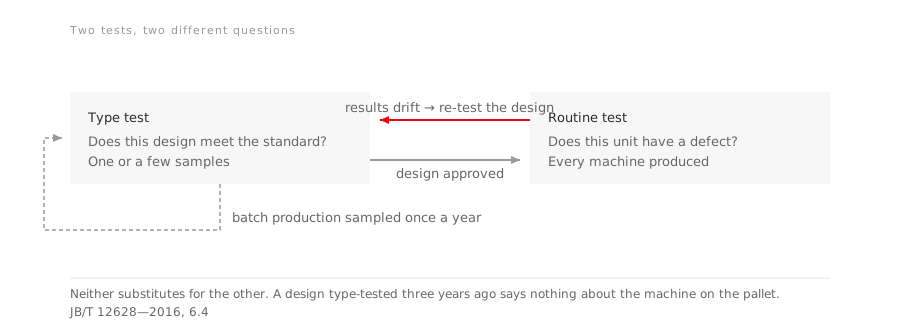
Ask a supplier for “the test report” and you will get whichever one they happen to have. The two documents answer different questions, and the gap between them is where most specification arguments start.
Direct answer
| Type test | Routine test | |
|---|---|---|
| Question it answers | Does this design meet the standard? | Does this unit have a manufacturing defect? |
| Run on | One or a few samples | Every machine produced |
| Includes | Temperature rise, efficiency, locked-rotor characteristics, overspeed, damp heat, noise, full vibration | Resistance, dielectric, no-load, mechanical checks |
| Repeated | On defined triggers, including annually on production series | Continuously, by definition |
Neither substitutes for the other. A design that passed a type test three years ago tells you nothing about the machine on the pallet; a routine test on that machine tells you nothing about whether the design ever met its efficiency or temperature-rise figures.
When the type test has to happen again
This is the more useful half of the type-test question, and the product standards answer it directly. A type test is required when any of these occurs:
- First trial production or small-batch production after the design has been appraised.
- A design or process change sufficient to alter some characteristic or parameter.
- Routine test results deviating impermissibly from the results of the previous type test.
- Periodic sampling of batch production — once a year.
Item four is the one to put in an enquiry: when was this series last type-tested, and may we see that report? A supplier who can answer it immediately is running the system the standard describes. One who cannot is telling you something useful too.
Item three is worth noticing as well, because it describes a feedback loop that most buyers assume does not exist: routine results drifting away from the type test is itself a trigger to re-test the design.
Where the two tests visibly differ
Abstract definitions are easy to nod at. These are the concrete differences in one product standard, and they show what “same test, different purpose” actually means.
Vibration. During routine testing, only vibration velocity is measured. In the type test, all three quantities — displacement, velocity and acceleration — are measured. And there is a mounting condition attached: if routine testing was carried out in free suspension, the type test must include the rigid-mounting condition.
Dielectric withstand. The test is one minute. But for motors in continuous mass production on a conveyor line, the routine test time may be shortened to one second. Same voltage, same purpose, a duration chosen for throughput.
Insulation resistance. Routine testing may measure the cold value, on the condition that the hot value would still comply with the standard’s limit. A cold reading is a proxy that the standard explicitly permits — and explicitly conditions.
Damp heat. This one is type-test only, and it is instructive about what type tests are for. Six cycles at 40 °C alternating damp heat (twelve cycles for underground coal-mine machines), after which the sample must still meet a raised insulation resistance limit, must withstand a dielectric test at reduced voltage — and, on a flameproof machine, its flameproof joints must not have corroded.
That last clause is the tell. The damp-heat test is asking whether the design survives a climate over time. It is not, and was never, a field acceptance value — a point worth holding onto, because borrowing a type-test figure into a maintenance procedure is a common and permissive error. We set out the correct field criteria in why oilfield motors run hot.
The explosion-protection layer sits outside both
For a flameproof or increased-safety machine there is a third activity, and it is neither of the above: a review of drawings and documents together with explosion-protection performance testing. The product standards list when it is required:
- The product does not yet hold an Ex certificate.
- A certified product has been locally modified in a way that touches explosion-protection requirements — in which case the changed drawings, documents and instructions go back to the original inspection body.
- The inspection body needs to re-examine a product that already holds a certificate.
- The certificate has expired.
So on a hazardous-area machine there are three documents in play, not two, and they expire on different clocks. See how to verify an explosion-proof motor certificate for what the certificate itself should carry.
What this means for a purchase specification
Three lines, and none of them asks for anything a compliant manufacturer does not already have:
- “Supply the routine test record for the serial numbers shipped.”
- “Supply the type test report for this design, and state its date.”
- “Where the machine is explosion-protected, supply the Ex certificate and confirm its validity period.”
The reason to name all three is not suspicion. It is that they are produced by different processes, kept by different people, and expire on different schedules — so “send us the test report” reliably produces whichever one is nearest to hand.
And when the reports arrive, the comparison worth making is between the type test figures and the machine’s published data. That is the check nobody runs, and it is the one that would catch a datasheet that has drifted away from the design it describes.
What to ask for
- Routine test record, by serial number, for the units being shipped.
- Type test report, with its date, and the trigger under which it was run.
- When the series was last sampled — the annual requirement above.
- For Ex machines, the certificate, its validity, and whether anything has been locally modified since it was issued.
- The test method standard each report was run to, so the numbers are comparable with someone else’s.
LEADGO’s product series are built and tested to the JB/T product standards cited throughout this article, and both report types exist per series and per unit — ask for them by name rather than as “the test report”, and the right documents come back the first time.
Going deeper
- How to verify an explosion-proof motor certificate — the third document, and the X suffix that changes what you may do with the machine
- Why oilfield motors run hot — where the field insulation criteria live, and why the damp-heat figure is not one of them
- GB 18613 and IE classes — efficiency as a declared value with a tolerance, which is a type-test question