
Almost every supplier of hazardous-area motors can send you a certificate. The question that decides whether it protects you is narrower: does it cover the model and rating on your order, and does it match the area classification of the place the motor will stand?
Direct answer
Five checks, in this order. Four of them can be done from documents; the first one is done on somebody else’s website.
- Verify the certificate number exists, with the issuing body, independently of the supplier.
- Check the scope — the model designation and rating range the certificate actually covers.
- Check the marking against your classification — group, protection type, temperature class and equipment protection level.
- Check for an X suffix, and if there is one, read the special conditions of use.
- Check the instructions carry what the standard requires them to carry.
What the marking has to tell you
GB/T 3836.1—2021 (the general requirements standard, equivalent to IEC 60079-0) sets out in clause 29.3 what the marking on Ex equipment must include:
| Required item | |
|---|---|
| a) | Manufacturer’s name or registered trademark |
| b) | The manufacturer’s type designation for the product |
| c) | Serial number — with defined exceptions for cable glands, blanking elements, thread adapters and bushings, and for very small equipment with limited surface area, where a batch number may be used instead |
| d) | Name or mark of the certification body that issued the Ex certificate, and the certificate number |
| e) | The symbol X appended to the certificate number, where the certification body has stated special conditions of use |
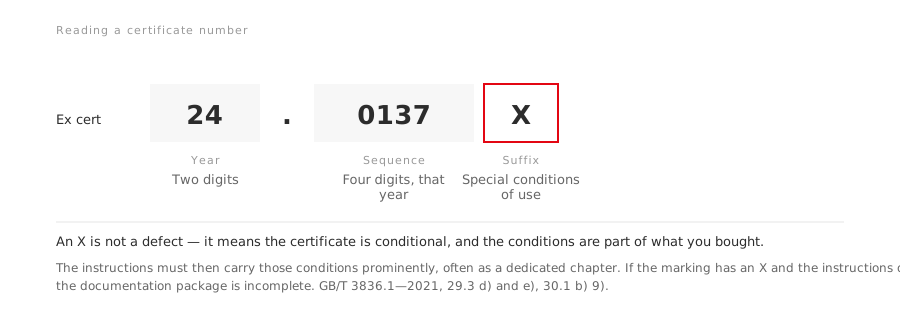
Item d) has a defined format worth recognising: a two-digit year, then a four-digit sequential number for that year, separated by a full stop. A number that does not have this shape is not necessarily wrong — different schemes use different conventions — but it is a reason to ask which scheme you are looking at before you go looking it up.
Clause 29.2 adds something easy to overlook on site: the marking must be in a conspicuous place on the main external part of the equipment, and must be easy to see before the equipment is installed. If it can only be read after installation, that is a finding, not a detail.
The X suffix is the item most often skipped
When a certification body needs to state special conditions of use, the certificate number carries an X. A warning marking on the equipment may be used in place of the symbol.
An X is not a black mark. A great deal of ordinary, correctly certified equipment carries one. What it means is that the certificate is conditional, and the conditions are part of what you bought. Common examples involve ambient temperature limits, specific cable entry requirements, or restrictions on cleaning to avoid electrostatic charge.
The standard is also specific about where those conditions have to appear. Clause 30.1 b) 9) requires that the special conditions of use be given in the instructions, and that the information should not be hidden within the text — it should be placed prominently, often as a dedicated chapter.
So there is a practical document check here: if the marking has an X and the instructions have no visible section covering the conditions, the documentation package is incomplete. That is worth raising before shipment, not after.
What the manufacturer is actually asserting
Clause 28.3 puts the marking in its proper place. By applying the marking required by clause 29, the manufacturer certifies that:
- the equipment has been manufactured in accordance with the relevant safety standards; and
- the product has passed all the routine inspections and tests required by 28.1, and conforms to the documentation.
That is a statement about this unit, not only about the design. It is the reason routine test records and the type test file answer different questions — and the reason a purchase specification should ask for both.
The standards list, and where it is allowed to live
Clause 30.1 f) requires the instructions to name the standards the equipment complies with, including their publication dates. There is an explicit alternative: if the Ex certificate itself states the standards and their publication dates, the separate list is not required — and that holds even when the certificate is not part of the instructions.
This is useful in a document review. You are not entitled to the list in a particular place; you are entitled to it somewhere. If neither the instructions nor the certificate names dated standards, ask which edition the assessment was made against. Standards get revised, and an assessment against a superseded edition is a fact worth knowing before it becomes an audit finding.
If the motor will run on a drive
Clause 30.3 adds requirements for motors specifically. Where applicable, the instructions must include a speed/torque curve for inverter-fed machines. For increased-safety motors that were type-tested together with an inverter, the instructions must also state the inverter parameters used in that test — rated motor current, weighted total harmonic distortion or pulse frequency, and DC-link voltage — expressly so that a similar inverter can be selected.
That paragraph is the answer to a question buyers ask constantly and usually get a marketing answer to: can I run this explosion-proof motor on a VFD? The documentation is supposed to tell you which drives the certification covers. If it does not, the honest answer is that nobody has established it yet.
Putting it into a purchase specification
Three lines are enough to change what arrives:
- “Supply the Ex certificate covering the specific model and rating ordered, not a family-level statement.”
- “Where the certificate number carries an X, supply the special conditions of use as a marked section of the instructions.”
- “Where the motor is to be inverter-fed, supply the speed/torque curve and the type-test inverter parameters.”
None of these asks a supplier for anything the standard does not already require them to have. What they do is move the check to before shipment, where it is a document request, rather than to commissioning, where it is a delay.
LEADGO supplies certificates per model and rating for its hazardous-area range rather than a family-level statement — send the classification and the rating, and ask for the certificate covering that specific machine.
Going deeper
- Hazardous area classification: who does it and who carries the risk — the drawing you need before any of the checks above mean anything
- Explosion-proof motor selection: how to read the marking — the five independent decisions inside
Ex db IIB T4 Gb - ATEX vs IECEx vs NEC: which certification do you need — how the three paperwork systems compare