
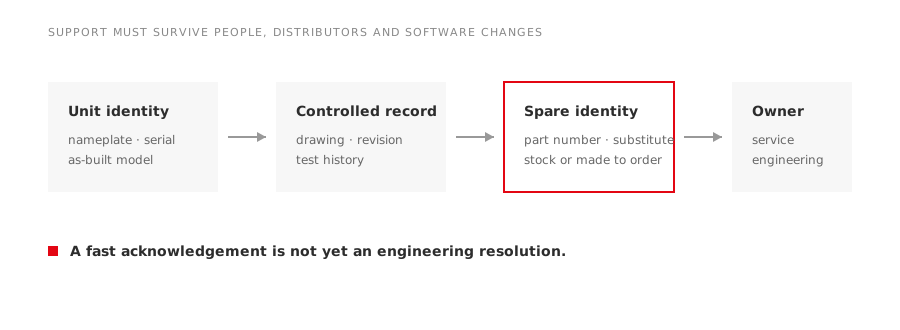
A motor can remain in service longer than the salesperson, distributor or software system used to place the order. Support continuity therefore has to live in records and responsibilities, not in one person’s inbox.
Direct answer
Before ordering, ask the supplier to show how a future technician will identify the motor, find the correct drawing, obtain a compatible part and reach someone able to make an engineering decision.
Four areas reveal most continuity risks:
- configuration and serial traceability;
- spare-part identification and substitution rules;
- retained drawings and test records;
- service ownership and escalation.
Ask for parts by identity, not description
“Bearing,” “fan” and “seal” are not sufficient spare-part descriptions. A useful list states whether the item is standard or model-specific and records the information needed to replace it correctly.
| Item | Questions to resolve before purchase |
|---|---|
| Bearings | Full designation, clearance, insulation, approved alternatives and lubrication basis |
| Fan and fan cover | Material, direction, dimensions and compatibility by frame and pole count |
| Seals | Construction, material, shaft contact and environmental limits |
| Terminal components | Voltage/current basis, link arrangement and hardware specification |
| Brake parts | Coil voltage, rectifier, friction disc and permitted working air gap |
| Sensors | Type, wiring, calibration or replacement designation |
For a critical motor, classify each part as locally available, supplier-stocked, made to order or dependent on an external brand. A long lead time is manageable when it is visible early.
Test whether the documentation can survive change
Request a sample document pack before award. It should make the following chain possible:
nameplate or serial number → as-built configuration → drawing revision → test record → spare-part identity
Check whether a replacement drawing carries a revision and approval date. Ask how deviations agreed during manufacture are captured. A generic catalogue cannot preserve an as-built terminal orientation, special shaft, bearing substitution or sensor package.
If the supplier changes an ERP system or distributor, the technical record should remain retrievable by the manufacturer’s identifier. Buyers can reinforce this by keeping their own approved datasheet, drawings, test reports and correspondence in the asset record.
Separate response from resolution
A service desk may answer quickly but still require days to identify who owns the technical question. During supplier evaluation, send a realistic sample request:
“Using this model and nameplate, identify the drive-end bearing, approved substitute, drawing revision and the engineering contact for a fit question.”
Evaluate the path, not only the speed. Did the commercial contact forward it to the correct product team? Was the answer tied to the exact configuration? Did the supplier state what it could not confirm?
Define escalation levels in the order documentation:
- acknowledgement of the request;
- technical triage;
- containment advice where safe and applicable;
- engineering disposition;
- parts quotation and dispatch plan.
These are different events and should not be compressed into one vague “24-hour support” claim.
Build a risk-based spares list
Stocking every part is expensive and often unnecessary. Rank parts by failure consequence, detectability, local availability and replenishment time. A standard bearing available in the country may need only a verified specification; a custom shaft, brake coil or terminal assembly may justify a site spare.
Also check preservation. Bearings, wound parts, heaters and electronic sensors have different storage needs. A spare damaged by humidity or incorrect rotation in storage does not improve availability.
What belongs in the purchase package
- Approved motor datasheet and dimensional drawing.
- As-built drawing and revision-control requirement.
- Routine-test records linked to the supplied unit.
- Recommended commissioning and critical spares.
- Complete part identifications and permitted substitutions.
- Storage and preservation instructions.
- Commercial and engineering escalation routes.
- Record-retention and traceability statement.
Support continuity is not a reason to select the largest supplier or the supplier with the biggest warehouse. It is a reason to select the clearest evidence chain for the specific motor being purchased.
Test the plan with future events
Before award, walk the supplier through three scenarios: a bearing temperature rises five years after delivery and the original salesperson has left; a fan and cover are damaged overseas; a rewinder needs original connection data after the nameplate becomes unreadable.
For each event, ask which identifier starts the search, which record is retained, who approves a substitution and how the answer reaches the site. The exercise exposes gaps that a warranty statement will not show.
Distributor and manufacturer responsibilities
| Activity | Responsibility to name |
|---|---|
| Identify the supplied configuration | Manufacturer or controlled record owner |
| Hold local consumables | Distributor, site or service partner |
| Approve an alternative part | Qualified engineering authority |
| Diagnose an operating event | Site and supplier engineering using field data |
| Authorise a design change | Manufacturer and buyer under change control |
If support runs through a distributor, ask what happens when its territory agreement changes. Manufacturer-direct support, transfer to another partner or a controlled record handover can all work when written down.
Track acknowledgement, technical triage, first usable answer, final resolution and parts dispatch separately. This creates evidence for the next supplier review without reducing it to anecdotes about one helpful contact.