
A polished factory film proves that someone filmed a factory. It does not establish which legal entity owns the order, whether the equipment is current or whether the quoted motor can be tested there.
Remote verification works best as a sequence of cross-checks. Each piece should agree with the next.
Direct answer
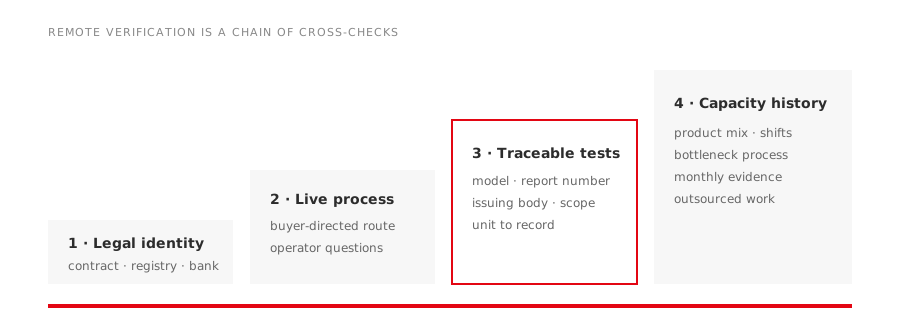
Verify four layers before travel or payment:
- legal and commercial identity;
- relevant production processes;
- testing and traceability;
- capacity evidence over time.
No single document proves all four. Consistency across them is more valuable than a long folder of unrelated certificates.
Start with the legal entity
For a Chinese supplier, search the exact Chinese registered name or unified social credit code in the official National Enterprise Credit Information Publicity System. Compare:
- registered name and legal status;
- registered address and disclosed branches;
- business scope;
- abnormal-operation or serious-violation records where shown;
- the entity named on the quotation, contract and invoice.
The brand, factory operator, exporter and bank beneficiary may be different entities for legitimate reasons. The supplier should explain the relationship in writing. A buyer should not discover it only after payment instructions arrive.
Run a buyer-directed live walk
Do not ask only for “a factory tour.” Send a route and evidence list in advance, then introduce one or two random checks during the call.
| Stage | Ask to see | Question for the operator |
|---|---|---|
| Incoming material | Current batch, identification and storage | How is this batch linked to an order? |
| Core and winding | Work instruction, tooling and in-process record | What is checked before the next operation? |
| Assembly | Model traveller or serial identity | Which parts are model-specific? |
| Test area | Connected instrument and current job | Which results are routine-tested and recorded? |
| Packing | Nameplate, order mark and packing list | How is the shipped unit tied to its test record? |
Ask the camera operator to move from one adjacent process to another rather than showing isolated machines. Where confidentiality prevents showing another customer’s information, that is reasonable; the supplier can mask the data or use an internal sample.
Verify reports outside the PDF
A logo on a report is not independent verification. Record the issuing organization, report or certificate number, exact model scope, standard edition and date. Check the issuing body’s own database where available. For China-based accredited laboratories and certification bodies, CNAS and national certification-information services provide independent search routes.
Distinguish three things:
- a management-system certificate;
- a product certificate or type-test report;
- a routine test for the actual supplied unit.
They answer different questions. ISO 9001 does not prove a particular efficiency value, and a type test for one model does not automatically cover an unrelated series.
Challenge capacity without asking for one number
Annual capacity claims are difficult to confirm remotely. Ask for the assumptions behind the number:
- product mix and average frame size;
- shifts and operating days;
- bottleneck process;
- winding, machining, impregnation and test capacity;
- outsourced operations;
- recent monthly output records with customer data removed;
- utility or staffing evidence where appropriate.
Then test whether the claimed bottleneck and the visible equipment are consistent. A factory can own many machines and still be limited by testing, skilled labour, impregnation or purchased components.
When an on-site audit is still needed
Use an independent or customer audit when the motor is safety-critical, highly customised, subject to project inspection points, or financially significant enough that remote evidence is insufficient. Remote verification should make the visit more focused, not provide false certainty.
Use a scored evidence sheet
Separate “seen,” “verified” and “not applicable.” A live view of a test bench proves that the bench exists; it does not prove calibration, range or use on the quoted motor. A certificate proves a defined assessment; it does not prove current monthly output.
Suggested headings include legal identity, contracting route, process ownership, incoming inspection, winding and insulation process, assembly traceability, test capability, nonconformance control, packing and export documentation. Add the evidence filename, date and reviewer rather than saving anonymous screenshots.
Ask questions that expose process ownership
- Which operation establishes the critical air gap or bearing fit?
- Where is the winding connection checked before impregnation?
- How is a changed bearing brand approved and recorded?
- Which routine tests are performed on every unit?
- How is a failed test linked to corrective action and retest?
- Which process is outsourced, and how is its quality accepted?
Agree that the factory may mask other customers’ names while keeping dates, model identity, process steps and record structure visible. A supplier that protects another customer’s information is demonstrating a control the buyer should also want.
Close with unresolved evidence and convert material items into contract deliverables or inspection points. Remote verification has value when it changes the control plan, not when it ends as a video-call impression.