
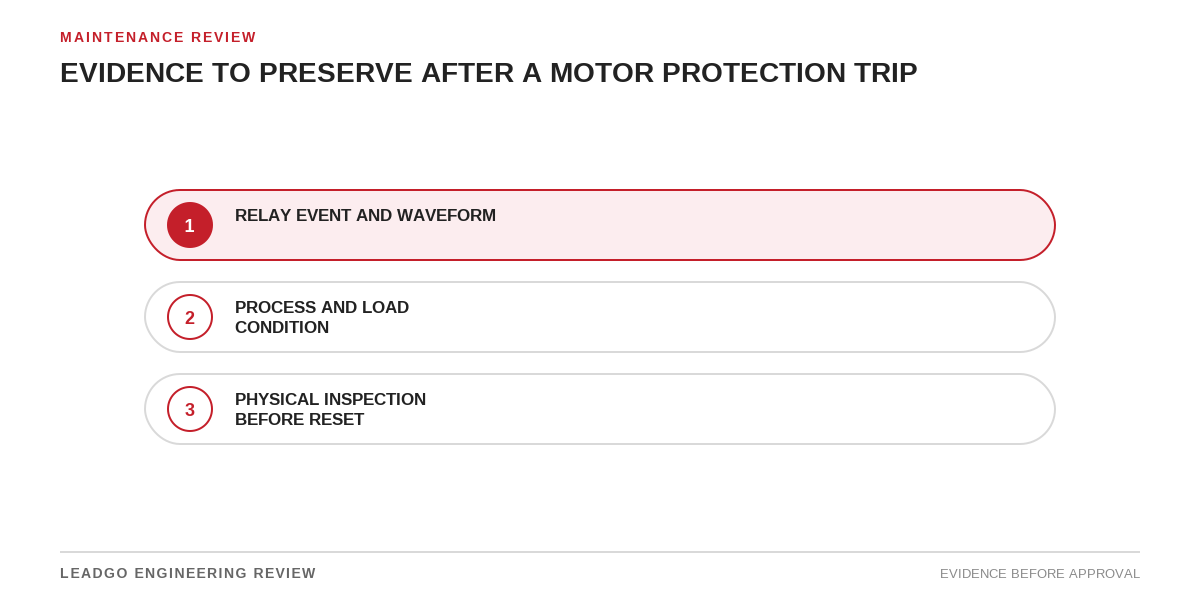
The first minutes after a motor trip often contain the best evidence and the greatest pressure to restart. Resetting the relay, clearing the process or moving the shaft can overwrite event data and alter physical clues. A disciplined response preserves the condition first, then decides what can be tested safely and who has authority to restart.
This is an investigation framework, not a live-work instruction. Isolation, access, testing and return to service must follow the plant’s electrical-safety rules, lockout process and authorised procedures.
Scope of a post-trip evidence review
The method applies to unexpected trips of industrial induction and permanent-magnet motors, whether the initiating element is electrical, thermal, mechanical or process-related. It supports maintenance and engineering teams managing a single motor or repeated fleet events.
It cannot prescribe one universal test sequence. A differential trip, overload operation, bearing-temperature alarm and upstream undervoltage event create different hazards and evidence needs. Hazardous-area motors, fire-damaged equipment, water ingress and suspected internal faults require equipment- and site-specific controls.
Engineering tool: evidence and restart decision tree
| Branch | Immediate evidence to preserve | Questions before testing | Restart disposition |
|---|---|---|---|
| Supply disturbance | Bus voltage, frequency, breaker and upstream event records | Did other loads see the same event? | Consider restart only after supply stability and motor condition are confirmed |
| Overcurrent or short-circuit indication | Operated elements, phase currents, oscillography and breaker data | Is the pattern external, cable-related or internal? | Hold until fault location and damage risk are resolved |
| Thermal overload model | Load current history, thermal state, starts, ambient and cooling status | Was heating caused by duty, cooling loss or setting error? | Cool and correct cause; do not reset the history blindly |
| Earth-fault indication | Residual or neutral quantities, cable condition and moisture evidence | Which zone is protected and what equipment is included? | Hold until insulation system and protected zone are assessed |
| Differential indication | Phase and restraint quantities, CT circuits and event timing | Could CT wiring, saturation or internal fault explain operation? | Treat as high consequence; use the approved specialist process |
| Bearing or vibration trip | Trend, waveform, sensor status, lubrication and process condition | Is the signal real, installation-related or instrument failure? | Inspect motor and driven train before movement or restart |
| Process overload or jam | Process historian, speed, torque proxy, valve or material state | What changed immediately before current rose? | Remove process cause and check mechanical damage |
| Cooling or auxiliary failure | Fan, pump, filter, water and auxiliary supply status | How long did the motor run with reduced cooling? | Restore cooling and assess thermal exposure |
The tree directs evidence collection; it does not replace the authorised protection and maintenance procedure.
First response: preserve the event
Record date, time and time source. Photograph relay indications and local equipment condition before reset. Export event logs and waveform files in their native format where possible, and note relay model, settings revision and clock offset. Capture breaker status, upstream protection events, bus measurements, control-system alarms and process historian trends over a window that includes conditions before and after the trip.
Identify the motor by tag, serial number and operating duty. Record load state, speed, starts since cooling, ambient condition, cooling-system status and any unusual sound, smell, smoke, leakage or vibration reported by operators. Preserve recent maintenance and switching actions because a changed setting, disconnected sensor or mechanical intervention can be part of the sequence.
Ten decisions before an authorised restart
- Make the equipment and area safe under the plant procedure.
- Record the operated protection element and all targets before reset.
- Export relay, breaker, historian and control-system evidence with timestamps.
- Define the protected zone: motor, cable, starter, transformer, VFD or package auxiliaries.
- Compare measured quantities with the approved settings and motor data.
- Inspect the motor, cable, driven equipment, cooling and auxiliaries without disturbing evidence unnecessarily.
- Build a test plan from the suspected branch and manufacturer guidance.
- Record findings, unresolved assumptions and the risk of another start.
- Obtain the required operations, electrical and mechanical release.
- If restart is permitted, define monitoring and the stop criteria for the trial.
Common errors after a motor protection trip
Resetting first and investigating later is the clearest failure. Another is assuming the relay element names the root cause. An overload element can operate because of a jammed process, low voltage, frequent starts, cooling failure, phase imbalance or an incorrect model input.
Teams also compare event current with nameplate current without considering time, starting state or relay measurement basis. Protection review must use the actual setting logic and event quantities. A healthy-looking motor exterior does not rule out winding, bearing or rotor damage; conversely, one abnormal sensor does not prove mechanical failure until the measurement chain is checked.
Repeated “successful” restarts can destroy evidence and accumulate damage. If the trip recurs without an understood cause, escalate rather than normalising the event.
Technical support package for the motor supplier
For technical support, send the supplier the motor data sheet and serial identity, connection and supply, relay event files, settings, current and voltage records, operating duty, start history, ambient and cooling condition, driven-equipment state, vibration or temperature trends, inspection photographs and a chronology of actions after the trip.
Ask for applicable inspection limits, test precautions, thermal restrictions, bearing and sensor details, and whether the observed event changes warranty or repair requirements. Do not ask the supplier to diagnose from a single screenshot while withholding the duty and event sequence.
Build the evidence chronology
Arrange facts by time: normal operation, first abnormal process or electrical indication, protection pickup, breaker opening, coastdown, operator response and post-trip inspections. Mark clock differences between devices. Separate observations from interpretations. “Phase B current increased” is an observation; “winding fault” is a hypothesis until supported.
Map each hypothesis to confirming and contradicting evidence. A process jam should align with process state, speed and current. A supply event may appear across other feeders. A sensor failure may disagree with independent temperature or vibration indications. The exercise exposes what must be checked before restart.
Use an explicit decision node after each branch: evidence supports an external event with no motor damage indication; evidence supports a correctable auxiliary or process cause; evidence indicates possible motor, cable or driven-equipment damage; or evidence remains insufficient. Only the first two routes can proceed toward a controlled restart review. The latter routes require additional inspection, testing or specialist assessment. This separation prevents production pressure from turning uncertainty into an informal “try once” decision.
Restart acceptance record
The final record should name the cause or state that it remains unconfirmed, list inspections and tests, identify repairs or setting changes, document remaining risk, name the approving roles and define trial-run monitoring. Include alarm and shutdown criteria rather than relying on “watch closely.”
After return to service, retain a baseline of current, voltage, temperature, vibration and process condition at a comparable load. Review the event later for fleet implications only after confirming that other motors share the relevant design, protection and duty. Evidence captured once can prevent the same uncertainty from following the next trip.
Minimum evidence retention set
Store the native relay event and waveform files, exported settings, screenshots, historian trend, operator chronology, inspection photographs, test results, repair record, restart authorisation and monitored trial-run data under one event identifier. Record the software or relay tool needed to open proprietary files. A PDF summary is useful for review, but it should not replace native data that may be needed for later analysis.
If no cause is proven, say so. Record the hypotheses eliminated, the evidence still missing and the conditions that require shutdown or escalation. An honest unresolved status is safer and more useful than a confident label unsupported by the event record.