
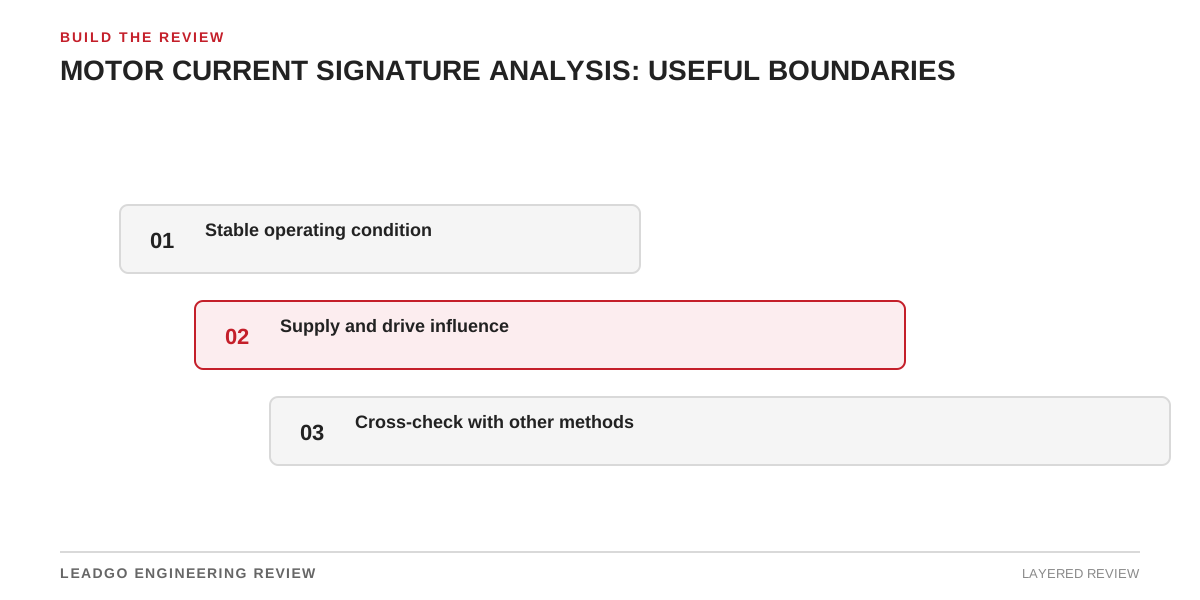
Motor current signature analysis can detect changes that deserve investigation, but a labelled spectral peak is not a final fault verdict. The load, slip, supply waveform and drive control can all change the spectrum.
Make captures comparable
| Record with every capture | Why it matters |
|---|---|
| Motor identity and connection | Prevents comparison with a different configuration |
| Speed and process load | Frequency components and amplitude move with operating point |
| Phase voltage and current | Reveals supply or phase influence |
| Line-fed or VFD-fed state | Converter harmonics can dominate the spectrum |
| Sampling rate, duration and window | Processing choices affect visible features |
| Sensor/channel and scaling | Preserves trend consistency |
Collect a healthy baseline at representative operating states. Comparing a lightly loaded baseline with a heavily loaded alarm capture can manufacture an apparent change.
Use features to form a testable hypothesis
When a new sideband or amplitude change appears, ask what mechanical or electrical behaviour could create it and what independent observation would be expected. For example, a suspected rotor issue may justify repeat captures at comparable load plus vibration and motor-specific testing.
Avoid automatic diagnoses that omit confidence, operating state and alternative explanations.
Escalate on trend and corroboration
Repeat the measurement before planning intrusive work. If the feature persists or grows under comparable conditions, combine it with vibration, temperature, current balance and maintenance history. Document the evidence that supports the final maintenance decision.
Related checks: motor vibration analysis and phase-current imbalance.