
An overload trip is the protection system reporting a condition, not naming its cause. Resetting repeatedly destroys the evidence that can separate process load, mechanical drag, supply problems and motor condition.
Match symptoms to evidence
| Observation from the event | Questions to test | Evidence to collect |
|---|---|---|
| All phase currents rise with process demand | Did flow, pressure, density, material rate or valve position change? | Time-aligned process trend and shaft-load information |
| One phase differs materially | Is there voltage unbalance, a poor connection, sensor error or winding issue? | Per-phase voltage/current, terminals and instrument check |
| Current rises after temperature increases | Has ventilation deteriorated or mechanical friction developed? | Cooling path, bearing condition, temperature and vibration trend |
| Trip occurs only during starting | Is acceleration longer, load starting condition different or voltage lower? | Start current/time trace, bus voltage and driven-load state |
| VFD reports current limit | Is speed/torque demand credible and is drive setup matched to the motor? | Drive event log, motor data, torque reference and speed |
| Relay trips while measured current appears normal | Are CT ratio, wiring, thermal memory and settings correct? | Relay record, secondary injection history and approved setting sheet |
Gather data from the same timestamp. A process trend from Tuesday and an electrical reading from Friday may both be correct while describing different machine states.
A disciplined investigation order
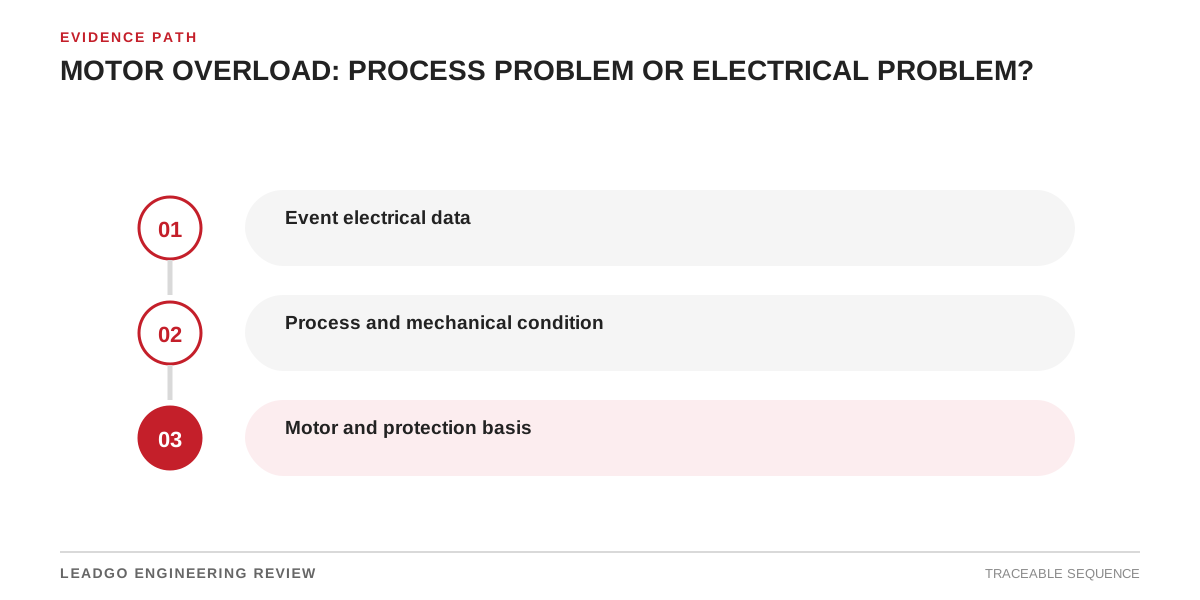
First preserve the relay or drive event record. Confirm equipment identity, current-transformer ratio, motor connection and approved settings. Review supply voltage and phase balance before translating current into a load conclusion.
Next compare the process and mechanical condition with the commissioning baseline. Pumps may move to a different point on their curve; conveyors may carry wetter or denser material; bearings, couplings or brakes may add drag. Inspect the cooling path because a correctly loaded motor can still reach a thermal limit when airflow is restricted.
Decide without hiding the cause
- Keep the equipment stopped when the event indicates a safety risk or unresolved damaging condition.
- Correct the process, mechanical, supply or cooling cause before changing protection.
- Change a setting only through the approved protection process and retain the previous value.
- Repeat measurements under a defined operating case and update the baseline.
For delayed thermal events, continue with Motor Trips After Running Two Hours. For supply-related heating, use Voltage Unbalance and Motor Overheating.