
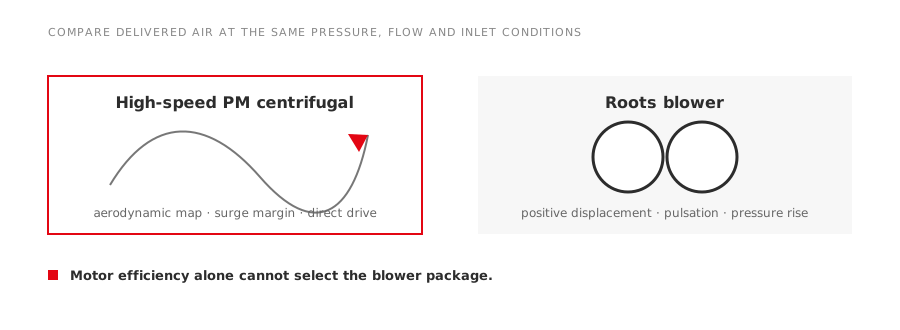
Replacing a Roots blower with a high-speed permanent-magnet centrifugal package is sometimes presented as a motor upgrade. It is a change of blower principle, drive train and control behavior. The correct comparison starts with the air system.
Both technologies can be sound choices. Their strengths appear in different parts of the pressure-flow requirement, and a single rated-power comparison hides those differences.
Two machines respond differently to the system
A Roots blower is a positive-displacement machine. Its rotors move a largely fixed volume per revolution. System resistance determines the pressure that develops, within the blower’s pressure, temperature and power limits. Flow control commonly uses speed, bypass or other system arrangements.
A centrifugal blower adds velocity to the gas and converts it to pressure. Its operating points lie on a speed-dependent aerodynamic map. At low flow it approaches surge; at high flow it approaches other aerodynamic and power limits. Inlet conditions change the relationship between actual volume, mass flow and pressure.
This means that “same cubic metres per minute” is not a complete duty statement. Pressure basis, inlet temperature, inlet pressure, gas composition and reference conditions must match.
What the high-speed PM architecture changes
A high-speed PM motor can drive the centrifugal impeller directly. Eliminating belts or a speed-increasing gearbox can remove transmission loss, alignment points, lubrication and selected wear components. The inverter controls speed and therefore moves the blower operating point across its permitted map.
The GTYP high-speed PM motor and water-cooled GTYPS series support high-speed drive architectures. The complete blower package still determines bearings, impeller, cooling, controls and performance.
At high rotational speed, rotor dynamics and balancing are central design issues. Bearing technology, critical-speed separation, overspeed protection and vibration monitoring deserve the same attention as electrical efficiency.
Compare complete package power
Ask each supplier for package input power at the same defined duty points. Include:
- motor and inverter loss;
- blower aerodynamic or displacement loss;
- cooling pumps or fans;
- inlet filter pressure loss;
- silencers and check valves;
- gearbox or belt loss where present;
- bypass or blow-off energy;
- control-panel auxiliaries.
A motor efficiency value does not establish blower-package efficiency. Likewise, a good rated duty point says little about a plant that spends most of its time at minimum flow.
Build a load profile with annual hours at normal, minimum and maximum demand. Calculate energy from package input at those points. If the plant currently controls pressure by throttling or bypassing, show the present wasted power explicitly.
Turndown and surge margin
A Roots blower can retain its displacement characteristic over a useful speed range, though temperature, leakage, motor cooling and process constraints still apply. A centrifugal machine must stay inside its aerodynamic map with sufficient surge margin.
The control system may use speed, inlet guide vanes, blow-off or multiple units. The right arrangement depends on how demand changes. A single large centrifugal package may be efficient near design flow but less flexible at very low demand. Multiple smaller units can improve staging but add capital equipment and maintenance points.
Ask suppliers to plot every required operating point, including worst-case inlet conditions, on the guaranteed map. Confirm what happens after a rapid valve movement, filter blockage or process trip.
Air quality and process compatibility
Oil-free air can be important in wastewater aeration, food processing, chemicals and other processes, but “oil-free” must be defined at the package boundary. Bearing and sealing arrangements differ by design. Confirm whether any lubricant can contact the process stream and what filtration or monitoring is required.
Dust, corrosive gas, moisture and condensation influence material selection and inlet treatment. A clean-air blower selection cannot simply be reused for a contaminated process gas.
Noise also shifts rather than disappears. Roots blowers have characteristic pulsation and often need substantial silencers. High-speed machines introduce high-frequency aerodynamic and motor tones. Compare guaranteed sound data for the complete installed package and specified measurement condition.
Reliability questions are architecture-specific
For a Roots package, review timing gears, bearings, seals, belt or coupling, lubrication and rotor clearances. For a high-speed PM package, review high-speed bearings, cooling, inverter, rotor balance, vibration protection and overspeed shutdown.
Ask for:
- maintenance intervals and consumables;
- bearing replacement method and local capability;
- inverter parameter backup and software access;
- impeller inspection criteria;
- vibration alarm and trip logic;
- recommended critical spares;
- response plan if the proprietary high-speed core is unavailable.
Fewer mechanical components can reduce routine work, but a specialized cartridge may require a different spare and service strategy.
A fair commercial comparison
Use a common evaluation period and include equipment, electrical work, piping changes, cooling, commissioning, spares, maintenance and downtime. Apply the same electricity tariff and production assumptions to both cases. Run sensitivity cases for flow profile and energy price.
Do not transfer a savings percentage from another plant. Small changes in pressure, flow control and annual profile can materially change the result. A verified case history can show that a technology works; it cannot calculate the value at a new site.
Availability deserves its own line in the model. If one blower trip stops the process, compare the cost of installed standby capacity and the changeover method. A high-efficiency package without a realistic repair or bypass plan can produce a weak lifecycle result despite lower running power.
Selection sequence
- Define pressure, flow and inlet conditions at every required point.
- Confirm gas quality, environment and noise requirements.
- Place the points on each supplier’s guaranteed operating range.
- Compare complete package input power, not motor efficiency alone.
- Review surge, bypass, staging and upset behavior.
- Compare maintenance tasks, critical spares and service capability.
- Build a load-weighted lifecycle model.
A high-speed PM centrifugal blower can be an excellent fit when its aerodynamic map matches the plant’s demand. A Roots blower can remain the better tool where its displacement behavior, pressure range or service familiarity suits the process. The air system decides.