
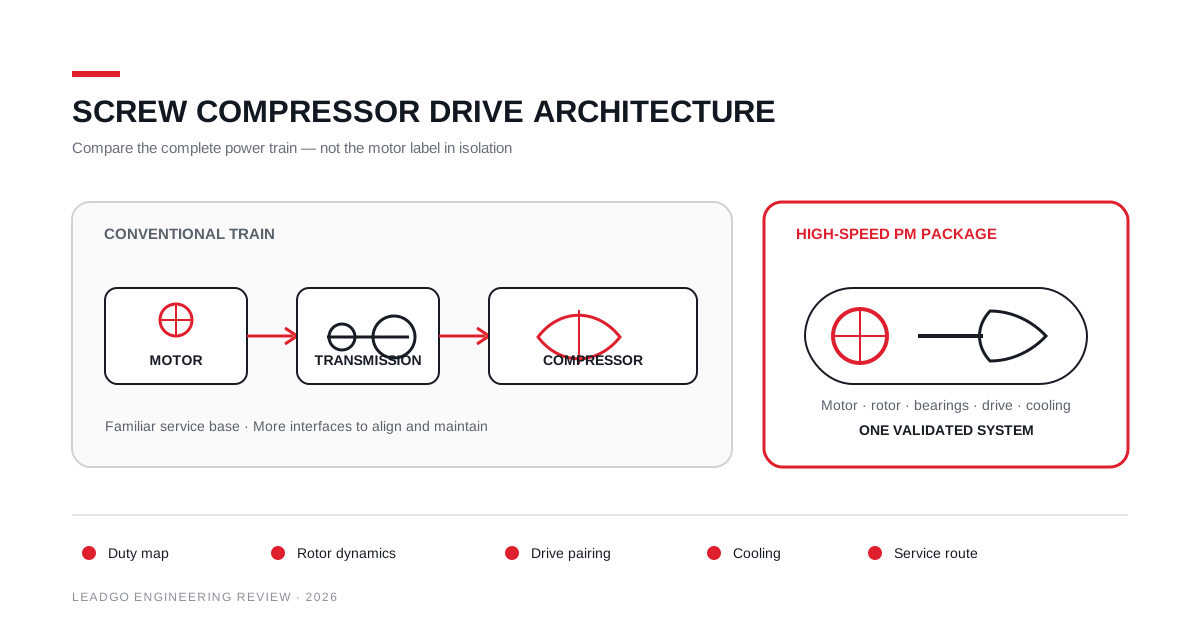
A motor data sheet does not tell you whether a compressor package will be compact, efficient or easy to maintain. That decision sits in the complete power train.
For a new screw-compressor platform, the useful comparison is not “PM versus induction” in isolation. It is a conventional arrangement with its transmission and controls versus a high-speed arrangement designed around the compressor element.
The two architectures
| Conventional arrangement | High-speed PM arrangement |
|---|---|
| Standard-speed motor plus coupling, belt or gearbox | PM motor coupled directly or through a simplified interface |
| Familiar motor and bearing service | Fewer transmission components, but a more specialised rotor system |
| Speed range set by motor, transmission and drive | Speed range set by motor, inverter and compressor map |
| Alignment and transmission maintenance remain | Rotor dynamics and package integration become more demanding |
The compact layout is attractive because it may remove parts that create loss, noise, alignment work and maintenance. That does not make it automatically superior. It moves engineering responsibility into the high-speed rotor, bearings, cooling and control system.
Start from the compressor map
Ask the compressor supplier for the required speed and shaft torque across the operating envelope, not only a rated power. Include normal pressure, turndown, unloading, maximum ambient, startup and any brief overload condition.
The selection team should agree on:
- continuous and maximum speed;
- torque at each pressure and flow point;
- time spent at each operating point;
- acceleration and coast-down requirements;
- allowable shaft loads and coupling arrangement;
- process-gas and ambient conditions;
- expected starts, stops and load cycles.
A motor sized at one duty point may run with poor margin at another. For variable-air-demand service, compare several duty points and their annual hours.
The inverter is part of the machine
High-speed PM operation requires a drive selected for that motor and speed range. Confirm maximum output frequency, current capability, control method, encoder requirement, switching-frequency limits, motor-cable arrangement and overspeed protection.
The drive also affects motor heating. Harmonic loss, carrier frequency and cable reflections cannot be treated as afterthoughts. If a sine filter, output reactor or special cable is required, put it in the supplier boundary and efficiency calculation.
For a conventional induction-motor package, the same discipline still applies. The guide to matching a VFD to a motor covers the electrical checks that should appear in the order data.
High speed changes the mechanical questions
At high rotational speed, a small geometric or balance error has a larger consequence. The package designer needs to own the critical-speed study, rotor balance, bearing selection, lubrication method and vibration limits.
Do not split those responsibilities loosely between the motor vendor and compressor vendor. The order should identify who validates the assembled rotor train, who sets alarm and trip levels, and how vibration is checked during the package test.
Cooling also needs a boundary. Air-cooled and water-cooled high-speed motors place different demands on the skid. Cooling-water quality, flow, pressure, inlet temperature and alarm logic must be stated if water cooling is used. Dirty or hot ambient air may change the apparent simplicity of an air-cooled design.
Where each approach usually fits
Choose a high-speed PM concept for serious evaluation when compactness matters, the compressor element benefits from direct high-speed operation, the package builder can validate the complete rotor system, and specialist drive and bearing support are available.
Keep a conventional arrangement in the comparison when interchangeability, local service, familiar spares, a wide supplier base or a conservative maintenance strategy is more valuable than minimum package size.
Neither answer should be chosen from purchase price alone. Compare:
- guaranteed package power at agreed duty points;
- auxiliaries and cooling consumption;
- planned transmission or bearing maintenance;
- critical spares and repair route;
- downtime exposure;
- test evidence for the complete package.
A useful purchase specification
Write the request around outcomes. State the gas or air conditions, flow and pressure range, ambient, site altitude, utility voltage, operating profile, sound limit and expected life. Require a clear efficiency boundary: motor only, motor plus drive, or complete compressor package.
For high-speed proposals, request the rotor-dynamic basis, bearing and cooling description, overspeed strategy, allowable vibration, drive pairing and package test plan. For conventional proposals, request transmission losses, alignment requirements and service intervals.
LEADGO’s GTYP air-cooled high-speed PM motor and GTYPS water-cooled series are possible building blocks for high-speed equipment. Their suitability still depends on the compressor manufacturer validating the assembled package.