
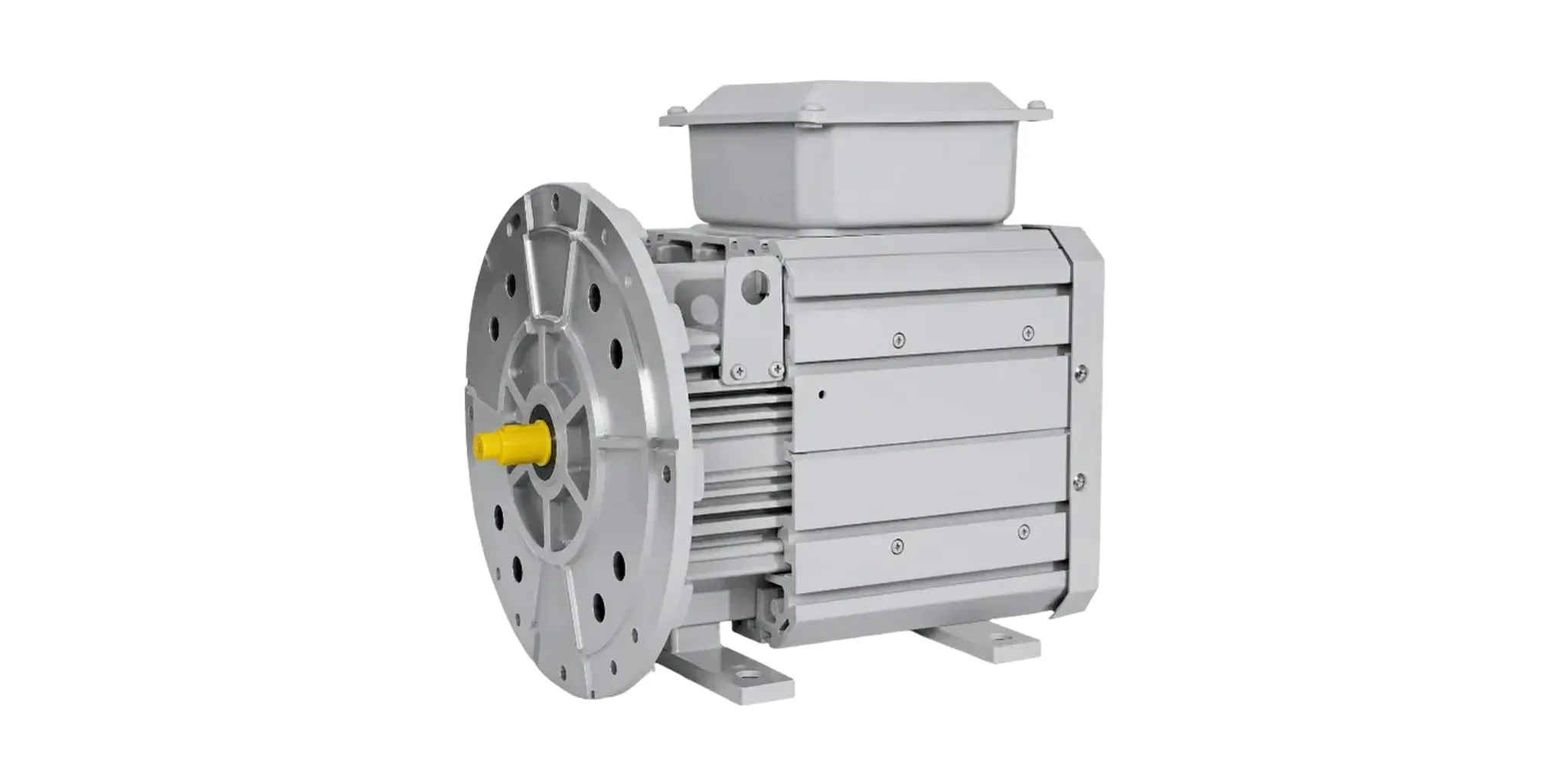
Permanent magnet motor datasheets from different manufacturers use IPM, SPM, interior, surface-mount and sometimes just “PMSM” for what look like similar machines. The rotor construction behind those labels is not a detail of manufacturing preference. It decides how the motor produces torque, how far you can push it above base speed, and whether it can be started without a drive.
Direct answer
There are three rotor magnetic-circuit structures for permanent magnet synchronous motors: surface, interior and claw-pole. The first two cover almost everything in industrial use.
On a surface rotor the magnets sit on the outside of the rotor core, facing the air gap directly. On an interior rotor the magnets sit inside the rotor body, with ferromagnetic pole shoes between each magnet and the air gap.
Rare-earth magnet material has a relative permeability close to 1 — magnetically it behaves almost like air. So a surface-mount rotor looks uniform to the stator field in every direction: electrically it is non-salient. An interior rotor has iron between adjacent magnet poles, so the magnetic path differs from one rotor axis to the other: electrically it is salient.
Everything else follows from that.
What salience buys, and what it costs
| Surface (SPM) | Interior (IPM) | |
|---|---|---|
| Electrical character | Non-salient | Salient |
| Reluctance torque | None | Yes, adds to magnet torque |
| Power density | Lower | Higher |
| Overload capability | Lower | Higher |
| Field weakening | Limited | Usable, wider constant-power range |
| Starting cage possible | No | Yes, in the pole shoes |
| Magnet protection | Exposed to the air gap | Shielded by the pole shoes |
| Leakage flux | Lower | Higher |
| Rotor cost | Lower | Higher |
| Air-gap flux shape | Easier to make sinusoidal | Harder |
The asymmetry of the interior rotor’s magnetic circuit produces reluctance torque on top of the torque from the magnets. That raises overload capability and power density, and it makes field weakening practical — which is what extends the constant-power speed range above base speed.
The price is paid in leakage flux and rotor cost, both higher than a surface-mount rotor, and in a harder job getting the air-gap flux close to a sine wave.
The starting cage is the practical divider
A surface-mount rotor has no room on its outer face for a starting winding. It therefore has no asynchronous starting capability at all, and cannot be used in a line-start permanent magnet motor.
An interior rotor can carry a cast aluminium or copper bar cage inside the pole shoes. That cage does two jobs: it damps oscillation in normal running, and it can provide asynchronous starting torque.
This is worth stating plainly because it is the source of a common and expensive mistake: a permanent magnet motor without a starting cage cannot be connected directly to a fixed-frequency supply. It will not pull into synchronism, and the resulting inrush current drives an armature reaction across the magnets that can demagnetise them irreversibly. That damage is not repairable in the field.
Whether a given series has a starting cage is a property of that series. Check its documentation before connecting any permanent magnet motor across the line.
Interior rotors are not one thing either
Within interior construction, the magnets can be magnetised radially, tangentially, or in a combination of the two. Radial, tangential and hybrid layouts differ in how much flux they concentrate and in how the rotor is mechanically retained, which is why two motors both described as “IPM” can behave quite differently under overload.
If a supplier’s datasheet says only “interior permanent magnet”, that is not enough information to predict overload behaviour. Ask which layout, and ask for the torque-speed curve rather than a single overload multiple.
Where LEADGO uses interior rotors
The GTYP high-speed permanent magnet series uses an interior permanent magnet rotor with d-axis and q-axis magnetic circuits designed to give the series a degree of salient-pole torque. The inverter has to be matched to the motor for that to be realised across the speed range.
Across the rest of the permanent magnet range, the rotor construction varies by series and by duty. If the application turns on reluctance torque, overload capability or field-weakening range, ask for the rotor type of the specific series rather than assuming from the family.
Related: Permanent Magnet vs Induction Motors in Oilfield Duty