
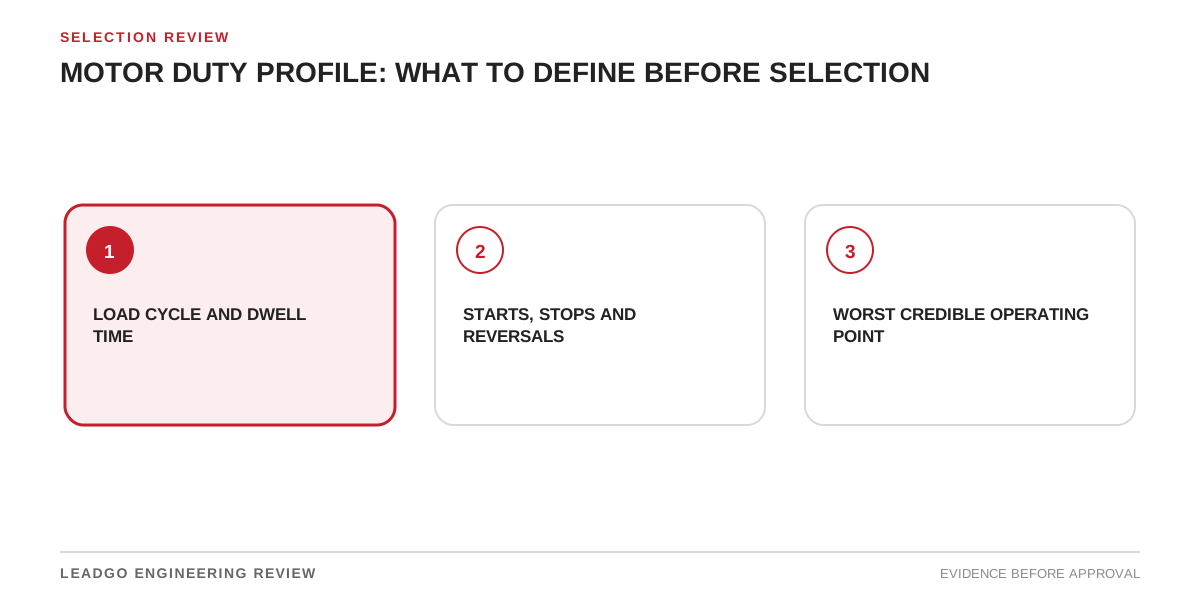
Many motor enquiries reduce the application to power, voltage and speed. That may be adequate for a steady load, but it can conceal the events that dominate a conveyor, mixer, hoist, centrifuge or indexing machine. The useful input is a timeline: what torque is required, at what speed, for how long, and what happens next.
Build one complete operating cycle
Start at rest and follow the machine until the same condition repeats. Use measured process data where available and label estimates clearly.
| Stage | Required input | Typical question |
|---|---|---|
| Start | Load torque, combined inertia and permitted acceleration time | Is the machine starting empty, normal or jammed? |
| Run | Torque or shaft power, speed and duration | Is load steady, ramped or fluctuating? |
| Process peak | Magnitude, duration and frequency | Is this an expected event or an abnormal case? |
| Deceleration | Coast, mechanical brake, DC braking or regenerative control | Where does the stored energy go? |
| Stop/dwell | Duration and cooling state | Does the shaft-mounted fan stop while the motor remains hot? |
| Restart | Temperature state and number of successive starts | Is a hot restart required after a short interruption? |
Repeat the table for each production mode. Normal production, cleaning, changeover, emergency clearing and commissioning can place different demands on the same motor.
Separate torque, power and energy
Torque determines whether the motor can accelerate and carry the driven machine at a given speed. Power combines torque and speed. Heating accumulates over time and is affected by losses and cooling. Treating those as one “load percentage” removes information the motor and drive supplier need.
For a VFD application, include the minimum continuous speed and time spent there. A motor may deliver the requested low-speed torque while its own fan provides less cooling. If separate ventilation is proposed, state its supply and interlock arrangement.
Define the cases that must work
Mark each operating case as one of the following:
- continuous requirement: expected production and allowable indefinitely under the stated conditions;
- cyclic requirement: repeats with a known sequence and dwell time;
- occasional requirement: permitted only for a defined event and duration;
- prohibited condition: handled by process control or protection rather than motor capability.
This distinction prevents an unlikely upset case from silently becoming the normal rating basis. It also prevents a frequent process peak from being dismissed as a short overload.
Evidence needed to approve the motor
The final selection file should contain the duty timeline, load-source revision, motor torque-speed data, acceleration assessment and thermal basis. Record assumptions about inertia, friction, material density and process accumulation. If the driven-equipment vendor owns an input, identify that owner rather than replacing the value with a generic service factor.
Use the electric motor RFQ checklist to package the enquiry, and compare the proposed machine with the motor performance curve before approval.