
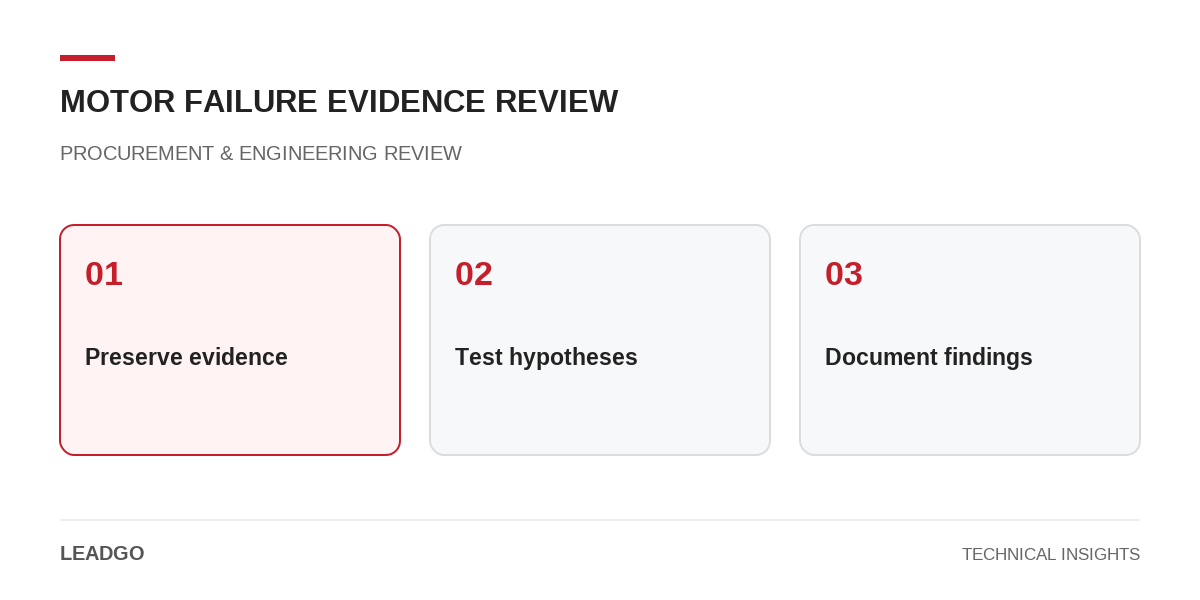
A motor failure creates two parallel pressures: restore production and explain what happened. The first pressure encourages cleaning, rewinding or replacing parts quickly. The second requires evidence to be preserved before those actions destroy the clues. A useful claim package does not begin with an accusation. It begins with a controlled record that distinguishes observed damage, operating facts, plausible mechanisms and contract responsibilities.
Applicability boundary
This method applies to warranty reviews, supplier disputes, internal reliability investigations and repeated motor failures. It covers electrical, mechanical, thermal, environmental and installation-related mechanisms. It does not replace a specialist laboratory report, a legal opinion or the manufacturer’s repair limits. The claim boundary must be agreed by the responsible engineering, commercial and legal teams.
Freeze the motor tag, serial number, driven equipment, duty, supply, protection, environment, installation state and time of failure. If the motor was repaired or modified before the event, record the modification and approval basis. A root-cause conclusion that ignores a changed installation is not complete.
Root-cause evidence tree
| Evidence gate | Question | Required record | Claim implication |
|---|---|---|---|
| Identity | Is the failed machine and its parts traceable? | Serial, tag, photographs and chain of custody | Weak identity weakens every claim |
| Symptom | What physically failed? | Visual, electrical and dimensional findings | Symptom is not yet a mechanism |
| Operating case | What load, starts, speed and environment occurred? | Historian, relay and operator records | Defines stress applied to the machine |
| Protection | Did settings and devices operate as approved? | Relay files, settings and test reports | May shift responsibility toward system |
| Mechanism | Which failure path explains all evidence? | Test, laboratory or engineering analysis | Separate confirmed and suspected paths |
| Boundary | Which party controlled the contributing condition? | Contract, drawing and installation records | Allocates responsibility carefully |
| Corrective action | What prevents recurrence? | Action owner, date and verification | Claim is stronger when remedy is specific |
| Commercial record | What cost and notice are supported? | Invoice, downtime and notice log | Avoids unsupported compensation claims |
Common errors in failure claims
The first error is treating a burnt winding, broken bearing or damaged fan as the root cause. Those are physical observations. A second is searching for a single event while ignoring the cumulative load, starts, cooling restriction or misalignment history. A third is opening or cleaning the machine before photographs, samples and test results are captured. Another error is mixing a technical hypothesis with a contractual conclusion.
Do not write “supplier defect” when the operating case is still unknown. Do not discard relay files because the protection did not trip; the absence of a trip can itself be evidence. Do not let an emergency repair erase failed parts, serials or clearances. If evidence is missing, mark the gap and explain how it affects confidence.
Investigation decision steps
- Isolate the machine and preserve the scene, settings, files and physical parts.
- Build a timeline of manufacture, installation, commissioning, starts, alarms, maintenance and failure.
- Separate confirmed observations from assumptions and competing hypotheses.
- Select tests that can discriminate between those hypotheses.
- Map each finding to the operating or contract boundary it affects.
- Issue a preliminary responsibility position with confidence and open evidence.
- Agree corrective action, verification and claim-notice milestones.
The investigation should make it possible to say not only what probably happened, but also what evidence would disprove the current conclusion. That discipline prevents a preferred story from driving every test.
Supplier and warranty data request
Request manufacturing test records, serialised material certificates, winding and bearing data, approved drawings, protection requirements, permissible starts, thermal limits, installation instructions, warranty exclusions and prior nonconformance records. Ask the supplier to state which findings require their witness before cleaning, machining or winding removal.
For a field failure, request relay event files, trend data, starting history, alignment records, vibration and temperature records, lubrication history, environment, cable and VFD data, photographs and maintenance work orders. Keep the original files and hashes where practical. A screenshot without source metadata is a lead, not final evidence.
Claim boundary and confidence statement
Use a three-level statement: confirmed, probable or unresolved. “Confirmed” means the evidence directly supports the mechanism under a defined condition. “Probable” means the mechanism explains the evidence better than alternatives but has a stated uncertainty. “Unresolved” means more evidence is required. Attach each statement to a responsible reviewer and revision date.
Separate technical responsibility from commercial recovery. A supplier may agree to inspect or repair without accepting cause. Likewise, a plant may have contributed an operating condition without accepting every claimed cost. The evidence package should let both discussions proceed without changing the facts.
Corrective action and closure
Corrective action should address the mechanism, not the symptom. Examples include protection-setting changes, cooling restoration, alignment correction, material or process change, operator control, design revision or a revised acceptance test. Assign an owner and verification date. A repaired motor is not proof that the root cause is closed until the relevant operating baseline is compared after return to service.
Final rule
Protect evidence first, test to distinguish mechanisms, and describe responsibility only within the verified boundary. A strong failure claim package is useful even when it does not establish supplier fault: it prevents repeated failures, supports a fair warranty discussion and gives the next engineer a traceable basis.
Evidence preservation sequence
Start with a scene record before touching the motor: nameplate, terminal box, cable ends, coupling, bearing housings, cooling path, foundation, protection panel and local environment. Photograph each area with a scale and a tag. Download relay, drive and historian files in their native formats, then record the extraction time and source system. If a file is converted for review, preserve the original beside the converted copy.
Separate samples and failed parts by location. A bearing from the drive end, a winding connection and a damaged fan should not travel in one unlabelled box. Record who removed each part, which tool or test was used, and where the part is stored. If cleaning is necessary, photograph the condition first and record the solvent or method. Evidence that has been cleaned, machined or rewound cannot be presented as the original condition.
Discriminating tests and competing hypotheses
Build a short hypothesis register. For an insulation failure, possible paths may include overtemperature, moisture, surge stress, contamination, loose connection or manufacturing defect. For a bearing failure, consider lubrication, alignment, electrical current, load, contamination and assembly. Select a test or observation that distinguishes between at least two paths. An additional test that cannot change the decision is usually a poor use of outage time.
Use confidence language deliberately. A measured shaft ground-current path may support an electrical mechanism, but it does not by itself prove that the bearing was damaged by that current. A relay trip may confirm a protection event, but it does not prove why the overload occurred. State what the evidence establishes, what it suggests and what remains untested.
Warranty and claim communication
Send an early notice that preserves contractual timing without overstating cause. Identify the motor, failure date, immediate operational effect, evidence preserved, access required and next investigation milestone. Use a separate technical appendix for findings and an action register for requests to the supplier. This prevents a preliminary notice from being read as a final allocation of responsibility.
When a supplier proposes repair, inspection or replacement, record whether the proposal is without prejudice to cause. Keep the commercial cost ledger separate from the technical evidence. Downtime, labor, transport and replacement costs should be supported by dates and records, while the technical report should remain focused on mechanism, boundary and recurrence prevention.