
Hazardous Area

YBX3

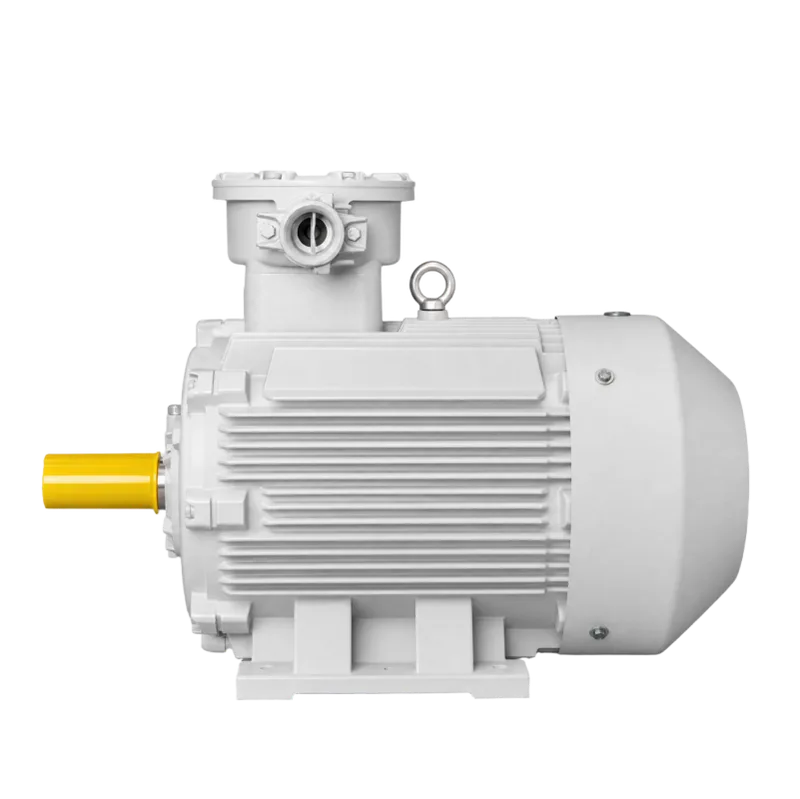
YBX3 Series High-Efficiency Flameproof Three-Phase Induction Motor

Flameproof enclosure for explosive gas atmospheres, in both a mining rating (Ex db I Mb) and an industrial rating (Ex db IIB T4 Gb), at IE3 efficiency.
Ex db IIB T4 GbIE30.18–315 kW
YBX series flameproof three-phase induction motor

YBX3 is a totally enclosed, high-efficiency flameproof three-phase induction motor. Efficiency meets grade 3 of GB 18613—2020 — the entry level of the three-grade scale, with YBX4 at grade 2 and YBX5 at grade 1.

Protection is by flameproof enclosure to GB/T 3836.1-2021 and GB/T 3836.2-2021. Two ratings are built: Ex db I Mb for underground mining, and Ex db IIB T1 Gb to T4 Gb for surface industrial plant.

Wide voltage coverage — 380 V, 660 V, 1140 V and the dual combinations 380/660 V and 660/1140 V — means the same series covers both surface plant and underground distribution without a separate product line.

Core specifications

ParameterValue
Frame sizeH80 – H355 mm
Power range0.18 – 315 kW
Explosion protectionEx db I Mb (mining) · Ex db IIB T1 Gb – T4 Gb (industrial)
Efficiency classIE3 · GB 18613—2020 grade 3
Voltage380 V · 660 V · 1140 V · 380/660 V · 660/1140 V, 50 Hz
Protection degreeIP55
Thermal class155 (F), assessed to class B rise
CoolingIC411
MountingB3 / B5 / B35

Standards and certification

  • GB/T 3836.1-2021 (explosive atmospheres, general requirements)
  • GB/T 3836.2-2021 (flameproof enclosure "d")
  • JB/T 12628-2016 (mining rating, frames 63–355)
  • GB 18613—2020 grade 3

Typical applications

  • Underground mining — fans, local ventilation, hoisting winches (Ex db I Mb)
  • Surface plant in gas group IIB explosive atmospheres
  • Wellsites, tank farms and chemical process areas requiring a flameproof machine

Selection guide

YBX3 is certified to gas group IIB, which covers atmospheres up to and including ethylene. It is not rated for group IIC atmospheres such as hydrogen or acetylene. If your area classification calls for IIC, tell us before selection — the requirement changes the machine.
They are different certificates on the same series. Ex db I Mb is the underground mining rating; Ex db IIB is the surface industrial rating. Specify which applies to your site, because the certification documents differ.
They are the same flameproof construction one and two efficiency grades higher. On a continuously running drive the efficiency difference accumulates; on a standby or intermittent drive it rarely justifies the premium.
The classification standard says so itself. GB/T 32891.2—2019 notes that motors designed to IEC 60079-0 for explosive atmospheres may fall short of the higher efficiency classes, because the safety requirements pull the design the other way — a larger air gap, a reduced starting current, heavier sealing. Reaching grade 3 inside a flameproof enclosure is not the same engineering problem as reaching it in a standard one.
The product standard this series is built to dates from 2016 and follows the 2012 edition of GB 18613, which set no eight-pole efficiency grades at all — those arrived with the 2020 edition. So the eight-pole column in the standard table is incomplete, and that is a question of which edition the standard follows rather than what the machine can do: our engineering department confirms that tested eight-pole efficiency meets grade 3 of GB 18613—2020. Ask us for the tested value of the specific rating you need, in writing, rather than reading it off the standard table. Two, four and six poles from 0.75 kW upward are unaffected; those values are identical to grade 3 of the 2020 edition. Where the eight-pole figure has to be guaranteed in the contract rather than tested on the unit, specify YBX4, whose eight-pole column is complete in the standard and reaches grade 2.

FAQ

Not by default — the certification covers the machine under the conditions it was tested. LEADGO builds separate flameproof variable-frequency series for that duty: YBBP for mining and YBBPX3 for mining and industrial. Tell us the drive and the duty and we will confirm what is certified.
Certification copies for the explosion-protection marking, and the dimension drawings for your frame size, are issued on request. Tell us the area classification, gas or dust group and temperature class for your site.

Downloads

DatasheetPDF · 774 kBDownload
Installation & maintenance manualInstallation, commissioning and servicingRequest
CertificationCertificates and test reportsRequest

Certificates and test reports are issued against the specific model and rating rather than the series, so we send the ones that apply to your order. Tell us the rating and the market and we will send them.

Related products

Technical articles on this series

ATEX vs IECEx vs NEC: Explosion-Proof Motor Certification Guide

Compare ATEX, IECEx and NEC motor certification: classification, gas groups, temperature class, markings and certificate scope.

Read

Container Humidity During Motor Shipment

Plan motor export packaging around route exposure, barrier integrity, desiccant control and receiving checks instead of container duration alone.

Read

Reading a Chinese Motor Model Number: What Each Segment Commits To

YBX4-280S4-W is four segments in a fixed order, and the second character tells you the protection type before you find the Ex plate.

Read

Drilling Rig Motors: Drawworks, Mud Pump and Top Drive

Three loads on one rig floor, and three different motor problems. One of them spends part of its cycle generating rather than consuming.

Read

Dust Layer vs Cloud Ignition Temperature

Why dust-cloud and dust-layer ignition temperatures are different inputs, and how they affect motor surface-temperature selection.

Read

Equipment Protection Levels: Ga, Gb, Gc, Da, Db and Dc Explained

Understand Ex equipment protection levels Ga, Gb, Gc, Da, Db and Dc, how they relate to fault conditions, and what must match the hazardous area.

Read

Ex db vs Ex db eb Motors: The Terminal-Box Difference

Practical engineering guidance on ex db vs ex db eb motors: the terminal-box difference, including the checks, evidence and common mistakes that matter befor

Read

Ambient Temperature on an Ex Motor Certificate

Practical engineering guidance on ambient temperature on an ex motor certificate, including the checks, evidence and common mistakes that matter before purch

Read

Explosion-Proof Cable Glands: Part of the Protection System

How to match a hazardous-area motor cable gland to the protection concept, entry thread, cable construction and certificate conditions.

Read

Explosion-Proof Motor Fasteners: Replacement and Inspection

How to identify, replace and inspect enclosure fasteners without compromising an explosion-protected motor's certified construction.

Read

Explosion-Proof Motor Inspection: Scope, Frequency and Records

Plan visual, close and detailed inspections for explosion-protected motors, with clear escalation and return-to-service evidence.

Read

Ex db IIB T4 Gb Meaning: Reading the Marking

Ex db IIB T4 Gb is five separate decisions written as one string. What each segment answers, and why none substitutes for another.

Read

Repainting Explosion-Proof Motors: Masking and Inspection Rules

Plan surface preparation and repainting without covering Ex markings, flamepaths, earthing contacts, drains or evidence of enclosure damage.

Read

What a Flameproof Joint Does, and Why It Cannot Be Re-Machined

A flameproof enclosure does not keep gas out. It lets the explosion happen inside and cools what escapes, through a gap that is a certified dimension.

Read

Gas and Dust Subgroups: IIA, IIB, IIC and IIIA to IIIC

The subgroups work in one direction only. IIC equipment covers IIA and IIB areas; IIB equipment does not cover a IIC area, and no margin argument changes that.

Read

Hazardous Area Classification: Who Does It and Who Carries the Risk

Classification describes the place, not the motor. The owner or designer decides it before any equipment is specified — and the drawing is what you buy against.

Read

Area Classification Inputs for Hazardous-Area Motor Selection

Translate the site area-classification dossier into the zone, substance group, temperature class and certificate checks needed for a motor RFQ.

Read

Increased Safety vs Flameproof Motors: What Changes?

How Ex eb increased-safety and Ex db flameproof motor concepts differ, and what buyers must confirm before selecting either one.

Read

Motor IP Rating Chart: IP55, IP65, IP66 and IP67 Explained

Use this motor IP rating guide to compare IP55, IP65, IP66 and IP67, understand both digits, and avoid assuming immersion ratings include hose tests.

Read

Explosion-Proof Motor Temperature Classes T1 to T6

Compare T1 to T6 maximum surface temperatures, learn why T6 is the strictest class, and select a motor class from the gas ignition temperature.

Read

VCI Packaging for Industrial Motors: Define the Preservation System

Use vapour corrosion inhibitor materials only within a compatible, sealed and inspectable packaging plan matched to route, storage climate and duration.

Read

Voltage Unbalance: How a Small Supply Error Overheats a Motor

Learn how to calculate three-phase voltage unbalance, why it creates larger current imbalance, and what to check before a motor overheats.

Read

Repairing Explosion-Proof Motors: Records That Matter

Practical engineering guidance on repairing explosion-proof motors: records that matter, including the checks, evidence and common mistakes that matter befor

Read

Reading Three-Phase Motor Terminal Markings: U1 V1 W1 and T1 T2 T3

Two marking systems, two rotation conventions, and one of them does not define rotation at all. Which one is on your terminal block changes what you can assume.

Read

Motor Type Test vs Routine Test: What Buyers Should Request

Compare motor type tests and routine tests, see what each report proves, and use an RFQ checklist to request traceable supplier evidence.

Read

How to Verify an Explosion-Proof Motor Certificate

A certificate covers a model and rating, not a product family. Five checks — and the one suffix that changes what you may do with the motor.

Read

VFD Bearing Currents: Causes, Warning Signs and Controls

Understand how variable-frequency drives create bearing currents, how electrical fluting develops, and which grounding and insulation measures help.

Read

TEFC vs IP Rating, IC416 and Explosion-Proof Motors

Compare TEFC with IP55 and IP65, IC411 with IC416, and TEFC with explosion-proof construction before specifying an industrial motor.

Read

Why Buyers Don't Trust Chinese Motor Suppliers

Distrust of Chinese motor suppliers tracks four specific, checkable patterns, not the country of origin itself. Here is what each one is and how to verify it.

Read

Why Oilfield Motors Run Hot: Three Paths to Check

Running hot is not a fault, it is a consequence. And "you can still touch it" is not a criterion — the standards measure rise above ambient, not temperature.

Read

YBX3 vs YBX4 vs YBX5: Select by Lifecycle, Not Label Alone

A practical comparison of YBX3, YBX4 and YBX5 flameproof motor efficiency routes, including starting, certificates and payback inputs.

Read

From Zone to Motor: What a Zone 1, 2, 21 or 22 Area Actually Requires

The area classification comes first, the nameplate later. Here is the zone-to-protection-level correspondence, from the installation standard.

Read

Request a quote — YBX3

Tell us the rating, quantity and application and an engineer will come back with a specification, the documents for that model, and a price.

Contact Sales