
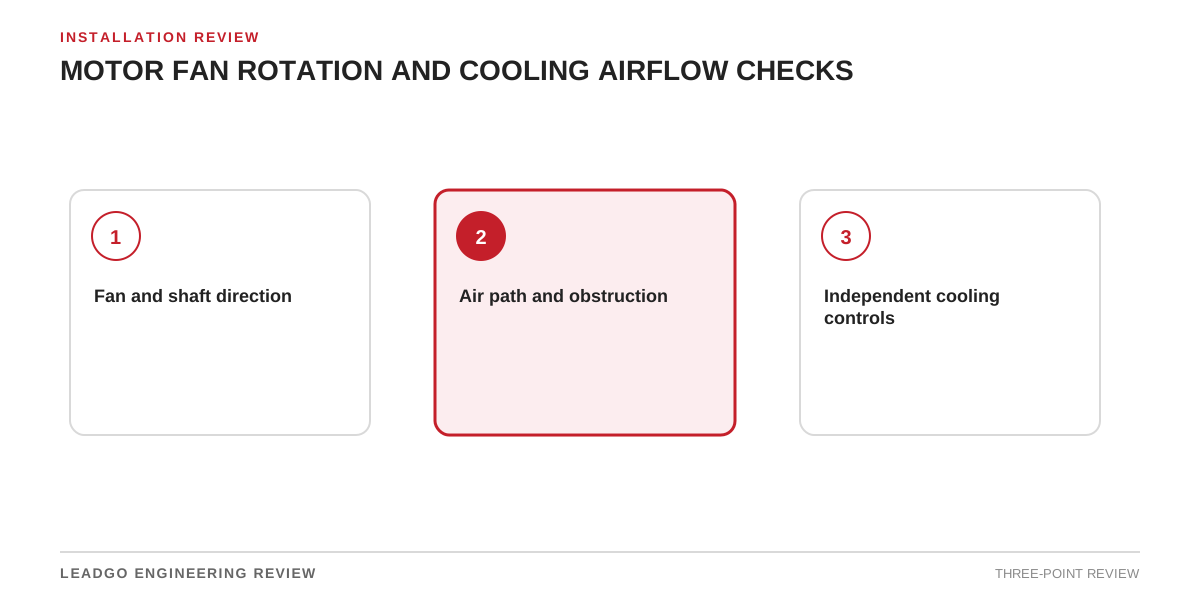
Cooling checks often stop after confirming motor rotation. That misses directional fans, blocked inlets, hot-air recirculation and independently powered blowers that are running backwards or not interlocked.
Follow the air from inlet to discharge
| Checkpoint | Confirm | Evidence |
|---|---|---|
| Fan identity | Correct fan and permitted rotation | Drawing and visual inspection |
| Inlet | Clearance, guards and clean filters | Installed photographs |
| Discharge | Unobstructed escape path | Airflow observation |
| Recirculation | Hot discharge does not return to inlet | Inlet/discharge temperature trend |
| Independent blower | Direction, supply and status | Functional test |
| Failure logic | Alarm, inhibit or trip response | Cause-and-effect test record |
Perform observations with guards installed in their operating position. Removing a guard can change airflow and creates a safety condition unlike normal service.
Check every operating mode
Test normal start, low-speed operation, reverse rotation where permitted, shutdown and auxiliary failure. A VFD motor may need independent ventilation during low-speed high-torque duty and may require blower run-on or pre-start logic.
Record motor load, speed and surrounding ventilation when establishing a temperature baseline. A no-load airflow check does not validate full-load thermal performance.
Investigate weak flow before changing settings
Check fan direction, blade damage, filters, covers, ducting and clearances. Confirm that nearby walls or machines do not create recirculation. Do not compensate for a physical airflow fault by raising thermal trip settings.