
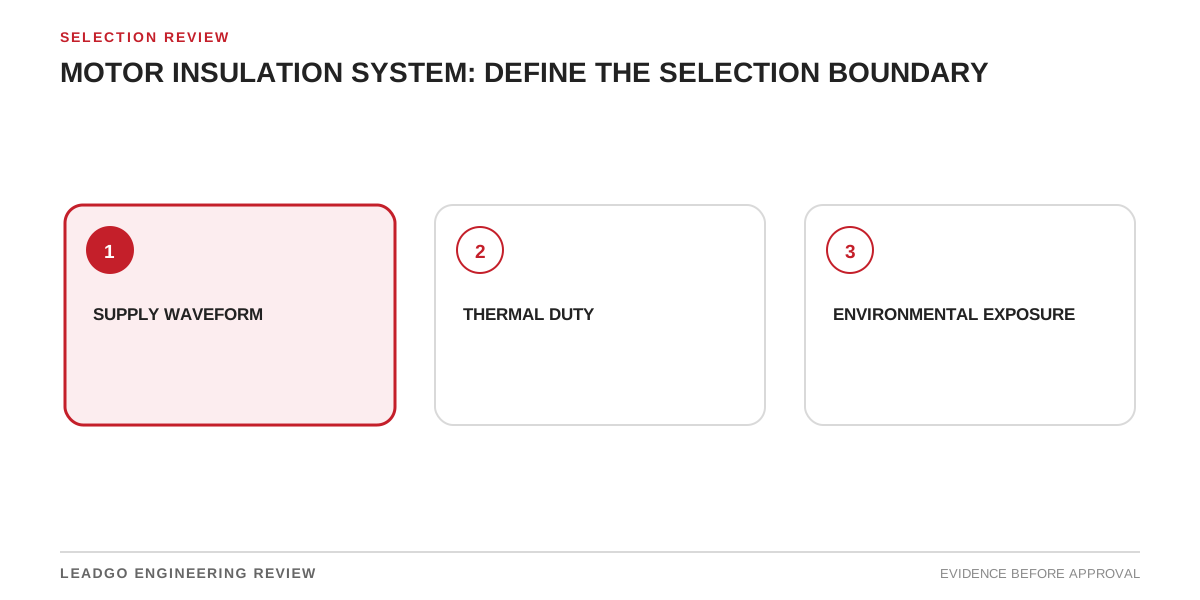
The insulation system must match electrical stress, temperature and environment together. A review that records only the final number leaves the source, condition and responsibility unclear; the insulation-system selection record must identify this boundary explicitly.
Set the boundary before choosing a value — insulation-system selection
Selection work is strongest when the load, environment, electrical supply and mechanical interface are reviewed as one package; the insulation-system selection record must identify this boundary explicitly. Catalogue ratings are a starting point; the purchase decision still needs a project-specific duty boundary and a controlled list of deviations; the insulation-system selection record must identify this boundary explicitly.
State the duty, site condition and equipment boundary before comparing options. Keep the model and document revision with manufacturer data; identify the engineering owner and operating case for plant inputs; the insulation-system selection record must identify this boundary explicitly.
Three checks that control the answer — insulation-system selection
| Step | Review point | What to confirm |
|---|---|---|
| 1 | Supply waveform | Define supply waveform and identify the controlled document or measurement that supports it. |
| 2 | Thermal duty | Confirm thermal duty under the stated operating condition rather than a nominal assumption. |
| 3 | Environmental exposure | Record environmental exposure with its source, revision and responsible reviewer. |
Read the three items together. A change at one boundary can move stress into the supply, controls, bearings, cooling system or driven equipment; record that trade-off with the decision; the insulation-system selection record must identify this boundary explicitly.
Where the review often fails — insulation-system selection
- Borrowing an unverified input. Using supply waveform from a similar motor or site. A similar frame or power does not prove that the operating boundary is the same; the insulation-system selection record must identify this boundary explicitly.
- Treating an interface as a late detail. Closing the review before environmental exposure is documented. That moves an unresolved interface into manufacture, installation or commissioning.
If an input is unavailable, request the exact drawing, calculation, test result or site measurement needed to close it; the insulation-system selection record must identify this boundary explicitly. A visible open action is safer than a borrowed number.
Keep a usable project record — insulation-system selection
Keep these items with the approval or maintenance record:
- source and operating condition for supply waveform
- dated evidence for thermal duty
- approved limit or disposition for environmental exposure
The record should show revision, date, reviewer and open assumptions. Photographs and field notes can support the decision, but controlled drawings, calculations and test reports remain the governing evidence where specified; the insulation-system selection record must identify this boundary explicitly.
Decision rule — insulation-system selection
The insulation system must match electrical stress, temperature and environment together. Apply that rule across the full operating envelope. If evidence is missing, name the document, measurement or responsible party required before manufacture, shipment, installation or energisation; the insulation-system selection record must identify this boundary explicitly.
Going deeper — insulation-system selection
- Electric Motor RFQ Checklist: What Buyers Should Specify.
- How to Read an Electric Motor Performance Curve.
Use a three-axis stress matrix — insulation-system selection
“Class F insulation” or a similar single label is not a complete selection. Map the combined stresses and identify the evidence needed for each.
| Stress axis | Project inputs | Supplier response required | Verification evidence |
|---|---|---|---|
| Electrical | Voltage, grounding, starts, transients, VFD waveform, cable/filter arrangement | Insulation system and turn/ground-wall suitability | Design statement and agreed test plan |
| Thermal | Load profile, starts, overloads, ambient, altitude, cooling and minimum VFD speed | Temperature-rise basis, margin and sensors | Heat-run or calculation tied to offered motor |
| Environmental | Humidity, condensation, dust, chemicals, salt, storage and cleaning | Materials, impregnation, sealing, heaters and preservation | Process description plus inspection requirements |
Close a row only when the response refers to the offered winding and operating condition. A brochure may describe a family but cannot resolve a project cable length, ambient range or chemical exposure.
Define the electrical boundary — insulation-system selection
State supply configuration, voltage/frequency range, grounding method, switching events and starting method. For VFD supply, provide drive topology, switching-frequency range, motor cable type/length, output filter or reactor, maximum frequency and braking arrangement. Motor and drive suppliers should agree on the waveform boundary at the terminals.
Separate turn-to-turn stress from ground-wall stress. Adequate thermal class may still need construction for repetitive fast-front pulses. A higher thermal-class label does not automatically solve waveform stress.
Define thermal duty as a profile — insulation-system selection
Include load versus speed, starts per period, acceleration time, stall/protection coordination, overload sequence, ambient, altitude and cooling restrictions. A constant-torque low-speed duty may need independent ventilation; intermittent high torque may be limited by thermal cycling rather than average power.
Specify sensors and alarm/trip ownership where consequences justify them. Sensor count, location and logic should address failure modes, not merely satisfy a checkbox.
Define environmental exposure — insulation-system selection
Describe condensation during shutdown, conductive dust, abrasive particles, salt, washdown, vapour and long storage. Identify cleaning method and heater control. Material names are insufficient if compatibility has not been reviewed against concentration, temperature and duration.
For spare or seasonal motors, request storage humidity/temperature limits, heater use, shaft rotation, inspection interval and release-from-storage checks.
Applicability and boundaries — insulation-system selection
This framework supports low- and high-voltage motor procurement, including sinusoidal and converter-fed duties. It does not select a proprietary system or prescribe test voltages. Those decisions belong to the responsible manufacturer and applicable project requirements.
Do not extrapolate from one sample or frame without design equivalence. Repaired motors need a specification preserving intended electrical, thermal and environmental performance. Hazardous-area construction adds certification controls treated separately.
Common specification errors — insulation-system selection
- Naming only thermal class and omitting allowable rise and duty.
- Requesting “inverter duty” without cable, switching and speed data.
- Assuming a heater prevents condensation without control philosophy.
- Applying a severe test by habit without considering age and purpose.
- Leaving sensors to vendor standard when protection is project-specific.
- Treating varnish colour as proof of capability.
Supplier RFQ checklist — insulation-system selection
Request system designation, material/process description, winding construction, impregnation, thermal class and rise basis, VFD limits, surge/withstand verification, sensor arrangement, heaters, environmental protection, storage controls and repair restrictions. Require deviations from the matrix to be explicit.
Decision and acceptance workflow — insulation-system selection
During bid review, compare unresolved stress rows, not labels. Before manufacture, freeze the drive/cable/filter interface and duty. At inspection, confirm winding identity and test plan. At site, verify connection, grounding, heater/sensor circuits and preservation before energisation.
Keep the final matrix with the record. If a drive, cable, process duty, ambient or cleaning chemical later changes, engineers can see which assumption was affected and reopen the relevant review.
Purchase hold points — insulation-system selection
Set a hold point before winding manufacture if the drive, cable, filter or duty profile is still provisional. Set a second hold point before final testing if the approved winding construction, sensor arrangement or environmental treatment has changed. The supplier should provide a deviation note that states the affected stress row and the replacement evidence.
At document review, check that the data sheet, winding specification, test plan and terminal drawing describe one configuration. A correct statement in one document does not resolve a contradictory value elsewhere. At final inspection, verify lead markings, sensor circuits, heater ratings and nameplate supply details against approved records.
For handover, identify maintenance actions that preserve the insulation basis: heater operation during shutdown, cleaning limits, approved test methods, storage controls and any restriction on converter settings. These are operating conditions, not optional brochure notes.