
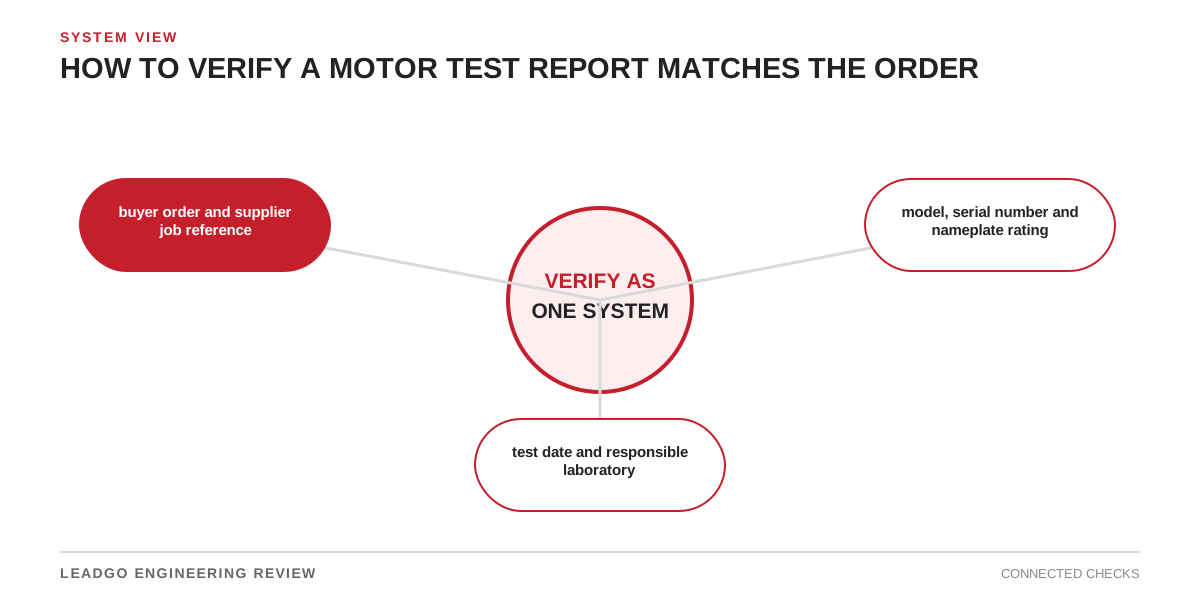
Read a motor test report in two passes. The first asks, “Is this report for the ordered and shipped motor?” The second asks, “Do the tests and results meet the agreed requirements?” Reversing that order wastes time reviewing numbers that may belong to another unit or another design revision.
Pass 1: close the identity chain
Start with the purchase order and move forward through the supplier’s records.
| Link | What should reconcile |
|---|---|
| Purchase order | Buyer reference, line item, quantity and agreed specification revision |
| Supplier job | Contract or works number and approved data-sheet revision |
| Motor identity | Model, serial number, rated power, voltage, frequency, speed/poles, duty and mounting |
| Drawing set | Outline, connection and accessory schedules applicable to the tested unit |
| Test event | Date, location, responsible organisation, report number and revision |
| Shipment | Nameplate/serial number and packing list match the reported machine |
A report for a “same type” unit may support a type-test obligation if the contract permits representative evidence. It should not be presented as the routine test record for a different serial number.
Pass 2: compare the report with the agreed test plan
Mark every required test as witnessed, reviewed, submitted by reference or not applicable. The required scope may come from IEC 60034-1, another applicable standard, the data sheet and project additions.
The IEC 60034-1 catalogue entry describes the current rating-and-performance standard for rotating machines. The standard includes routine-test and product-documentation requirements, but the project must still identify edition, deviations and any additional tests.
Do not confuse:
- routine tests, performed according to the applicable standard and production scope;
- type tests, used to establish characteristics of a design or representative machine; and
- special tests, added by agreement for a project or application.
The report should identify the method and standard edition when the result depends on them. For efficiency, vibration, noise, temperature rise or high-voltage testing, the measured value is meaningful only with the defined method and operating condition.
Review the raw structure of each result
For every acceptance item, look for five elements:
- the measured quantity and units;
- the operating point and connection;
- the method or instrument reference;
- the acceptance requirement; and
- the disposition, including any approved deviation.
A bare “PASS” is weak evidence when the contract calls for measured results. Conversely, a value should not be rejected because it differs from a catalogue example if the approved data sheet or tolerance permits it.
Check arithmetic and unit conversions. Confirm that phase labels remain consistent across winding resistance, no-load current and connection records. When values are corrected to a reference temperature or condition, the report should identify the correction basis.
Treat edits as controlled changes
Handwritten alterations, overwritten PDFs and unexplained replacement pages break traceability. A revised report should carry a new revision, change description, date and approval. If a retest was performed, keep the original result and state the reason for the retest and the final disposition.
Photographs of the nameplate and test setup can support the file. They do not replace report identity, calibration control or the agreed witness record.
A concise acceptance note
The reviewer should be able to close the document with a short statement:
Report [number/revision] is traceable to order [reference/line] and motor [serial number]. The submitted test scope matches ITP [revision], except for the listed deviations. Results meet the cited acceptance requirements subject to the open actions below.
Attach an open-item list rather than hiding gaps in email.
Release rule
Accept the report when identity, scope, method, result and disposition all reconcile with controlled documents. If any link is missing, request the exact correction or evidence; do not approve a report because its values merely look typical.
Related reading: