
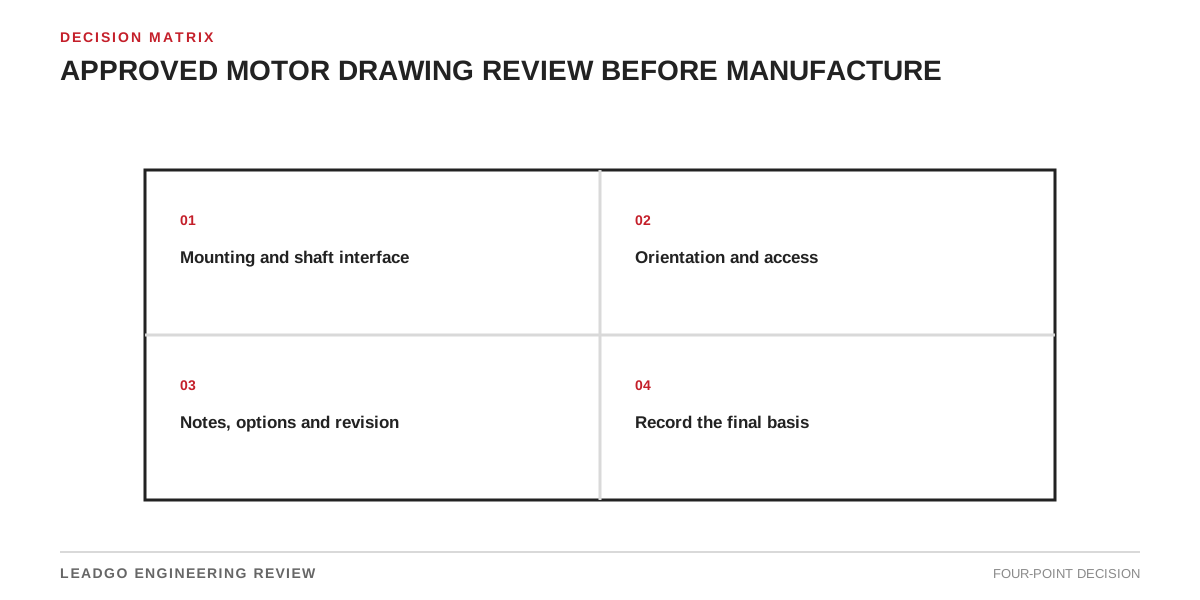
The most expensive drawing errors are rarely hard to understand. A cable cannot bend into the terminal box, a cooler tube bundle cannot be withdrawn, or a replacement shaft sits above the existing coupling. These failures occur when reviewers check dimensions individually without testing the installation as a whole.
Define what approval means
State whether the review is for information, approval, construction or final record. Record the drawing number, revision, motor tag and purchase-order item. Approval of one revision does not automatically approve a later change.
The buyer confirms project interfaces and stated options. The motor manufacturer remains responsible for its design and warranted performance. The driven-equipment supplier remains responsible for its equipment and transmitted loads.
Review fit in the installation coordinate system
| Review gate | Questions to close | Governing evidence |
|---|---|---|
| Mounting | Do feet, flange, shaft height and bolt pattern fit? | Foundation and driven-equipment drawings |
| Shaft line | Are diameter, extension, key and coupling space correct? | Coupling data and shaft detail |
| Orientation | Which end defines left/right and terminal-box position? | GA views and project convention |
| Access | Can covers, bearings, filters and coolers be removed? | Site layout and maintenance envelope |
| Cabling | Is entry direction compatible with bend radius and glands? | Cable schedule and routing |
| Lifting | Are lifting points accessible for motor-only handling? | Installation and handling plan |
Dimensions should be checked from a common datum. Adding several chain dimensions can hide tolerance accumulation; the mating interface needs the controlling dimension and tolerance.
Follow services and accessories to their connections
Locate space heaters, RTDs, bearing sensors, vibration probes, separately powered fans, oil piping and water connections. Confirm quantity, thread or flange, direction, voltage and terminal destination against the control schematic and data sheet.
A symbol without connection information is not a closed interface. A connection shown on the drawing but absent from the purchase scope is equally unresolved.
Test maintenance access on paper
Outline drawings often show the operating envelope but not the space needed for maintenance. Check rotor withdrawal, cooler removal, bearing replacement, terminal access and lifting paths. For a confined skid, mark the obstruction and required clearance directly on the review copy.
Direction-sensitive equipment also needs an unambiguous rotation arrow with its viewing end. This matters for fans, pumps, backstops and machines with one-direction bearings or lubrication arrangements.
Control notes, options and revisions
Read notes with the same care as dimensions. A general note can change coating, fasteners, tolerances or supply scope. Remove mutually inconsistent standard notes instead of expecting the factory to guess which one governs.
For every review comment, record one disposition: incorporated, rejected with reason, accepted as deviation, or still open. Compare revisions visually and by comment register before changing status to approved for manufacture.
Release decision
- Release only when all installation-critical dimensions are closed.
- Keep manufacture on hold if a mating drawing or site datum is missing.
- List accepted deviations in the purchase record, not only in email.
- Require an as-built revision when manufacture changes a controlled interface.
The final drawing package should let an installer identify the motor, orient it, place it, connect every service and plan maintenance without relying on memory.