
Hazardous Area

YBX4

YBX4 Series High-Efficiency Flameproof Three-Phase Induction Motor

The same flameproof construction as YBX3, one efficiency grade higher — grade 2 of GB 18613—2020, corresponding to IE4.
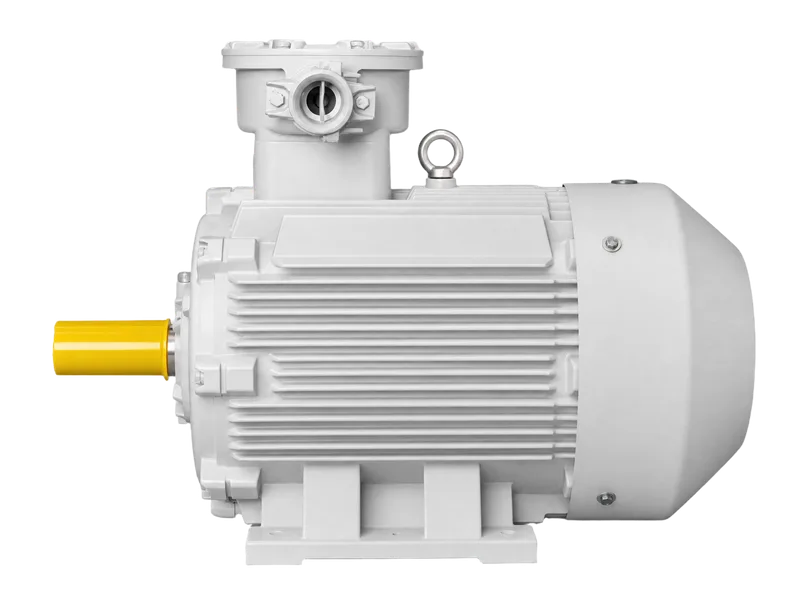
Ex db IIB T4 GbIE40.18–315 kW
YBX series flameproof three-phase induction motor

YBX4 is a totally enclosed, high-efficiency flameproof three-phase induction motor meeting grade 2 of GB 18613—2020 — the middle of the three-grade scale, above YBX3 at grade 3 and below YBX5 at grade 1.

Protection is by flameproof enclosure to GB/T 3836.1-2021 and GB/T 3836.2-2021, with the same two ratings as YBX3: Ex db I Mb for underground mining and Ex db IIB T1 Gb to T4 Gb for surface industrial plant.

Core specifications

ParameterValue
Frame sizeH80 – H355 mm
Power range0.18 – 315 kW
Explosion protectionEx db I Mb (mining) · Ex db IIB T1 Gb – T4 Gb (industrial)
Efficiency classIE4 · GB 18613—2020 grade 2
Voltage380 V · 660 V · 1140 V · 380/660 V · 660/1140 V, 50 Hz
Protection degreeIP55
Thermal class155 (F), assessed to class B rise
CoolingIC411
MountingB3 / B5 / B35

Standards and certification

  • GB/T 3836.1-2021
  • GB/T 3836.2-2021 (flameproof enclosure "d")
  • JB/T 14517-2022 (mining rating, frames 63–355)
  • GB 18613—2020 grade 2

Typical applications

  • Continuously running flameproof drives where efficiency accumulates
  • Underground mining (Ex db I Mb) and surface IIB plant
  • Hazardous-area retrofits replacing older flameproof machines

Selection guide

Like YBX3, YBX4 is certified to gas group IIB. It is not rated for hydrogen, acetylene or other group IIC atmospheres.
Identical envelope and identical protection concept; the difference is efficiency grade and price. Where the motor runs continuously, the higher grade returns the premium through energy. Two things to settle before a like-for-like swap: the product standards guarantee a locked-rotor current roughly 15 to 25 per cent higher than YBX3, and a locked-rotor torque about 10 per cent lower. Those are the guaranteed envelopes rather than measured values, and our engineering department reports that the measured difference between the two series is smaller than the envelope suggests — so in practice the swap is usually uneventful. It is still a check worth doing: confirm the starter, the protection settings and whether the load still breaks away, and ask for the measured locked-rotor figures of the specific rating if the margin is tight.
This is where the gap is widest. The eight-pole column of YBX4 is complete and reaches grade 2, while YBX3 follows a product standard written before eight-pole efficiency grades existed at all. At eight poles the two series are not one grade apart — they are on different footings.

FAQ

Certification copies for the explosion-protection marking, and the dimension drawings for your frame size, are issued on request. Tell us the area classification, gas or dust group and temperature class for your site.

Downloads

DatasheetPDF · 822 kBDownload
Installation & maintenance manualInstallation, commissioning and servicingRequest
CertificationCertificates and test reportsRequest

Certificates and test reports are issued against the specific model and rating rather than the series, so we send the ones that apply to your order. Tell us the rating and the market and we will send them.

Related products

Technical articles on this series

Approved Motor Drawing Review Before Manufacture

A practical motor drawing review covering dimensions, shaft and mounting interfaces, orientation, accessories, notes and revision control.

Read

ATEX vs IECEx vs NEC: Explosion-Proof Motor Certification Guide

Compare ATEX, IECEx and NEC motor certification: classification, gas groups, temperature class, markings and certificate scope.

Read

Belt Drive Sheave Alignment and Motor Overhung Load

A practical belt-drive review covering sheave alignment, belt pull, shaft overhang, bearing load and the final installed condition.

Read

Reading a Chinese Motor Model Number: What Each Segment Commits To

YBX4-280S4-W is four segments in a fixed order, and the second character tells you the protection type before you find the Ex plate.

Read

Dust-Hazard Motor Housekeeping: Cooling and Ignition Control

Inspect dust layers, cooling paths, leaks and cleaning methods around motors in combustible-dust locations without disturbing certified protection.

Read

Dust Layer vs Cloud Ignition Temperature

Why dust-cloud and dust-layer ignition temperatures are different inputs, and how they affect motor surface-temperature selection.

Read

Equipment Protection Levels: Ga, Gb, Gc, Da, Db and Dc Explained

Understand Ex equipment protection levels Ga, Gb, Gc, Da, Db and Dc, how they relate to fault conditions, and what must match the hazardous area.

Read

Ex db vs Ex db eb Motors: The Terminal-Box Difference

Practical engineering guidance on ex db vs ex db eb motors: the terminal-box difference, including the checks, evidence and common mistakes that matter befor

Read

Ambient Temperature on an Ex Motor Certificate

Practical engineering guidance on ambient temperature on an ex motor certificate, including the checks, evidence and common mistakes that matter before purch

Read

Ex t vs Ex d Motors: Dust and Gas Need Different Protection

Why Ex t dust-protected and Ex d flameproof motors address different hazards, and what buyers must verify when gas and dust may both be present.

Read

Explosion-Proof Cable Glands: Part of the Protection System

How to match a hazardous-area motor cable gland to the protection concept, entry thread, cable construction and certificate conditions.

Read

Explosion-Proof Motor Fasteners: Replacement and Inspection

How to identify, replace and inspect enclosure fasteners without compromising an explosion-protected motor's certified construction.

Read

Explosion-Proof Motor Inspection: Scope, Frequency and Records

Plan visual, close and detailed inspections for explosion-protected motors, with clear escalation and return-to-service evidence.

Read

Ex db IIB T4 Gb Meaning: Reading the Marking

Ex db IIB T4 Gb is five separate decisions written as one string. What each segment answers, and why none substitutes for another.

Read

Repainting Explosion-Proof Motors: Masking and Inspection Rules

Plan surface preparation and repainting without covering Ex markings, flamepaths, earthing contacts, drains or evidence of enclosure damage.

Read

What a Flameproof Joint Does, and Why It Cannot Be Re-Machined

A flameproof enclosure does not keep gas out. It lets the explosion happen inside and cools what escapes, through a gap that is a certified dimension.

Read

Hazardous Area Classification: Who Does It and Who Carries the Risk

Classification describes the place, not the motor. The owner or designer decides it before any equipment is specified — and the drawing is what you buy against.

Read

High No-Load Current in an Induction Motor

A practical fault-isolation sequence for high no-load current, covering test boundary, supply, connection, mechanical drag and motor-specific evidence.

Read

IEC 60034-2-1 vs IEEE 112 Efficiency Tests

Practical engineering guidance on iec 60034-2-1 vs ieee 112 efficiency tests, including the checks, evidence and common mistakes that matter before purchase

Read

Increased Safety vs Flameproof Motors: What Changes?

How Ex eb increased-safety and Ex db flameproof motor concepts differ, and what buyers must confirm before selecting either one.

Read

Industrial Motor Data Sheet Review: Fields That Must Agree

A buyer-side method for finding contradictions between motor ratings, duty, environment, mechanical interfaces, protection and drawings.

Read

Export Packaging and Storage for Industrial Motors

How to specify export packing, transport restraints, moisture control and storage maintenance for industrial electric motors.

Read

Locked-Rotor and Stall Protection for Industrial Motors

How to separate normal acceleration, failure to accelerate and a running jam using motor thermal limits, speed evidence and load behaviour.

Read

Coastal Motor Specification: Salt, Condensation and Corrosion Control

A procurement checklist for motors exposed to salt, humidity, condensation, outdoor storage and marine maintenance conditions.

Read

Mixer Motor Sizing for Changing Viscosity and Batch Starts

Select agitator motors and VFDs when viscosity, fill level, impeller torque and starting condition change during the batch.

Read

Motor Drain Plugs and Condensation Management

Coordinate motor drains, mounting orientation, space heaters and inspection routines without compromising enclosure or certification requirements.

Read

Motor Bearing Internal Clearance: When C3 Is Not a Default

A clear method for reviewing motor bearing internal clearance using fit, temperature, speed, load and the actual bearing arrangement.

Read

Motor Bearing Storage and Handling: Receiving-to-Assembly Controls

Prevent bearing damage before motor assembly through traceable receiving, clean storage, correct heating and force application.

Read

Motor Feeder Voltage Drop During Running

Calculate and measure motor-terminal voltage under real load, including conductor temperature, joints and phase balance, then assess torque and heating.

Read

Motor Cable Terminations: Electrical Fit and Mechanical Stress

Check motor cable lugs, glands, bend radius, support, phase spacing and screen termination without loading terminal studs or insulators.

Read

Motor Code Letters and Locked-Rotor Starting Current

The nameplate code letter is locked-rotor kVA per horsepower, not amps. On a dual-frequency motor it refers to 60 Hz. Both catch people replacing motors.

Read

Motor Commissioning Baseline Data Worth Keeping

Create a repeatable electrical, thermal, vibration and process baseline at handover so future condition changes can be judged against evidence.

Read

Motor Core Loss Testing Before and After Rewind

Compare stator-core condition before stripping and after repair using a controlled method, mapped hot spots and traceable acceptance criteria.

Read

Motor Earth-Fault Protection: Settings Need a System Study

A practical method for selecting motor earth-fault protection from system grounding, sensor placement, feeder boundaries and coordination evidence.

Read

Motor Factory Acceptance Test Checklist

Practical engineering guidance on motor factory acceptance test checklist, including the checks, evidence and common mistakes that matter before purchase or

Read

Motor Factory Test Witness Plan: Hold, Witness and Review Points

Turn a motor inspection and test plan into clear hold, witness and document-review points with criteria, notice and release authority.

Read

Motor Grounding and Earthing: Installation Checklist

Separate protective bonding from cable-screen and high-frequency current paths, then verify the installed motor before energisation.

Read

High-Potential Testing: What a Pass Result Does Not Prove

How to specify and review a motor high-potential test without confusing dielectric withstand with a complete insulation-condition assessment.

Read

Motor Insulation Resistance After Cleaning or Washdown

A controlled return-to-service process after motor washing, flooding response or wet cleaning, including drying, IR trending and inspection.

Read

Motor Bearing Grease Compatibility: A Safe Changeover Checklist

Identify existing grease, verify compatibility, calculate relubrication needs and plan a controlled purge without overgreasing.

Read

Motor Nameplate Data and Document Control

Keep motor nameplate, approved data sheet, test report and drawings aligned through manufacture, inspection, commissioning and replacement.

Read

Motor No-Load Run Test: A Practical Checklist

Record supply, current, direction, vibration, bearing condition and temperature during a motor no-load run so results remain comparable.

Read

Motor Overload: Process, Mechanical or Electrical?

Use time-aligned process and electrical evidence to separate real load growth from supply, mechanical, cooling, motor and protection problems.

Read

Motor Paint Damage and Field Corrosion Repair

Assess coating damage, corrosion depth, surface preparation and touch-up compatibility before returning an industrial motor to service.

Read

Motor Preservation When Commissioning Moves by Months

A storage control plan for industrial motors when project delays extend beyond transport packaging and the original commissioning date.

Read

Motor Rewind vs Replace: A Decision Framework

In a controlled EASA/AEMT study, best-practice rewinds held efficiency within 0.2 points. Here is how to apply that evidence without overgeneralising it.

Read

Motor Rotation Bump Test: Scope, Readiness and Safety

Plan a controlled direction check only after mechanical, process, electrical and communication risks have been cleared.

Read

Motor Shaft Key and Keyway Fit: Avoiding Fretting

What to verify in a motor shaft key and keyway connection before assembly, including fit, contact, retention and hub installation evidence.

Read

Motor Receiving Inspection: Find Shipping Damage Early

A receiving checklist for crates, shock indicators, shaft locks, moisture, bearings, accessories and claim evidence before storage.

Read

Motor Space Heater Control Logic: Interlocks, Alarms and Commissioning

Define when a motor anti-condensation heater is energised, how it is interlocked and what must be tested before service.

Read

Explosion-Proof Motor Temperature Classes T1 to T6

Compare T1 to T6 maximum surface temperatures, learn why T6 is the strictest class, and select a motor class from the gas ignition temperature.

Read

Motor Terminal Box Position and Cable Entry Planning

A layout review for motor terminal boxes covering orientation, cable bend, gland space, phase segregation and maintenance access.

Read

How to Read a Motor Torque-Speed Curve

Read locked-rotor, pull-up, breakdown and rated torque on one curve, then compare the motor with the real load and starting voltage.

Read

Motor Winding Resistance: When a Phase Difference Matters

A field method for comparing motor winding resistance without confusing temperature, test leads or terminal connections with a winding defect.

Read

PTC Thermistors vs RTDs for Motor Temperature Protection

A practical comparison of PTC thermistors and RTDs in motor protection, including measurement purpose, wiring and trip logic.

Read

Reciprocating Compressor Motors: Loaded vs Unloaded Start

How unloading, pressure equalisation, pulsating torque and restart conditions change motor selection for reciprocating compressors.

Read

Repairing Explosion-Proof Motors: Records That Matter

Practical engineering guidance on repairing explosion-proof motors: records that matter, including the checks, evidence and common mistakes that matter befor

Read

Replacement Motor Interchangeability Checklist

A side-by-side method for checking electrical, mechanical, thermal, environmental and certification compatibility before replacing a motor.

Read

Site Acceptance Testing for Industrial Motors

A risk-based site test plan that verifies installation, protection and operating behaviour without blindly repeating factory tests.

Read

Soft Foot in Motor Installations: Checks Before Alignment

How to identify and document soft foot before motor alignment, with practical checks for shims, base distortion and bolt sequence.

Read

Spare Motor Storage and Periodic Inspection

A practical preservation plan for stored motors covering environment, bearings, heaters, insulation records and release to service.

Read

Surge Comparison Testing for Motor Windings

How to control winding scope, test connections and trace comparisons before treating a surge-test difference as a turn-insulation defect.

Read

Thermal Overload Relay Settings: Protect the Motor, Not a Number

A field-ready method for setting motor thermal overload protection from nameplate data, starting duty, cooling condition and relay behaviour.

Read

How to Verify an Explosion-Proof Motor Certificate

A certificate covers a model and rating, not a product family. Five checks — and the one suffix that changes what you may do with the motor.

Read

How to Verify a Motor Test Report Matches the Order

A document-control and engineering check for linking a motor test report to the purchase order, manufactured unit and agreed test scope.

Read

YBX3 vs YBX4 vs YBX5: Select by Lifecycle, Not Label Alone

A practical comparison of YBX3, YBX4 and YBX5 flameproof motor efficiency routes, including starting, certificates and payback inputs.

Read

From Zone to Motor: What a Zone 1, 2, 21 or 22 Area Actually Requires

The area classification comes first, the nameplate later. Here is the zone-to-protection-level correspondence, from the installation standard.

Read

Request a quote — YBX4

Tell us the rating, quantity and application and an engineer will come back with a specification, the documents for that model, and a price.

Contact Sales