
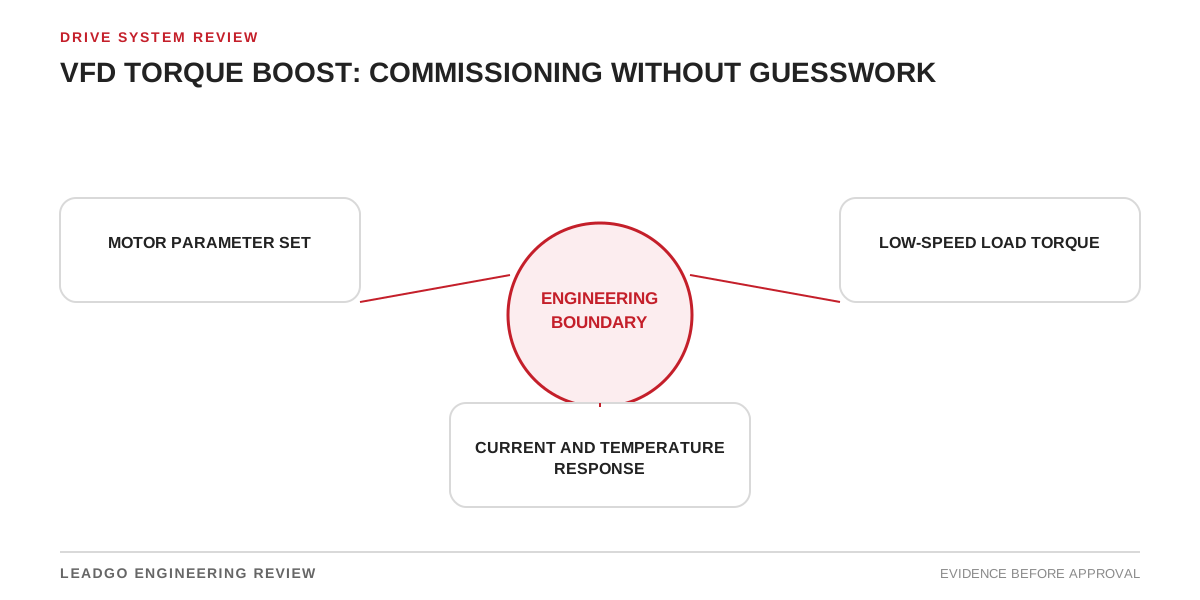
Use the minimum boost that starts and controls the load without excessive current or heating. Project teams should be able to reproduce the decision without relying on memory or an email fragment; the torque-boost commissioning record must identify this boundary explicitly.
Define what the review must prove — torque-boost commissioning
A variable-frequency drive changes voltage waveform, motor heating, bearing-current exposure, speed range and control behaviour; the torque-boost commissioning record must identify this boundary explicitly. Review settings and hardware as one drive system, with the actual cable, load and operating range included; the torque-boost commissioning record must identify this boundary explicitly.
Fix the review point in time: proposal, approved design, factory test, installation or operating condition; the torque-boost commissioning record must identify this boundary explicitly. A value can be correct in one state and misleading in another; the torque-boost commissioning record must identify this boundary explicitly.
The evidence chain — torque-boost commissioning
| Step | Review point | What to confirm |
|---|---|---|
| 1 | Motor parameter set | Record motor parameter set with its source, revision and responsible reviewer. |
| 2 | Low-speed load torque | Define low-speed load torque and identify the controlled document or measurement that supports it. |
| 3 | Current and temperature response | Confirm current and temperature response under the stated operating condition rather than a nominal assumption. |
Compare the inputs on one common basis. Mixing a rated value, a temporary site reading and a worst-case calculation can produce a neat answer that does not describe a real condition; the torque-boost commissioning record must identify this boundary explicitly.
What a checklist can miss — torque-boost commissioning
- Borrowing an unverified input. Using motor parameter set from a similar motor or site. Small differences in supply, mounting, load or environment can change the result; the torque-boost commissioning record must identify this boundary explicitly.
- Treating an interface as a late detail. Closing the review before current and temperature response is documented. Approval should show the open action instead of burying it in a general note; the torque-boost commissioning record must identify this boundary explicitly.
Where the evidence is incomplete, define what must be supplied and who owns it; the torque-boost commissioning record must identify this boundary explicitly. The review can remain provisional without pretending the boundary is settled.
What belongs in the closeout record — torque-boost commissioning
Keep these items with the approval or maintenance record:
- source and operating condition for motor parameter set
- dated evidence for low-speed load torque
- approved limit or disposition for current and temperature response
Keep the evidence with the equipment identity and operating case. A standalone screenshot or number is difficult to audit once the project team and site condition change; the torque-boost commissioning record must identify this boundary explicitly.
Decision rule — torque-boost commissioning
Use the minimum boost that starts and controls the load without excessive current or heating. The decision is complete when the stated inputs refer to the same equipment, revision and operating case; the torque-boost commissioning record must identify this boundary explicitly. Otherwise record the gap and its owner.
Going deeper — torque-boost commissioning
Torque-boost tuning worksheet — torque-boost commissioning
Treat boost as a controlled commissioning variable, not a knob to turn until the shaft moves. Record one row for each trial so another engineer can reproduce the decision.
| Trial field | Record before or during the run | Stop or hold condition |
|---|---|---|
| Motor model and connection | Nameplate values, winding connection, rated frequency and current | Data do not match the drive parameter set |
| Control mode and identification | Scalar/vector mode, autotune type, measured motor parameters | Identification incomplete or inconsistent with motor data |
| Load state | Coupled/uncoupled, process condition, brake or static friction state | Load condition is unknown or unsafe |
| Boost command | Method, value and frequency region where applied | Change exceeds the approved trial increment |
| Response | Start time, minimum speed, current, torque estimate and oscillation | Overcurrent, unstable speed, reverse movement or protection operation |
| Thermal check | Temperature indicators and repeated-start count | Temperature trend or starts per period exceeds the approved limit |
| Decision | Retain, reduce, investigate load or change control method | Evidence cannot separate motor and load causes |
The goal is the lowest setting that gives repeatable acceleration and stable low-speed operation for the defined load. More boost is not extra starting capacity without consequence: it can raise magnetising current and heating, especially where the motor spends time at low speed with reduced self-cooling.
Commissioning sequence — torque-boost commissioning
First verify the hardware boundary. Confirm motor lead connection, phase balance, insulation checks, encoder orientation where fitted, drive output cable arrangement, grounding, cooling auxiliaries and mechanical freedom. A tight process machine, wrong brake state or incorrect motor connection can imitate insufficient boost. Do not compensate for those faults in software.
Second, load the correct motor parameters from controlled data. Where the drive offers identification or autotune, follow the drive manufacturer’s prerequisites and record whether the test was static or rotating. Do not copy a parameter set from a similar frame. Stator resistance, rated flux data and current scaling can materially change low-speed control.
Third, establish a low-risk baseline with boost at the drive’s justified default or minimum setting. Trend speed command, actual speed, output current and relevant torque estimate. For a coupled machine, have the process owner define the starting condition: valve position, material head, conveyor loading, lubricant temperature or brake release timing.
Increase boost only in an approved small step, repeat the same starting condition and compare the traces. If current rises but acceleration does not improve, stop increasing boost and investigate breakaway torque, binding, parameter error or voltage limitation. Once a setting works, repeat the start after a realistic dwell or temperature condition. A single warm, unloaded start is weak evidence for a cold production start.
A comparison example — torque-boost commissioning
Suppose Trial A starts a loaded machine in 7.2 seconds at a peak measured current of 1.45 per unit. A modest boost change in Trial B reduces start time to 6.8 seconds but increases peak current to 1.72 per unit. Trial C adds more boost, reaches 1.95 per unit and still starts in 6.8 seconds. Trial B may be the useful boundary; Trial C adds electrical and thermal stress without a measurable acceleration benefit. The actual acceptance still depends on motor, drive, protection and process limits, but the comparison makes the decision auditable.
Applicability and limits — torque-boost commissioning
This method applies to drive functions described as torque boost, voltage boost, IR compensation or a comparable low-frequency voltage correction. The labels and algorithms differ by manufacturer. It is not a universal formula and it does not replace vector-control tuning where accurate torque at zero or very low speed is required.
Do not use torque boost to solve an undersized motor, inadequate drive current rating, excessive voltage drop, a mechanically jammed load or incorrect acceleration ramp. For explosion-protected motors, low-speed thermal protection and certification conditions require specific review. For long motor cables or output filters, confirm that the drive/motor terminal voltage and waveform remain within the supplier’s system limits.
Common commissioning mistakes — torque-boost commissioning
- Adjusting boost with the driven machine condition changing between trials.
- Looking only at whether the shaft starts, without recording current and temperature response.
- Applying a high fixed boost across a wider frequency range than needed.
- Repeating starts without respecting the motor’s allowed thermal duty.
- Treating a drive torque estimate as a calibrated shaft-torque measurement.
- Hiding a poor result by extending the acceleration time without checking process requirements.
Information to request from suppliers — torque-boost commissioning
Ask the motor supplier for rated data, connection, thermal limits, permissible starts, cooling method, minimum continuous speed where relevant and any VFD supply restrictions. Ask the drive supplier for the definition and range of the boost function, the parameters it depends on, autotune requirements, current-limit interactions and recommended trend signals. Ask the driven-equipment supplier for breakaway and running torque across speed, expected cold/high-load cases, inertia and allowable acceleration time.
The final commissioning record should contain the chosen setting, software revision, parameter backup, trial traces, load condition, protection state and approval. That record is the starting point for future troubleshooting; without it, a later technician may increase boost again and erase the original safety margin.