
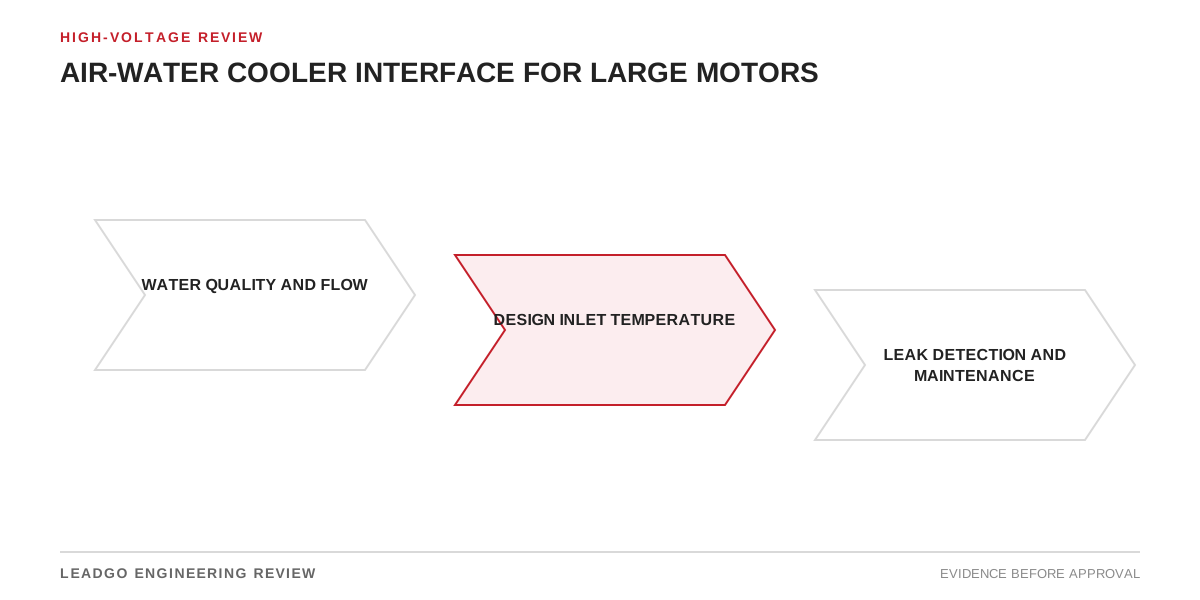
An air-water-cooled motor transfers internal heat to plant water through a heat exchanger. Its quoted output and temperature rise depend on conditions at that boundary.
| Interface | Buyer supplies | Motor supplier returns |
|---|---|---|
| Thermal | Maximum inlet temperature and ambient | Required flow and heat rejection |
| Hydraulic | Available pressure and connection limit | Pressure drop and allowable pressure |
| Water chemistry | Analysis and treatment regime | Material limits and cleaning guidance |
| Protection | Alarm/trip philosophy | Sensors, contacts and recommended setpoints |
Close normal and failure cases
Check minimum flow, maximum inlet temperature, fouling margin and degraded operation. Define whether loss of water causes immediate trip, controlled unload or standby transfer. A motor temperature alarm alone may react too late for the intended process response.
Review tube and header materials against water chemistry. State whether the circuit is closed, open or seawater-derived, and identify strainers, isolation valves, vents and drains supplied by each party.
For acceptance, retain cooler data, hydraulic calculation, water analysis, P&ID, sensor list, leak test and functional trip test. Provide physical access for cleaning or bundle removal.
Related reading: 6 kV and 10 kV high-voltage motor selection and motor cooling method IC codes.