
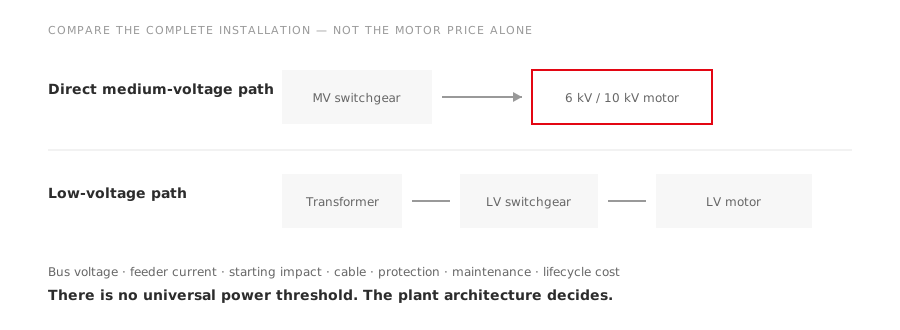
The cost comparison between a high-voltage motor and a low-voltage motor is often made too narrowly. One quotation contains an expensive motor; the other appears cheaper until the transformer, switchgear, feeder and installation work are added.
Direct answer
A 6 kV or 10 kV motor makes sense when it fits the plant’s existing medium-voltage distribution and avoids excessive feeder current, conductor size or voltage drop. A low-voltage motor can be the better system choice when the rating and feeder are manageable, low-voltage infrastructure already exists, and the site benefits from simpler switching and maintenance.
There is no universal output at which high voltage becomes mandatory. The crossover changes with cable length, bus voltage, starting method, duty, local equipment cost and the site’s maintenance organisation.
Compare complete systems
| Question | Direct high-voltage motor | Low-voltage motor supplied through a transformer |
|---|---|---|
| Plant interface | Connects to the matching MV bus through MV equipment | Adds a transformer and LV distribution stage |
| Feeder current | Lower at the same power and power factor | Higher on the motor side |
| Cable requirement | Often smaller current-carrying cross-section, but MV cable and terminations need specialist work | Larger conductors or parallel runs may be needed |
| Starting | Requires an MV starting or drive solution and a network-impact check | More LV starter and drive options, but high current still affects transformer and bus |
| Maintenance | MV competence, procedures and spares are required | LV equipment may be more familiar and widely supported |
| Protection | MV relays, instrument transformers and coordination | Transformer plus LV protection must be coordinated |
| Footprint | Avoids a dedicated step-down stage where the bus matches | Transformer and LV switchgear add space and heat |
The correct comparison includes installed capital cost, losses, planned maintenance, spares, outage consequence and the expected operating life.
Why current changes the decision
For the same three-phase power and power factor, increasing voltage reduces line current. Lower current can reduce voltage drop, conductor requirement and feeder loss. The benefit grows with power and distance, but it is not free: insulation coordination, terminations, switching and test procedures become more demanding.
This is why a compact plant with a short feeder can reach a different answer from a mine, cement plant or pipeline station with long distribution runs, even at the same shaft power.
Starting can decide the architecture
Ask how the motor will accelerate the actual load. Direct-on-line starting, reduced-voltage starting, soft starting and variable-frequency starting impose different requirements on the network and motor.
A system study should check:
- starting current and bus-voltage dip;
- load torque and acceleration time;
- starts per hour and thermal recovery;
- transformer capacity if an LV route is used;
- fault level and protection coordination;
- whether speed control is required.
Do not choose voltage first and try to force the starting method around it later.
6 kV versus 10 kV
The established plant bus normally has more influence than the motor catalogue. Standardising on the site’s voltage reduces special switchgear, cable, relay, training and spare-parts requirements.
LEADGO’s YKK and YXKK high-voltage induction motors are documented against JB/T 12730—2016 for the 6 kV range and JB/T 12729—2016 for the 10 kV range. The specific rating, efficiency requirement, cooling method, starting duty and driven load still need to be selected together.
Information needed for a useful quotation
Send:
- available bus voltage, frequency, fault level and earthing method;
- shaft power, speed, load curve and inertia;
- feeder route and approximate length;
- starting method and permitted voltage dip;
- duty, starts per hour, ambient and altitude;
- enclosure, cooling and installation arrangement;
- site MV and LV maintenance capability;
- the required efficiency and test standard.
If the commercial comparison does not include the transformer and both sides of the switchgear, it is not yet a system comparison.