
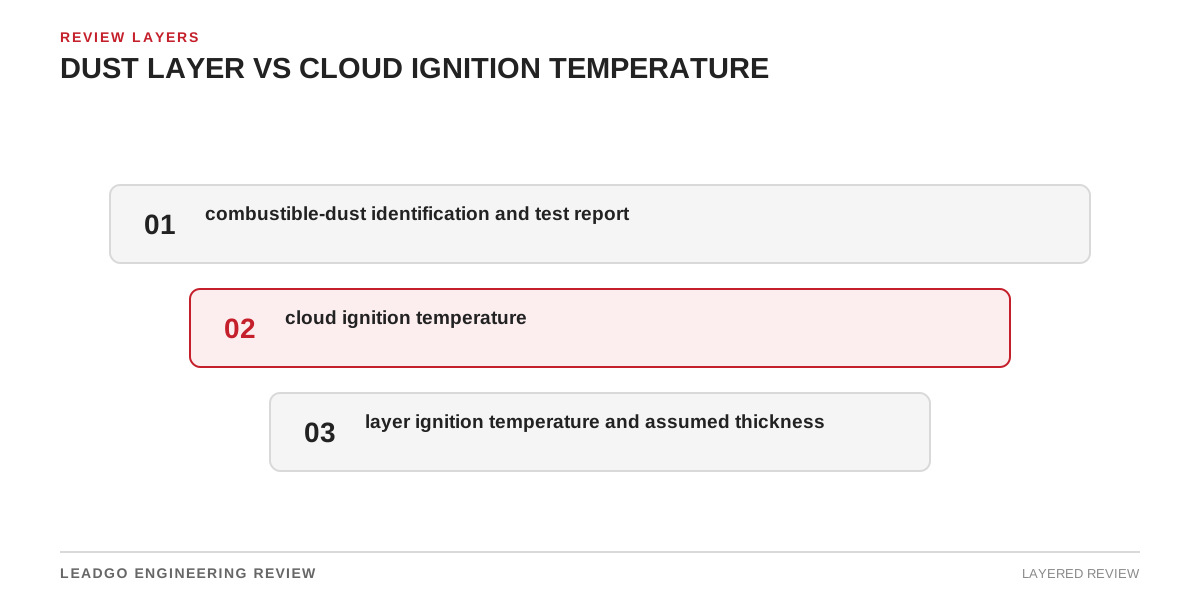
Combustible dust has two hot-surface questions. Can a dispersed cloud ignite? Can a settled layer ignite or begin to smoulder? The tests represent different physical conditions, so one result cannot be substituted for the other.
Cloud and layer results answer different questions
Minimum ignition temperature of a dust cloud concerns a dispersed concentration of dust exposed to a hot environment under a defined test method. The result is relevant to an explosive dust atmosphere.
Minimum ignition temperature of a dust layer concerns dust deposited on a heated surface under a specified layer thickness and test condition. A layer can insulate the equipment, retain heat and change behaviour as thickness or exposure time changes.
The UK’s Health and Safety Executive notes that the temperature required to ignite a dust layer depends on layer thickness and contact time. Its combustible-dust guidance also recommends testing dust representative of the process because composition and particle size affect explosibility.
The required input is a dust report, not a material name
“Flour”, “coal” or “plastic powder” is not sufficient selection data. Obtain a laboratory report linked to a representative sample and record:
- product and process location;
- particle-size distribution and moisture condition;
- cloud ignition temperature and test method;
- layer ignition temperature, test method and layer thickness;
- dust group or conductivity information required by the area standard; and
- other explosion parameters needed by the site’s protection design.
If process changes can create a finer, drier or contaminated dust, the site specialist should decide which sample governs.
Convert the data into an equipment limit
The responsible hazardous-area designer applies the selected edition of the installation standard and local law. The motor supplier then confirms that the motor marking, certificate conditions and maximum surface temperature comply with that requirement at the stated ambient, load and dust condition.
| Input owner | Information to close |
|---|---|
| Process/site | Representative dust data and credible layer accumulation |
| Area-classification designer | Zone, equipment protection level, dust group and permitted surface temperature |
| Motor supplier | Marking, certificate, ambient range and surface-temperature capability |
| Operations | Housekeeping and inspection controls that keep accumulation within the design basis |
IEC 60079-31 addresses equipment protected by enclosure “t” and surface-temperature limitation for explosive dust atmospheres. Use the current project-specified edition; do not lift a shortcut formula from an older guide without checking its applicability.
Why housekeeping cannot be an afterthought
A motor cooling system selected for clean service can run hotter when fins, screens or air paths are covered. A dust layer also changes the hot-surface condition assumed by the area design. If the selection depends on a maximum layer thickness, the inspection and cleaning programme must make that thickness credible.
The HSE’s safe handling of combustible dust guidance warns that deposits can block ventilation and that equipment surface temperature must remain below the temperature capable of igniting either a layer or a cloud.
Common errors to reject
- Using only the cloud result because it is the higher or more familiar number.
- Treating a generic database value as representative of the plant sample.
- Applying gas temperature-class logic without the dust-specific requirements.
- Ignoring dust on non-motor surfaces that can fall, be disturbed or form a secondary cloud.
- Selecting the motor at one ambient temperature while the certificate or process specifies another.
- Relying on housekeeping without defining inspection frequency and responsibility.
Release rule
Release the motor selection when the dust report, area classification, permitted surface temperature, motor certificate and housekeeping basis refer to the same process condition. If layer thickness or sample identity is unknown, the temperature selection is not closed.
Related reading: