
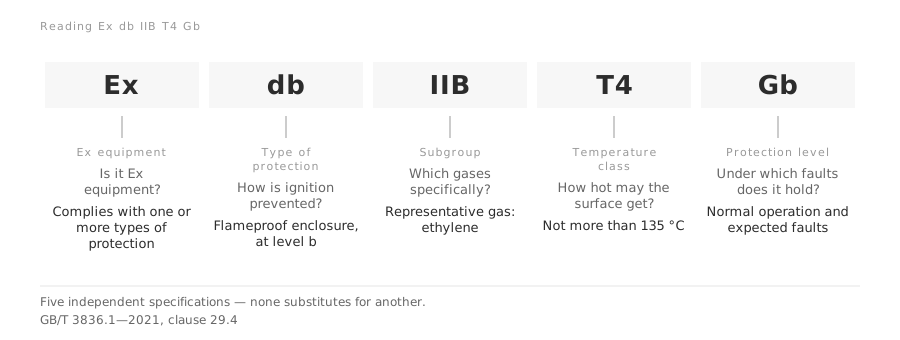
A motor nameplate carrying Ex db IIB T4 Gb looks like one specification. It is five, and they are independent of each other. A buyer who matches four of them and assumes the fifth is the one who ends up with a certificate that does not cover the area the motor is standing in.
Direct answer
Read the marking left to right. Each segment answers a different question:
| Segment | Answers | Example values |
|---|---|---|
| Equipment group | What kind of atmosphere? | I, II, III |
| Type of protection | How is ignition prevented? | d, e, t, n, p |
| Subgroup | Which gases or dusts specifically? | IIA, IIB, IIC / IIIA, IIIB, IIIC |
| Temperature class | How hot is the surface allowed to get? | T1 to T6 |
| Equipment protection level | Under what fault conditions is it still safe? | Ga, Gb, Gc / Da, Db, Dc / Ma, Mb |
None of them substitutes for another. A motor can be correct on protection type and wrong on subgroup, and the marking will still look reassuring.
1. Equipment group — the first fork
GB/T 3836.1—2021 divides equipment into three groups by the atmosphere it is intended for:
- Group I — equipment for coal-mine firedamp atmospheres.
- Group II — equipment for all other explosive gas atmospheres. Subdivided further.
- Group III — equipment for explosive dust atmospheres other than coal mines. Subdivided further.
This is the fork that catches people out most expensively, because a Group II certificate is a real certificate — it just does not cover underground mining. Mining motors carry a Group I marking and a mining protection level.
2. Type of protection — gas and dust are different, not stronger and weaker
The second segment says how ignition is prevented, and this is the point where the two main families separate:
- Flameproof “d” is for gas. The enclosure is built so that an explosion occurring inside it does not propagate to the atmosphere outside. It does not keep gas out; it contains the consequence. That containment depends on the certified gap and length of the flameproof joints.
- Enclosure protection “t” is for dust. Here the enclosure does keep the dust out, and the protection also depends on limiting the enclosure’s surface temperature so a settled dust layer cannot be ignited.
- Increased safety “e” takes a third approach: no arcing or hot surfaces are permitted in normal operation, with additional measures to make them unlikely under fault.
A motor certified for gas is not thereby certified for dust. The mechanisms are different, the standards are different parts of the same series, and the markings are different. Where an area has both, the motor needs both markings.
3. Subgroup — which gases, which dusts
Group II is subdivided by the ease with which the gas ignites and propagates: IIA, IIB and IIC, with IIC the most demanding. Hydrogen and acetylene sit in IIC. A motor certified to IIB is not certified for a IIC area, and this is not a margin you can argue about — it is a different test.
Group III is subdivided the same way for combustible flyings, non-conductive dust and conductive dust, with IIIC the most demanding.
If you do not know the subgroup of the atmosphere on your site, that is the question to answer before specifying a motor, not after.
4. Temperature class — and what actually sets it
The temperature class is a classification based on the maximum surface temperature of the equipment, related to the specific explosive gas atmosphere it is intended for.
For Group II equipment, the measured maximum surface temperature must not exceed whichever of these applies: the limit for the specified temperature class, a specified maximum surface temperature, or the ignition temperature of the specific gas in the intended atmosphere.
Two practical consequences follow:
- The numbering runs against intuition. T1 allows the highest surface temperature; T6 the lowest. T6 is the harder requirement.
- Anything that raises surface temperature attacks this specification directly. A drive that was not matched to the motor, a blocked cooling path, or a layer of dust insulating the frame will all push the surface temperature up. That is why an inverter supply on a flameproof motor is a specification question and not a wiring question.
5. Equipment protection level — the fault condition
The last segment is the equipment protection level, which states how far the protection holds:
| EPL | Atmosphere | Holds under |
|---|---|---|
| Ga | Gas | Normal operation, expected faults, and rare faults |
| Gb | Gas | Normal operation and expected faults |
| Gc | Gas | Normal operation |
| Da / Db / Dc | Dust | The same three levels |
| Ma / Mb | Mining firedamp | Two levels |
Most industrial flameproof motors are Gb. That is not a shortcoming — it is the level matched to the zone they are intended for. Asking for Ga where Gb is required buys nothing; installing Gc where Gb is required is a different matter entirely.
The four questions that decide the motor
Before asking any supplier for a price, answer these. Every one of them is a property of your site, not of the motor:
- Gas, dust, or both? This picks the protection type and the equipment group.
- Which subgroup? IIA/IIB/IIC for gas, IIIA/IIIB/IIIC for dust.
- Which temperature class? Set by the ignition temperature of what is present.
- Which zone, and therefore which EPL? This is a classification of the area, usually already documented for the plant.
With those four answered, the marking you need is determined, and comparing suppliers becomes a matter of checking certificates rather than reading marketing.
Going deeper
- ATEX vs IECEx vs NEC Class/Division — the same physics certified through three different paperwork systems, and which one your market requires
- What TEFC actually means — the enclosure and IP specifications that sit alongside the Ex marking, and why neither implies the other
LEADGO’s hazardous-area range covers flameproof “d” machines for gas and enclosure “t” machines for dust, in both fixed-speed and variable-frequency versions. Certification is per series and per rating — ask for the certificate covering the specific model and rating you intend to buy, rather than a family-level statement, and check it against the four answers above.