
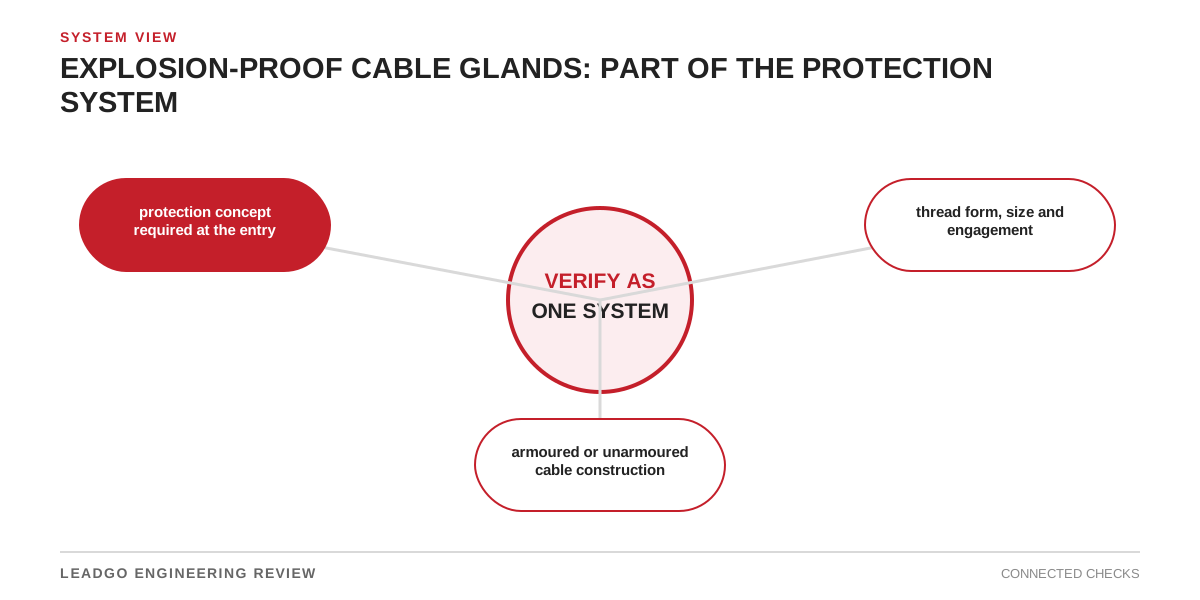
The cable entry is part of the hazardous-area protection system. A motor certificate cannot compensate for a gland that does not fit the entry, seal the actual cable or maintain the required explosion-protection concept.
This review should happen before the cable is purchased, not when an installer discovers that the armour size or thread is wrong on site.
Start from the motor certificate and entry drawing
Record the complete motor marking and certificate number, then read the certificate schedule and special conditions. Confirm the entry protection concept and whether the terminal box differs from the main motor enclosure.
From the certified drawing or manufacturer data, obtain:
- number and location of entries;
- thread type, nominal size and tolerance;
- stopping plugs for unused entries;
- permitted adapters or reducers;
- enclosure wall or boss details relevant to engagement; and
- required ingress-protection rating.
A thread that can be screwed in is not necessarily a compliant flamepath or earth connection.
Match the gland to the installed cable
The gland certificate must cover the cable construction and size range actually supplied. Check outer-sheath diameter at the seal, inner bedding where applicable, armour type and dimensions, conductor count and whether the cable contains gaps that affect sealing.
| Interface | Evidence needed |
|---|---|
| Protection concept | Gland marking and certificate compatible with the motor entry |
| Cable seal | Certified diameter range and actual measured cable diameter |
| Armour retention/earthing | Armour type, clamping arrangement and project bonding design |
| Entry thread | Matching thread form, size and required engagement |
| Environment | IP rating, corrosion material and service temperature |
| Installation | Assembly instructions, torque/engagement controls and inspection access |
IEC SC 31J’s official paper on flameproof cable-gland requirements explains that glands maintain enclosure integrity and environmental protection. For Ex d enclosures, the cable and gland must also prevent ignition-capable flames or hot gases from reaching the external atmosphere.
Barrier sealing is not a purchasing slogan
Whether a barrier or sealing gland is required depends on the applicable edition of the installation standard, the cable and enclosure arrangement, certificate conditions and local rules. The IEC paper describes two potential flame-transmission paths: through the gland seal and through gaps in the cable construction.
Ask the hazardous-area designer to record the selection route. “Use barrier glands everywhere” may be a project rule, but it should be distinguished from the minimum standard requirement. “No barrier needed” also needs a documented basis.
Installation can invalidate a correct selection
Inspectors should be able to confirm that:
- the gland model matches the approved schedule;
- seals act on clean, round, undamaged cable surfaces;
- armour is prepared and clamped according to instructions;
- the entry is not cross-threaded and any adapter is approved;
- required seals, washers and earth tags are installed in the correct order;
- unused entries use certified stopping plugs; and
- the cable is supported so its weight and bending do not load the entry.
Do not add tape, sealant or improvised washers unless the certified installation instructions require them. The IECEx online system and scheme guidance provide the controlled certificate source; a distributor screenshot is not equivalent to the certificate and schedule.
Handover record
Keep the motor and gland certificates, cable data sheet, gland schedule, entry drawing, installation instructions and initial inspection result together. Identify each installed entry, including stopping plugs, so a later maintenance team can verify that replacements remain equivalent.
Release rule
Energise only when the motor entry, gland certificate, actual cable, sealing method, earthing arrangement and installation inspection form one traceable chain. If any link depends on “it fits”, the protection system has not been demonstrated.
Related reading: