
Ex db IIB T4 Gb and Ex db IIC T4 Gb differ by one letter. In procurement terms they differ by a test the second one passed and the first one did not, and the difference does not work in both directions.
Direct answer
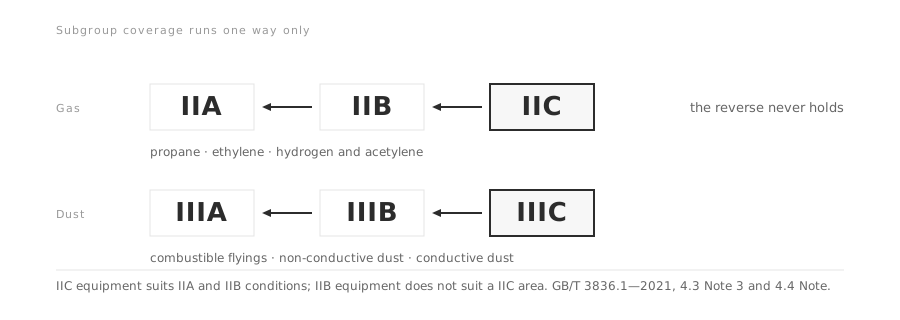
Subgroups are ordered, but the coverage is one-way:
- Equipment marked IIB is suitable for the conditions of IIA equipment.
- Equipment marked IIC is suitable for IIA and IIB conditions.
- Equipment marked IIIB is suitable for IIIA conditions.
- Equipment marked IIIC is suitable for IIIA or IIIB conditions.
There is no clause running the other way, and there is no engineering argument that substitutes for one. A IIB certificate in a IIC area is not a thin margin; it is the wrong certificate.
What the gas subdivision is actually measuring
Group II covers explosive gas atmospheres other than mine firedamp, and is subdivided by the characteristics of the atmosphere the equipment is intended for:
| Subgroup | Representative gas |
|---|---|
| IIA | Propane |
| IIB | Ethylene |
| IIC | Hydrogen and acetylene |
The standard names two bases for the subdivision, and both are worth knowing because they explain why the letter changes so much about the machine:
Maximum experimental safe gap (MESG) or minimum igniting current ratio (MICR). MESG is the gap through which a flame will not propagate out of an enclosure — which is exactly what a flameproof joint is engineered against. A gas with a smaller safe gap demands tighter joints over longer flame paths. That is why moving from IIB to IIC is a mechanical redesign of the enclosure, not a paperwork upgrade.
Electrostatic discharge risk from external non-metallic surfaces. This one surprises people, because it has nothing to do with the inside of the machine.
How much stricter IIC really is
The static-electricity limits in GB/T 3836.1—2021 make the gap concrete. For the maximum permitted surface area of non-metallic enclosure parts, in mm²:
| EPL | Group I | IIA | IIB | IIC |
|---|---|---|---|---|
| Ga | 10 000 | 5 000 | 2 500 | 400 |
| Gb | 10 000 | 10 000 | 10 000 | 2 000 |
| Gc | 10 000 | 10 000 | 10 000 | 2 000 |
And for the maximum acceptable transferred charge, in nC:
| EPL | Group I | IIA | IIB | IIC |
|---|---|---|---|---|
| Ga / Gb / Gc | 60 | 60 | 25 | 10 |
At Gb, a IIC machine is allowed one fifth the plastic surface area of a IIB machine, and one sixth the transferred charge of a IIA machine. Related limits run the same way: maximum diameter or width of long non-metallic parts, and maximum thickness of non-metallic layers, both tighten at IIC.
That is the practical reason a IIC motor costs what it costs. Terminal box covers, fan covers, nameplates, paint and coatings are all constrained by these limits.
Dust is subdivided by two measurable properties
Group III covers explosive dust atmospheres other than mines, and the subdivision rests on properties you can measure rather than on a representative substance:
Size. Combustible dust is solid particles of nominal size 500 µm and below that may form an explosive mixture with air. Combustible flyings are particles above 500 µm, including fibres, where one dimension has a high ratio to the other two — carbon fibre, rayon, cotton and cotton waste, sisal, jute, hemp, cocoa fibre, oakum and baled wood wool are the examples the standard gives.
Resistivity. Dust with a resistivity of 10³ Ω·m or less is conductive; above that it is non-conductive.
| Subgroup | Atmosphere |
|---|---|
| IIIA | Combustible flyings |
| IIIB | Non-conductive dust |
| IIIC | Conductive dust |
So the question to put to a site is not “is there dust” but “what size, and what resistivity”. Metal-working and carbon-black plants land in IIIC on resistivity alone; textile and timber operations often sit in IIIA on particle size.
Dust equipment is not marked with a T class
This trips up buyers moving between gas and dust duty. Gas equipment carries a temperature class T1 to T6. Dust equipment carries an actual maximum surface temperature in degrees Celsius.
- For EPL Db and Dc tested without a dust layer: a temperature preceded by T, for example
T90 °C. - For EPL Da: the temperature marked with a 200 mm dust layer thickness as a subscript, because measuring the maximum surface temperature without a dust layer is not permitted for Da equipment. Layers thicker than 200 mm do not produce a higher temperature rise that needs considering.
- Where a Class III machine has several maximum surface temperatures — for instance across several ambient ranges — the certificate carries the complete information, the marking carries an X, and the marking shows a range such as
T80 °C…T195 °C.
One further note worth carrying into a specification review: the EPL marked on a piece of equipment can be more restrictive than the protection type would normally allow, in order to reflect something else about the machine — the standard’s own example is equipment whose aluminium content exceeds the permitted value, marked Ex ia IIIC T135 °C Dc. On a motor, aluminium appears in frames, end shields and fans, so this is not a theoretical clause.
While you are checking: the ambient default
Equipment is normally taken to operate in an ambient of −20 °C to +40 °C, and nothing extra is marked. Anything outside that is a special case: the marking must show Ta or Tamb with the upper and lower limits, or, where that is not practicable, the symbol X indicating a special condition of use.
A motor going to a Gulf installation or a Siberian one is outside the default envelope by definition. If the marking says nothing about ambient, the specification has not been read.
What to do with this
- Get the subgroup from the site, not from the supplier. It is a property of what is present.
- Check direction, not proximity. IIC covers IIB; IIB does not cover IIC.
- For dust, ask for size and resistivity, and expect a temperature in °C rather than a T class.
- Check the ambient marking against where the machine is actually going.
LEADGO builds flameproof machines for gas atmospheres and enclosure-protection machines for dust in its hazardous-area range. Subgroup coverage is stated per model on the certificate — send the subgroup and the ambient, and ask for the certificate covering that machine.
Going deeper
- Explosion-proof motor selection: how to read the marking — where the subgroup sits among the five independent decisions
- Hazardous area classification: who does it and who carries the risk — how the subgroup gets established in the first place
- How to verify an explosion-proof motor certificate — including what that X after the certificate number means