
The most expensive mistakes in hazardous-area procurement are not made when someone picks the wrong motor. They are made earlier, when nobody has established what the area actually is — and the purchase order goes out with the specification blank in the one field that determines everything else.
Direct answer
Area classification is a property of the place. It describes what flammable material may be present, how likely it is to be present, for how long, and how far it reaches. None of that is a property of a motor, and none of it can be inferred from a motor datasheet.
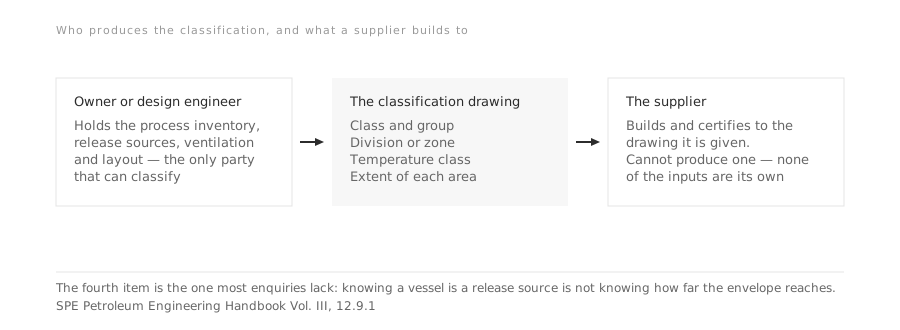
It is produced by the facility owner, normally through the design engineer or engineering contractor, and it is completed before electrical equipment is specified. A motor supplier builds to the classification it is given. It cannot produce one for you, and a supplier who offers to is telling you something about their process rather than about your site.
What a classification study actually produces
The petroleum engineering literature sets out four steps:
- Determine the class of hazard that might be present — combustible gas (Class I), combustible dust (Class II), or fibres (Class III).
- Identify the group of the hazardous substance (Groups A through G in the North American system). Almost all classifications in oil and gas production facilities land on Class I, Group D.
- Determine the degree — Division 1 or Division 2.
- Determine the extent of the classified locations.
Step four is the one that is missing from most purchase enquiries. Knowing that a separator is a release source is not the same as knowing how far the classified envelope reaches from it. The extent is what decides whether the motor you are buying stands inside the boundary or two metres outside it — and those are two different motors at two different prices.
Division 1 and Division 2 turn on likelihood, not on danger
A common misreading is that Division 1 means “more dangerous gas”. It does not. Both divisions can involve exactly the same substance. What separates them is how likely the ignitable concentration is to be there, and why.
| Class I, Division 1 | Class I, Division 2 | |
|---|---|---|
| Normal operation | Ignitable concentrations can exist | Material is confined in closed containers or systems |
| Release mechanism | Frequent, from repair, maintenance or leakage | Accidental rupture, breakdown, or abnormal operation |
| Role of ventilation | — | Positive ventilation normally prevents ignitable concentrations; failure of that ventilation is the hazard |
| Adjacency | — | Can arise purely from being adjacent to a Division 1 location, unless positive-pressure ventilation from clean air prevents communication |
That last row is worth sitting with. A location can be Division 2 for no reason other than what is next to it. If the classification study predates a layout change, this is where it goes stale first.
The IEC zone system asks the same question in three bands
Where the IEC system is used instead, the same logic is split three ways rather than two:
- Zone 0 — ignitable concentrations present continuously, or for long periods.
- Zone 1 — likely to exist in normal operation; or frequently, from repair, maintenance or leakage; or from equipment breakdown; or by communication from an adjacent Zone 0.
- Zone 2 — not likely in normal operation, and if it occurs, only for a short period; material otherwise confined; or ventilation-dependent; or by communication from an adjacent Zone 1.
The structural difference from Division is that Zone 2 is narrower than Division 2. Division 2 absorbs a range of circumstances that the zone system splits between Zone 1 and Zone 2. That is why the two systems are not interchangeable by lookup table, and why a classification done under one should not be re-labelled into the other by anyone but the engineer responsible for it.
“Unclassified” is a verdict, not an omission
Any area in a facility that is not Division 1 or Division 2 — or not Zone 0, 1 or 2 — is unclassified. Arcing electrical equipment installed in an unclassified area does not need to be explosion-proof, and general-purpose enclosures are accepted there.
This matters commercially in both directions. Specifying certified equipment for an unclassified area buys nothing but cost and lead time. Treating a classified area as unclassified because nobody produced the drawing buys something considerably worse.
Who carries what
The division of responsibility is clearer than most purchase conversations make it sound:
- The owner or design engineer produces the classification and owns its correctness. It rests on process inventory, release sources, ventilation and layout — all site information.
- The supplier supplies equipment certified for the classification it is given, and can be held to the certificate.
- In the United States, arcing electrical equipment installed in classified areas must be approved by a nationally recognized testing laboratory. That approval is against the classification, not a substitute for it.
Field practice fills in the rest, and it is worth knowing before you meet it on site. Experienced commissioning and inspection personnel will refuse to energise equipment they judge does not meet the requirement for the area it stands in — locking it out and notifying the client in writing. That is not obstruction; it is the standard responsible action, and the reason the classification drawing is normally the first document requested on arrival.
For the same reason, written confirmation of the classification is worth having in the file — not as a formality, but because it records which party answered a question that only one party was in a position to answer.
What to have before you ask for a quotation
Four answers, all of them properties of your site rather than of any motor:
- Class and group — what is present.
- Division or zone — how likely it is to be present, and for how long.
- Temperature class — set by the ignition temperature of what is present.
- Extent — whether the motor’s location is genuinely inside the boundary.
With those four, supplier comparison becomes a matter of checking certificates against a specification. Without them, every quotation you receive is a guess wearing the clothes of a specification — and the guess is being made by the party with the least information about your site.
LEADGO’s hazardous-area range is built and certified against these parameters rather than against a general claim of suitability. Certification is granted per model and per rating — so send the classification, and ask for the certificate covering the specific model you intend to buy.
Going deeper
- ATEX vs IECEx vs NEC: which certification do you need — once the area is classified, this is how the paperwork systems compare
- Explosion-proof motor selection: how to read the marking — the five independent decisions written into
Ex db IIB T4 Gb - What TEFC actually means — why an enclosure rating is not an explosion-protection rating