
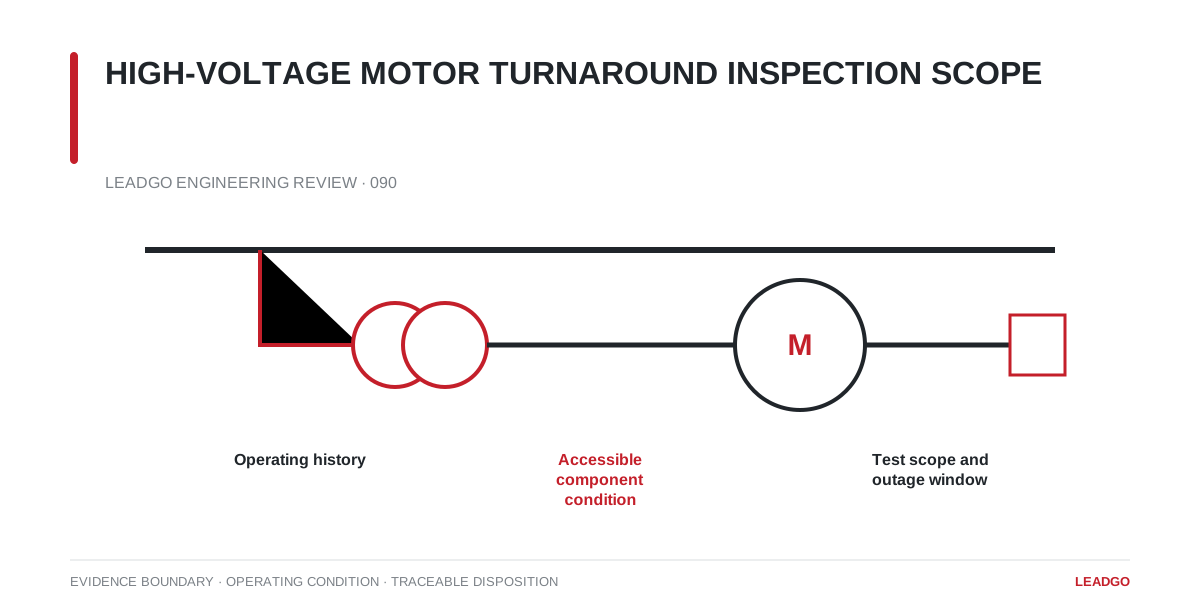
High-Voltage Motor Turnaround Inspection Scope can affect equipment selection, commissioning or maintenance. Set the turnaround scope from condition and failure consequence before the machine is opened.
Use one consistent machine boundary — high-voltage turnaround
Large high-voltage motors depend on clearly owned interfaces across insulation, cooling, protection, auxiliaries and the driven train; the high-voltage turnaround record must identify this boundary explicitly. For this review, identify who owns each input and whether it comes from a drawing, calculation, measurement, test record or site requirement; the high-voltage turnaround record must identify this boundary explicitly. Similar equipment can help frame questions, but it cannot stand in for evidence from the machine under review; the high-voltage turnaround record must identify this boundary explicitly.
Write down the operating state before comparing documents. Rated duty, starting, coastdown, standby and maintenance conditions can expose different limits; the high-voltage turnaround record must identify this boundary explicitly. A value without its condition is easy to carry into the wrong decision; the high-voltage turnaround record must identify this boundary explicitly.
Core review points — high-voltage turnaround
| Review point | Evidence to request | Closure question |
|---|---|---|
| Operating history | Applicable drawing, data sheet, calculation or measured record | Does it identify this motor and the relevant operating condition? |
| Accessible component condition | Dated design or test evidence with method and revision | Is it comparable with the first input rather than a different duty? |
| Test scope and outage window | Approved limit, setting, inspection or disposition | Does it state who accepts the result and what happens if it is not met? |
The three rows form one evidence chain. If one source uses a different rating, temperature, speed, load or assembly state, reconcile the difference before drawing a conclusion; the high-voltage turnaround record must identify this boundary explicitly.
What not to infer — high-voltage turnaround
- Closing on a familiar value. A number taken from another motor, an old project or an unverified spreadsheet may look plausible; the high-voltage turnaround record must identify this boundary explicitly. Keep it as a reference only until its applicability is demonstrated.
- Separating the final check from the first two. Test scope and outage window may depend on both operating history and accessible component condition. Treating it as an isolated form field hides the real interface.
Also avoid converting an unanswered question into a silent assumption. Mark it open, name the owner and record what evidence will close it; the high-voltage turnaround record must identify this boundary explicitly. That is faster to manage than discovering the missing boundary during testing or site work; the high-voltage turnaround record must identify this boundary explicitly.
How to work through the issue — high-voltage turnaround
- Identify the motor, driven equipment, supply or site boundary affected by the decision; the high-voltage turnaround record must identify this boundary explicitly.
- Confirm operating history and note the exact source revision.
- Review accessible component condition under the same operating case.
- Compare both with test scope and outage window, including any alarm, inspection or approval action.
- Close the item with an approved disposition, or leave it open with an owner and due date; the high-voltage turnaround record must identify this boundary explicitly.
This sequence works during specification, vendor-document review, factory testing and maintenance planning because it keeps the technical question connected to a decision; the high-voltage turnaround record must identify this boundary explicitly.
Minimum record set — high-voltage turnaround
Retain the machine serial or project tag, document revision, test or measurement date, operating condition and reviewer; the high-voltage turnaround record must identify this boundary explicitly. If a concession or temporary limit is used, record its scope and expiry; the high-voltage turnaround record must identify this boundary explicitly. Photos and plots are most useful when their locations, channels and units are identified; the high-voltage turnaround record must identify this boundary explicitly.
The result should let another engineer reconstruct why the motor was accepted, monitored, repaired or held; the high-voltage turnaround record must identify this boundary explicitly. It should not depend on a private email thread or on someone remembering which version was discussed; the high-voltage turnaround record must identify this boundary explicitly.
Decision rule — high-voltage turnaround
Set the turnaround scope from condition and failure consequence before the machine is opened. Apply the rule to the credible limiting condition, not only the easiest rated point; the high-voltage turnaround record must identify this boundary explicitly. When evidence conflicts, resolve the machine identity and test boundary before averaging or selecting the preferred result; the high-voltage turnaround record must identify this boundary explicitly.
Going deeper — high-voltage turnaround
Condition-to-scope decision matrix — high-voltage turnaround
The most useful turnaround tool is not a fixed list of tests. It is a matrix that converts operating evidence into a justified work scope. Complete one row for every credible degradation mechanism before the outage begins.
| Evidence before shutdown | Minimum action at outage | Escalation trigger | Release evidence |
|---|---|---|---|
| Stable vibration and temperatures; no protection events | External inspection, terminal checks, accessible cooling-path inspection and repeatable electrical baseline tests | Material change from the previous comparable baseline | Signed readings with instrument identity, test condition and comparison trend |
| Rising bearing vibration, temperature or oil debris | Inspect bearing system, fits, lubrication path, shaft journals and alignment influences | Scoring, looseness, abnormal clearance or unexplained debris | Dimensional record, photographs, disposition and post-assembly run results |
| Insulation trend deteriorating | Controlled winding inspection and tests selected for the insulation system and machine condition | Moisture, contamination, discharge change or non-comparable results | Clean/dry record, corrected-condition comparison and engineering acceptance |
| Repeated differential, earth-fault or temperature protection operation | Preserve relay records; inspect the protected zone and associated sensors before intrusive work | Fault evidence that cannot be reconciled with wiring or instrument error | Root-cause disposition, corrected protection checks and approved return-to-service basis |
| Cooling restriction or high winding temperature | Inspect complete cooling path, fans, coolers, seals and instrumentation | Deformation, leakage, blocked passages or capacity below requirement | Cleanliness record, flow evidence and temperature response |
This matrix prevents two costly extremes: opening a healthy machine without a reason, or repeating a superficial inspection after the machine has already shown a credible failure signal. A trigger should point to a failure mechanism, not merely to a department preference.
Build the scope before the outage clock starts — high-voltage turnaround
Start with a machine dossier: nameplate and serial identity, winding and bearing arrangement, cooling code, protection scheme, auxiliary list, previous findings, repair history, trend plots and unresolved concessions. Mark which records are comparable. A vibration value taken at a different load, sensor position or foundation state should not be presented as a clean trend.
Then conduct a scope review with operations, maintenance, electrical protection and the repair contractor. For each proposed opening or test, record four items: why it is needed, what decision it will support, what acceptance criterion applies, and how much outage time it consumes. If the team cannot state the decision enabled by a task, challenge the task before it enters the critical path.
Define hold points for findings that can change the work. Typical examples include removal of bearing covers, discovery of winding contamination, dimensional readings outside an approved limit, or evidence of rotor contact. Work should not proceed past such a point until the responsible engineer has seen the evidence and approved the next step. This avoids destroying evidence through cleaning, machining or further dismantling.
Inspection depth and applicable boundary — high-voltage turnaround
This approach suits large high-voltage induction or synchronous motors where outage duration, dismantling risk and failure consequence justify a condition-led scope. It does not prescribe test voltages, bearing clearances or insulation limits. Those values must come from the machine manufacturer, approved repair standard, applicable project documents and the condition of the particular insulation system.
A routine turnaround is also not a forensic failure investigation. After a severe electrical fault, rub, fire, flooding event or protection operation with physical damage, preserve evidence and establish a separate investigation plan. Hazardous-area machines also require controls for certified construction; changing fasteners, flamepaths, cable entries or repair methods can create a compliance issue beyond ordinary maintenance acceptance.
Common scope errors — high-voltage turnaround
- Ordering every available electrical test without checking whether previous results are comparable or whether the test adds avoidable stress.
- Cleaning components before recording deposits, tracking marks, oil paths and contact patterns.
- Treating a contractor’s standard overhaul package as the approved engineering basis.
- Recording “acceptable” without the measured value, test condition, instrument or governing limit.
- Replacing bearings without checking alignment, housing fit, lubrication delivery and driven-equipment forces that may have caused the damage.
- Closing an abnormal trend because a single post-maintenance reading happens to be lower.
Data to request from the motor and service suppliers — high-voltage turnaround
Ask for the proposed dismantling sequence, lifting and rotor-support method, test schedule, instrument accuracy, acceptance criteria, dimensional forms, cleaning materials, preservation method and list of parts that may require advance procurement. Request the manufacturer’s restrictions on winding tests, rotor removal, bearing fits, seals, coolers and reassembly. The service supplier should identify which findings require client witness or engineering disposition rather than making those decisions implicitly on the shop floor.
For replaced parts, require identity traceability appropriate to the purchase requirement, plus as-left dimensions where fit affects reliability. For repaired windings or core work, request the approved repair procedure and before/after evidence rather than only a final pass statement.
Release workflow — high-voltage turnaround
The release package should answer three questions. Was the planned scope completed? Were all unexpected findings dispositioned? Does the assembled motor demonstrate a coherent return-to-service condition? Check that open items are either closed or explicitly transferred to a monitored operating restriction with an owner.
Before energisation, reconcile protection settings, sensor connections, space heaters, cooling auxiliaries, grounding, coupling condition and rotation controls. Retain baseline vibration, current, temperature and any oil-system readings from the first stable run. The turnaround is complete only when the final machine condition can be compared with the evidence that justified the outage in the first place.