
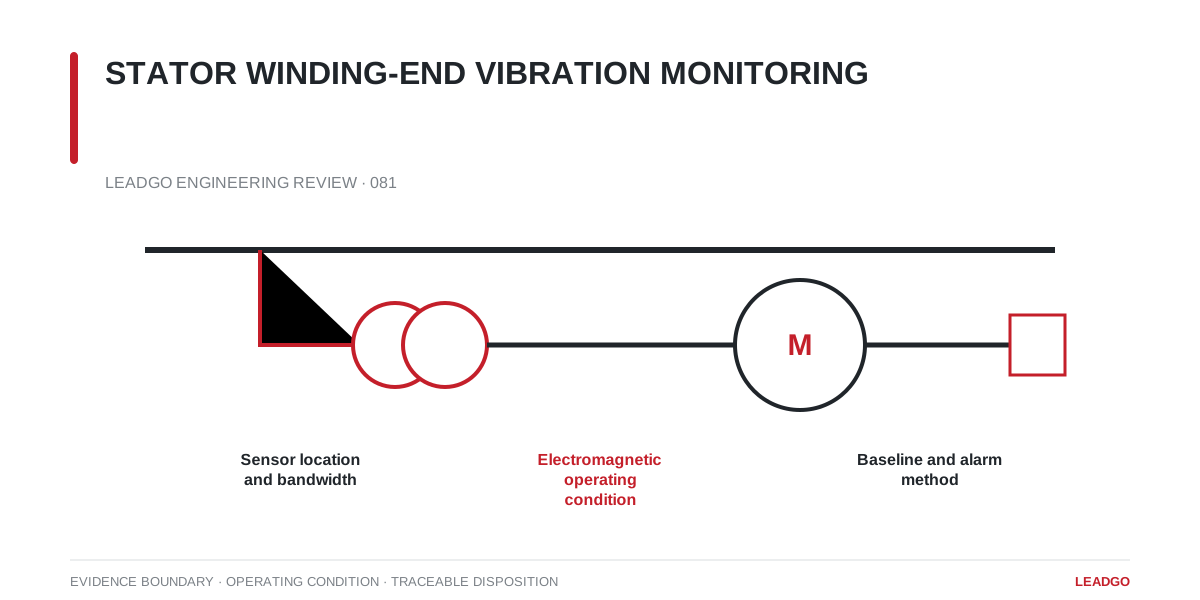
End-winding vibration in a large motor is influenced by electromagnetic force, structural support and the measurement installation. A changing value can be important, but only if the new reading is comparable with the baseline.
Fix the measurement configuration
Record the sensor type, orientation, mounting method, channel, sample rate and frequency range. Identify the exact winding-end or support location with a drawing or photograph. Reinstalling a sensor a short distance away can change the local response enough to distort a trend.
Capture motor current, voltage, frequency, load and temperature with the vibration record. For variable-speed operation, include speed and drive condition. Supply unbalance or a different operating point can alter electromagnetic forcing without a mechanical change in the winding support.
Escalation decision from spectrum and phase
Overall vibration can hide a narrow-band change. Retain spectra and, where the monitoring system supports it, phase relationships between locations. Compare components associated with electrical forcing and structural response rather than treating every peak as the same failure mechanism.
A rising trend should trigger verification steps before intrusive work:
- confirm sensor and cable integrity;
- repeat the reading at the same operating condition;
- compare related channels and electrical data;
- review maintenance, switching or load changes;
- escalate against the machine-specific engineering criteria.
Preserve the baseline
The baseline file should include raw data, processing settings, machine identity, load state, sensor map and reviewer. After rewind, support work or major disassembly, establish a new documented baseline while retaining the old one for history.
Monitoring does not by itself diagnose looseness or predict remaining life. It gives engineers a repeatable signal that can be combined with inspection, electrical tests and design knowledge.