
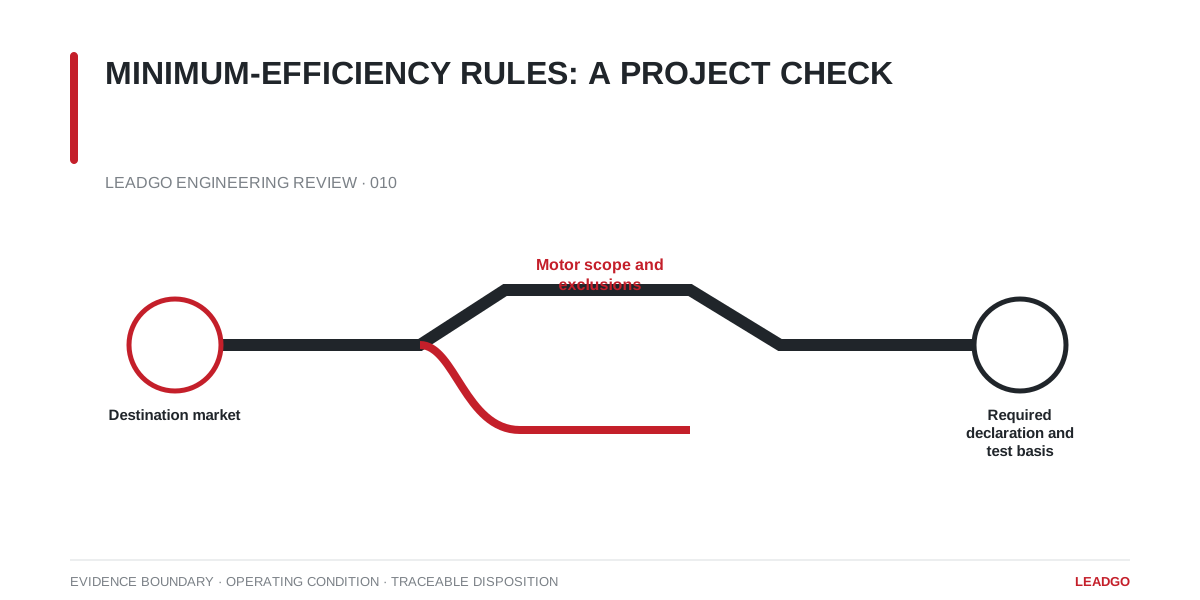
“IE3 required” is not a complete export specification. The project must determine which rule applies, whether the motor is within scope and what documentation the destination market expects.
Build the applicability record
Start with the country or customs territory where the equipment will be placed on the market, not the buyer’s headquarters. Record intended use, rated output, voltage, frequency, pole count, duty, enclosure, cooling method and whether the motor is supplied alone or in driven equipment.
Verify the current rule and effective date through an authoritative source. A clause copied from an older project is a lead for verification, not a final compliance basis.
| Project question | Evidence to retain |
|---|---|
| Is this motor type covered? | Scope clause and product description |
| Does an exclusion apply? | Exact text and engineering justification |
| Which class or minimum applies? | Applicable table, rating point and date |
| Which test method is recognized? | Standard and edition |
| Is registration or marking required? | Destination procedure and owner |
| What travels with the shipment? | Declaration, test evidence and checklist |
Do not assign an exclusion only from a commercial nickname such as “brake motor,” “explosion-proof motor” or “VFD motor.” A legal definition can be narrower.
Keep three decisions separate
The regulatory minimum is a floor, not necessarily the economic optimum. Keep legal compliance, contractual guarantee and lifecycle-cost selection as separate lines in the bid comparison. A legally compliant motor can still fail the buyer’s guarantee.
Before order release, assign ownership for destination verification, evidence, registration, labeling and document retention. Open items need an owner and due date; they should not disappear inside “supplier to comply.”
Because rules are market-specific and change, this checklist is not legal or certification advice. It makes the verification visible early enough to influence selection and delivery.