
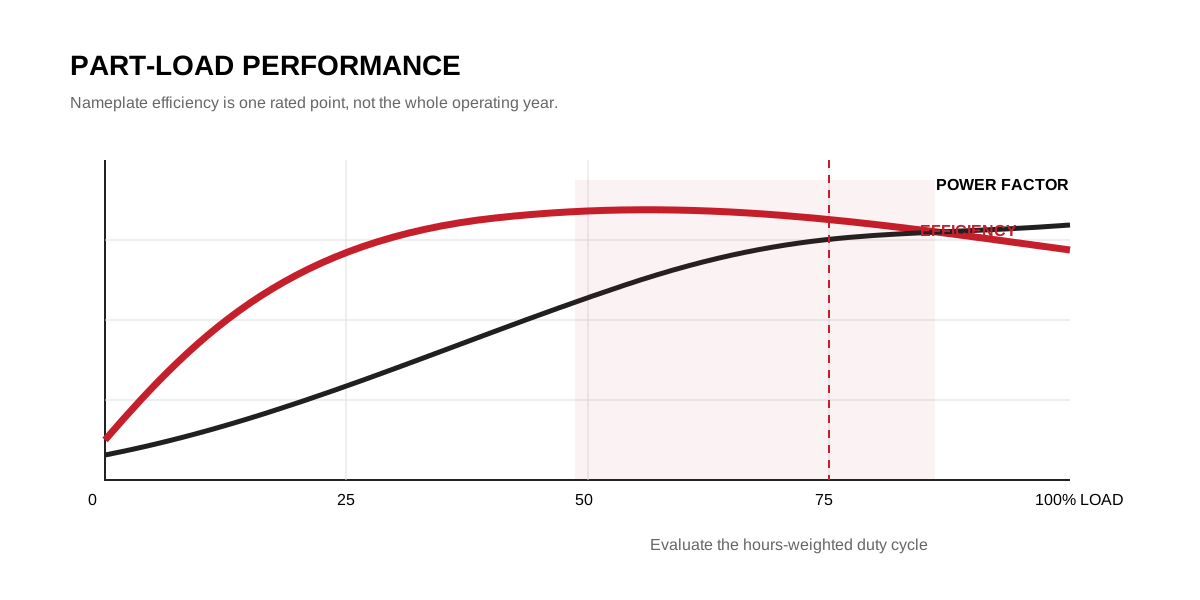
The efficiency on a motor nameplate is not a promise that the same value applies from no load to full load. It belongs to a defined rated condition. Real plants rarely hold every motor at that point, so an energy assessment must follow the load profile rather than multiply nameplate kW by running hours.
The US Department of Energy notes that many motors are intended to operate between roughly 50% and 100% of rated load and that maximum efficiency is commonly near 75% load. Those are screening observations, not a universal curve. Larger motors often maintain good efficiency across a broader range, and the exact result must come from the tested design.
What changes when load falls
Motor losses do not all move with shaft output.
| Loss component | Behaviour as load falls |
|---|---|
| Stator and rotor copper loss | Generally falls strongly with current |
| Core loss | Remains substantially tied to voltage and frequency |
| Friction and windage | Remains present while the motor turns |
| Stray-load loss | Changes with load |
At light load, fixed losses are spread over less useful output. Efficiency therefore eventually falls. The same motor also keeps drawing magnetising current, so power factor generally worsens before current appears proportionate to the shaft load.
This is why a clamp-meter reading alone can overestimate load. Current does not approach zero when mechanical output does. The load-estimation methods in Department of Energy guidance use input power, amperage or speed, each with the appropriate motor data.
Oversized does not mean it consumes nameplate power
A common misunderstanding is that a 90 kW motor driving a 45 kW load consumes 90 kW. It does not. Rated power is shaft-output capability. Actual electrical input is approximately the delivered shaft output divided by operating efficiency, plus any measurement and drive-system considerations already contained in that efficiency result.
Oversizing can still cost money because the operating point may carry lower efficiency and power factor, and the purchase itself may require larger switchgear. But the penalty must be calculated, not assumed.
Build a load-weighted calculation
For a motor that runs at several recurring conditions, divide the year into load blocks.
- Measure or estimate shaft load for each block.
- Obtain efficiency at each load from the correct manufacturer curve or test data.
- Calculate input power for each block.
- Multiply by annual hours in that block.
- Add the blocks and compare realistic alternatives.
For example, a pump may run at 80% load for production, 55% during normal throttled operation and 25% during standby circulation. Using only the full-load efficiency for all three hides the largest uncertainty. If speed control is proposed, compare the motor and drive as a system; our guide to IE and IES system efficiency explains why a motor class alone is incomplete.
When replacement is worth investigating
An oversized motor deserves closer study when it operates for long hours, the measured load remains persistently low, and a correctly sized alternative can meet starting, overload and environmental requirements. The case strengthens where power factor contributes to site demand or where the old motor has already been rewound and its present efficiency is unknown.
The case weakens when operating hours are short, the process regularly requires the installed peak torque, or replacement would introduce mechanical and production risk. A cyclic load can look lightly loaded on an average-power meter while still requiring high peak torque. Pumpjacks are a clear example, discussed in beam-pump motor sizing.
Do not resize from average current
Before reducing frame or power, verify:
- maximum continuous shaft demand;
- acceleration time and load inertia;
- starting voltage drop;
- overload duration and motor duty type;
- ambient temperature, altitude and cooling;
- service factor or permitted short-time margin;
- future process changes.
A smaller motor that looks efficient on a spreadsheet can run hotter, start more slowly or nuisance-trip if the load peaks were hidden by averaging.
A practical buying rule
Ask suppliers for efficiency and power-factor values at the load points that dominate annual operation, not only the rated value. When comparing IE3, IE4 and IE5 options, keep frame, pole count, voltage, test method and load profile aligned. Then use the auditable total-cost worksheet rather than a headline payback claim.
Partial-load efficiency is not an argument for automatically downsizing. It is a reason to measure the duty accurately and purchase around the load the plant truly has.