
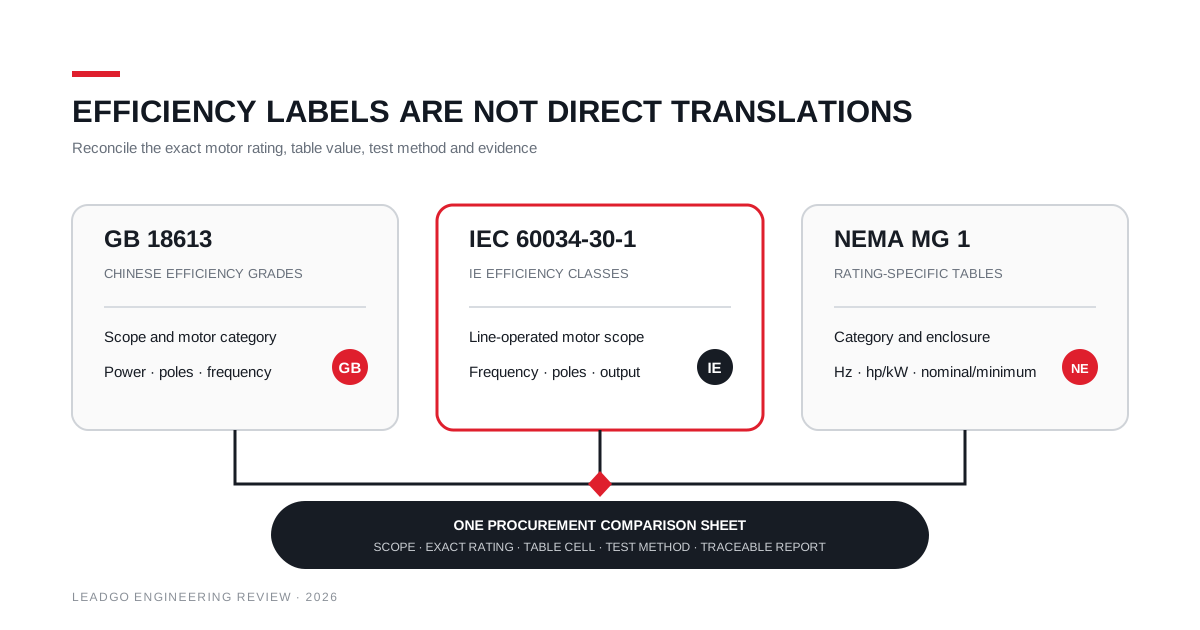
An international motor enquiry can contain three apparently simple phrases: “GB grade 2,” “IE4” and “NEMA Premium.” Treating them as translations of one another is an avoidable purchasing error.
Each designation belongs to a standard with its own scope, rating grid and evidence. The correct comparison begins with the offered motor, not with a slogan-level conversion chart.
What each system is doing
| System | Primary purpose | How the requirement is located |
|---|---|---|
| GB 18613-2020 | Chinese minimum allowable efficiency and efficiency grades for motors in scope | Motor type, rated output, pole count and the applicable table |
| IEC 60034-30-1 | IE efficiency classes for line-operated AC motors in scope | Supply frequency, pole count and rated output |
| NEMA MG 1 | Construction, performance and application requirements, including efficiency tables for covered motor categories | Motor category, frequency, enclosure, rating and table |
The class name is only the entrance to the table. A meaningful purchase requirement identifies the actual cell and the test basis behind it.
Step 1: prove that the motor is in scope
Before comparing values, record:
- motor technology and starting method;
- line-operated or converter-fed operation;
- rated power or horsepower;
- voltage and frequency;
- pole count and rated speed;
- duty and enclosure;
- hazardous-area or special-purpose construction;
- market and certification requirement.
IEC 60034-30-1 defines IE classes for motors within a stated range and operating basis. GB 18613-2020 is a mandatory Chinese efficiency standard for the motor categories it covers. NEMA MG 1 contains multiple tables for different motor groups. A motor outside one document’s scope cannot be made compliant by attaching the closest class label.
This is particularly important for high-voltage, variable-speed, special-duty and hazardous-area machines.
Step 2: compare the same rating
Efficiency limits vary with output, pole count and frequency. NEMA tables may also separate open and enclosed motors and distinguish nominal from minimum efficiency.
Build one comparison row for the actual purchase rating:
| Field | Offered value | GB requirement | IEC requirement | NEMA requirement |
|---|---|---|---|---|
| Output | ||||
| Poles / speed | ||||
| Frequency | ||||
| Voltage | ||||
| Enclosure / construction | ||||
| Rated or nominal efficiency | ||||
| Minimum / tolerance basis | ||||
| Test method |
Leave a standard column marked “not applicable” when the motor falls outside its scope. That is more accurate than forcing an equivalence.
Step 3: separate nominal, minimum and measured efficiency
The number on a nameplate, the table’s nominal value and a measured test result are not automatically the same thing. Standards use tolerances and defined test methods, so the acceptance rule must state which value is being checked.
The purchase specification should identify:
- the efficiency designation;
- the applicable standard edition and table;
- the rated or nominal efficiency to be marked;
- the permitted tolerance or minimum value;
- the test method and report requirement.
Without those five items, two parties can quote the same class and apply different acceptance criteria.
Step 4: verify the test method
IEC efficiency testing is commonly linked to IEC 60034-2-1 for applicable machines. NEMA requirements are associated with North American test and reporting conventions, including rating-specific tables in MG 1. A report should state the method used rather than only present a final percentage.
Check that the report identifies the motor model, output, voltage, frequency, poles, connection, temperature condition and test date. If the report covers a related design rather than the exact unit, request the manufacturer’s documented family or design-basis explanation.
Our comparison of IEC 60034-2-1 and IEEE 112 efficiency tests explains why test-method names matter at acceptance.
Common mistakes in international enquiries
Writing only “high efficiency.” This creates no measurable acceptance criterion.
Equating class names without a rating. The apparent relationship may change across frequency, poles, output or motor category.
Mixing motor and drive-system efficiency. An efficient motor does not prove an efficient variable-speed power-drive system. Converter loss and operating point remain part of the energy calculation; see motor and drive-system efficiency.
Ignoring mechanical standards. Two motors with similar efficiency labels may use different frame dimensions, shaft arrangements, voltage and frequency. Efficiency equivalence does not create interchangeability.
Accepting a certificate without model traceability. The document must cover the offered manufacturer, series, construction and rating.
A clean wording for the purchase order
Instead of “motor shall be IE4 or GB grade 2 or NEMA Premium,” write separate requirements for the destination market.
For each offered motor, require the supplier to state the applicable standard edition, scope category, table row, nominal or rated efficiency, minimum or tolerance basis and test method. Require documentary evidence traceable to the quoted model and rating. Where more than one system is requested, ask for a completed comparison sheet rather than allowing a general equivalence statement.
LEADGO’s YE3, YE4, YE5 and NEMA Premium Efficiency series serve different standards and market requirements. Select the series from the destination specification and exact rating—not from the similarity of the marketing names.